
Magic Incantations


Watch a troop of monkeys in the forest canopy long enough and you’ll notice something that looks, from a human vantage point, uncomfortably familiar. One shrieks. The others respond, or don’t. Every animal in earshot is fully convinced its call means something, that whoever hears it will understand and act accordingly — and within the troop’s own repertoire, it usually does. Vervet monkeys, the best-studied case, have distinct, genuinely meaningful alarm calls for different predators: one sound for leopard, another for eagle, a third for snake, each producing a different, appropriate evasive response from every vervet who hears it. The system works — but only within the troop’s own code. A vervet’s leopard-call means nothing to a baboon. It means nothing at all to a human standing under the same tree, listening to what sounds like frantic, purposeful communication and understanding none of it.
Now walk into any comment section, any group chat, any cable news panel, and ask what’s actually different. People chatter, certain they’re being understood, shocked and often furious when they aren’t. The confidence that one’s own words carry their meaning intrinsically — that anyone hearing them, if they were only paying attention, would grasp exactly what was meant — survives every daily demonstration that this isn’t how language actually works. We are, most of the time, still monkeys in the canopy, yelling with total conviction into a world that only sometimes shares our code.
The Oldest Version of the Same Story
Humanity told itself this exact story once already, and told it as catastrophe. Genesis 11 describes a single, unified population, “one people,” sharing “one language,” setting out to build a tower into heaven. The text is explicit about what that unity made possible: “nothing that they propose to do will now be impossible for them.” Not a vague blessing — a description of something close to real, worldly omnipotence, delivered entirely through the mechanism of everyone speaking the same words and meaning the same things by them. The response is equally explicit: “let us go down and confuse their language there, so that they will not understand one another’s speech.” Not a removal of language itself. The builders of Babel presumably kept right on talking after the confusion descended. What was removed was narrower and more devastating: the shared code that turned their talking into a single, coordinated act, capable of reaching heaven.
That’s the oldest account we have of exactly the plague this essay is named for. Not silence. Noise — abundant, urgent, utterly convinced of itself — with the binding, coordinating power drained out of it. Babel didn’t strike humanity mute. It struck humanity into permanent, mutual incomprehension while leaving every individual’s certainty that they were making sense fully intact. That specific combination — total confidence, zero shared code — is the plague, and it has never required a tower or a deity’s intervention to produce. It’s the default condition every time two people who don’t share enough context open their mouths at each other, expecting to be understood simply because they were understood yesterday, by someone else, who did share it. No doubt infants too mean what they say while they babble.
Post-literacy & The Library that Never Burned
James Corbett made a version of this same argument recently, about a different but adjacent loss. The popular story of the Library of Alexandria has it consumed in one great, tragic fire — Caesar’s siege, or a zealous emperor, or a conquering caliph, take your pick of villain. Corbett’s point is that none of these stories survive scrutiny particularly well, and the actual, better-supported account of the library’s end is far less dramatic and far more damning: the library wasn’t burned. It was neglected. Funding thinned, interest cooled, scrolls decayed unread and uncopied, and centuries of accumulated human knowledge dissolved not in a dramatic conflagration but in the much quieter process of nobody bothering to maintain it anymore. Corbett’s closing line borrows T.S. Eliot’s own ending for The Hollow Men, and it fits: this is the way the library ends, not with a bang but a whimper.
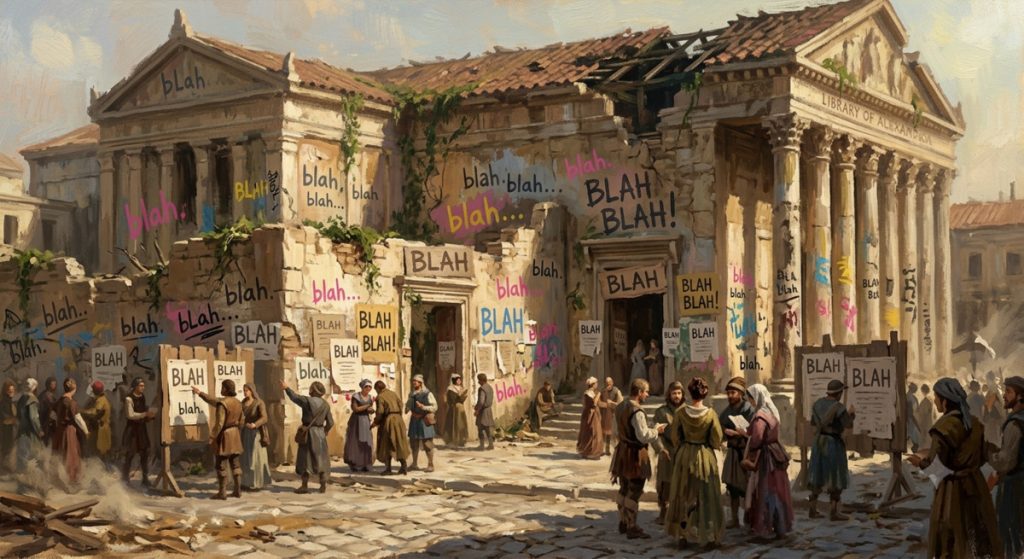
That is exactly the wrong shape for a “postliterate society” story to take if the actual mechanism is a plague of words rather than a drought of them. A burned library is a dramatic absence — an empty shelf, a visible gap, something a population can at least mourn as a loss. A neglected library is worse, precisely because nothing about it looks like an ending while it’s happening. The building still stands. People still walk past it, still occasionally wander in, still generate paperwork and correspondence and marginalia at a volume that would have been unthinkable to the scribes who once tended the actual shelves. Still splatter it with “blah” graffiti. The neglect is invisible specifically because the surrounding noise never stops.
That’s the modern condition exactly. The capacity for sustained, coherent, binding reading and writing isn’t being burned down by some visible catastrophe anyone could point to and grieve. It’s being quietly starved of attention while an unprecedented, ever-rising flood of shorter, stupider, words continues all around it, providing perfect camouflage: a population that has never generated more text in its history, standing in the exact spot where a library is dying of neglect, mistaking the volume of new words for evidence that nothing important could possibly be going wrong.
Consider Didymus Chalcenterus, the single most extreme case of literary output the ancient world ever produced. Ancient sources put his total at somewhere between 3,500 and 4,000 books — Athenaeus says 3,500, Seneca says 4,000, and his own nickname, “Bronze-Guts,” was earned specifically because he wrote so relentlessly he couldn’t remember what he’d already said, occasionally contradicting an earlier book in a later one. Every one of those books was, in its own time, read, cited, and used — his commentaries on Homer, Pindar, Sophocles, and Aristophanes formed the backbone of how those authors were studied for generations afterward. And virtually none of it survives. Not a fire, not a conquest, not a single dramatic villain — just centuries of nobody bothering to keep copying it forward, until nearly four thousand books existed only as scattered fragments quoted secondhand in other people’s marginal notes. The last scholar who even tried to gather what remained of Didymus into one place did it in 1854. Nobody has attempted it again since. A man who may have generated more words than anyone in the ancient world left behind, in the end, almost nothing but proof that he’d once said an enormous amount — which is either the most extreme case of the library that never burned, or the clearest warning available for what a plague of words actually produces once the noise stops and someone finally checks what’s left.
Two Kinds of Magic That Seem Real
Call this “the magic of words” and most people will assume you mean incantations — the belief that saying the right phrase, in the right sacred tongue, with the right intention, can bend the physical world: heal a wound, summon rain, curse an enemy. That belief is old, widespread, and, on its own terms, false. It is a specific instance of an error this series has documented elsewhere under a different name: the reification of Mind and Agency, the map mistaken for the territory. A word is a map. The thing it names, or the outcome it’s meant to compel, is the territory. Believing the map can reach out and rearrange the territory directly, without any of the ordinary causal machinery the territory actually runs on, is the same mistake as believing a storm has an angry spirit inside it, or that a simulator explains a universe rather than merely relocating the question of who explains the simulator.
But there really are two kinds of “magic” that words can perform, both seem real, both extensively documented, and both routinely mistaken for the false kind.
The first was formalized by the philosopher J.L. Austin in 1955, in lectures later published as How to Do Things with Words. Austin noticed that some utterances don’t describe reality at all — they change it, directly, through nothing but the act of being spoken under the right conditions. “I now pronounce you husband and wife.” “I resign.” “I promise.” Say these words, with the standing to say them, and something real and binding has occurred — not because the sounds themselves possess causal power over the physical world, but because a community of language-users has agreed, by convention, that these specific words constitute the act they name. Austin called them performative utterances, and the specific subclass that binds the speaker to a future action — promises, oaths, vows — carries a name that gives away exactly how seriously linguists take the binding: commissives. Built from the word commit. That is not incidental vocabulary. It is the correct technical term for what a promise actually does, and it is doing precisely the work the word “commitment” does in ordinary speech.
The second kind of real magic is quieter, aimed inward rather than outward, and it was demonstrated in a psychology laboratory rather than a philosophy seminar. In 1978, E. Tory Higgins and William Rholes published a study that has since been replicated dozens of times under the name “the saying-is-believing effect”: when a person describes something to an audience — tailoring the message, even slightly, to how they expect it to land — their own subsequent memory and belief shifts toward what they said, more than toward what they’d actually thought beforehand. Putting an opinion into words for someone else to hear doesn’t just express a pre-existing belief. It measurably manufactures a stronger version of that belief in the speaker’s own mind, after the fact, whether or not the speaker notices it happening.
Put these two findings side by side and a single mechanism emerges wearing two faces. A commissive utterance commits the speaker outward, into shared social reality, binding them to other people through convention. The saying-is-believing effect commits the speaker inward, into their own memory, binding them to their own prior words through nothing more than the act of having said them. Both are the same underlying event — an utterance generating real, lasting commitment — pointed in two different directions. Writing something down and publishing it, whatever else it does, performs both operations at once: it commits the writer to an audience, and it commits the writer to themselves.
Where the Confusion Actually Lives
None of this requires magic in the storm-spirit sense. A wedding vow works because a community agreed in advance that it would; the ceremony’s power is entirely convention, not causal, and it evaporates instantly outside a context where the convention is recognized — which is exactly why the same words spoken to someone who doesn’t share the underlying legal or religious framework accomplish nothing at all. A curse works on nobody, ever, because no causal mechanism connects the sound of a threatening phrase to the physical health of the person it’s aimed at. The confusion isn’t that words have no power. It’s that the very real power words demonstrably do have when commitment and convention are shared, gets smuggled, unnoticed, into a claim about power over reality that doesn’t run on convention at all: weather, disease, fate, the physical world in general.
Foreign and archaic language makes the smuggling easier, not harder. A phrase in Latin, Hebrew, or Sanskrit, only partially or not at all understood by the person hearing it, feels weightier than the same content delivered in plain vernacular — not because the words carry more actual force, but because the effort required to process them gets mistaken for depth. Difficulty and profundity are not the same thing, but they consistently get confused for each other, and every liturgical tradition that has ever preserved a sacred language long after the congregation stopped speaking it day to day has been drawing, whether it knew the mechanism or not, on exactly this confusion.
The Plague, Properly Named
Which brings the argument back to where it started, and to the actual gap sitting underneath the recent flood of essays declaring the end of reading. Those pieces have the data right and the diagnosis half-finished. It is true, and well documented, that sustained book-length reading has collapsed across the population, replaced by a constant stream of shorter, faster text. But it is also true, and rarely mentioned in the same essays, that almost everything modern life runs on still requires reading, constantly, at enormous volume — texts, captions, posts, prompts, comment threads. The species hasn’t gone quiet. If anything, it has never produced or consumed more words per capita in its entire history.
That’s the actual shape of the plague, and it is Babel’s shape exactly, just running without a myth attached: not a shortage of words, an abundance of them, arriving faster than any shared code can be built or maintained underneath them. Every one of those words still performs, or half-performs, the two kinds of real magic — some fragment of commitment outward, some fragment of belief-fixing inward — but at a volume and a velocity that leaves almost none of it load-bearing. A promise made in a text message carries the same technical structure as a vow spoken at an altar and almost none of its weight, because the shared convention behind it has thinned to nothing. An opinion posted and reposted a thousand times fixes the poster’s belief a thousand times over, each fixation slightly more confident and slightly less examined than the last, exactly as Higgins and Rholes’ subjects showed decades before anyone had a platform capable of doing this to a whole population continuously. Everyone is still talking. The magic — the part that used to bind a speaker to their word, and a listener to a shared understanding of what that word meant — is being spent faster than it can accumulate.
The builders of Babel didn’t lose the ability to speak. They lost the thing speaking had been quietly doing for them the whole time it went unnoticed. Post-literacy was never really the right diagnosis for what’s happening to the current population’s relationship to words. A plague of words is closer to it: everyone still shouting from the canopy, each fully convinced they’re making themselves understood, the actual binding magic thinning out with every additional word added to the pile.
No One Minted the Coin
None of this required a designer. That distinction matters, because the instinct, once you’ve seen the mechanism clearly, is to look for the architect — the room where someone decided attention should be thrashed, ideas cheapened, slices stolen at scale. There wasn’t one. What happened instead is the more familiar and more unsettling pattern this series has traced elsewhere under a different name: institutional outcomes that require no coordinated intent, only incentive gradients steep enough that everyone sliding down them independently produces the same result a conspiracy would have had to engineer on purpose.
The engineers who built the first infinite-scroll feed were solving a narrow, legitimate problem — how to keep a user from hitting a dead end and closing the app. The advertising models that funded the platforms rewarded time-on-screen because time-on-screen was the only variable anyone could measure and bill against. Comprehension, retention, the depth of an idea held loose in a reader’s mind before it hardened into an opinion — none of that throws off a metric. Engagement does. So the system optimized, ruthlessly and honestly, for the thing it could see, and the thing it could see was never attention’s quality. It was attention’s duration, sliced as thin as the interface could get away with, because thinner slices produced more discrete engagement events per hour than long, uninterrupted ones did. Nobody set the exchange rate between a tweet and a three-hour argument at parity because nobody was thinking about an exchange rate at all. They were thinking about retention curves. The parity was a side effect of the metric, not a decision about ideas.
That is the shape of every unforeseen consequence this corpus has documented, from monetary policy to institutional science: no one at the top ordered the outcome, because no one at the top needed to. The incentive structure did the ordering, invisibly, distributed across thousands of independent actors each optimizing a narrow, defensible piece of the whole, none of whom ever saw — or had reason to look for — the aggregate result their separate optimizations were quietly assembling. Gresham’s Law doesn’t require a corrupt mint issuing debased coin on purpose to hurt anyone. It only requires a fixed exchange rate and enough participants rationally responding to it. The feed became that mint by accident, the way a currency debases by accident when a government simply needs to cover a deficit and hasn’t stopped to ask what happens to savers ten years out. Nobody in either case is guilty of intending the damage. Everybody in both cases is responsible for having built a system that didn’t need intent to produce it.
Which is the harder problem to fix, not the easier one. A deliberate architecture has an architect, and architects can be found, named, opposed. An emergent one has no address. The thrashing continues to compound, the tax on symbolization continues to be collected at an accelerating rate on a population with steadily shrinking slices to pay it from, and there is no meeting where this could be stopped, because there was never a meeting to begin with.
The Tax, Not the Magic
Call the first two mechanisms what they actually are, stripped of the word that has been doing them a disservice from the start. There is no magic here, real or otherwise. A wedding vow and a saying-is-believing shift are not enchantments that happen to work under special conditions — they are the two circumstances, one legal, one psychological, under which a much older, duller, and far more universal fact happens to become visible enough to study. Austin needed felicity conditions: standing, context, a community willing to recognize the convention. Higgins needed an audience and a message tailored to land. Both are edge cases, interesting precisely because they are rare enough to isolate and measure. Neither is describing the mechanism itself. They are describing its shadow, cast occasionally, under laboratory or ceremonial lighting, onto something that is actually running constantly, in the dark, in every skull that has ever formed a sentence.
The mechanism itself has no felicity conditions. It doesn’t require a witness, a listener, a repetition, or even success. Say a thing, write a thing, and the neural pathway that produced it fires — and firing, per the oldest and least controversial finding in all of neuroscience, potentiates. The pre-verbal idea, complete and mutable the instant before, gets run through the linguistic apparatus and comes out the other side structurally reinforced, whether or not another mind ever receives it, whether or not the sentence is any good, whether or not anyone is in the room. A diary entry no one will read produces the same ossification as a vow spoken before three hundred witnesses. This is not magic. Magic implies specialness, ceremony, the possibility of its absence. What is actually happening is closer to a tax — flat, automatic, levied identically on success and failure, on communication and its total absence — paid the instant an idea is translated out of the pre-verbal state it started in and into the crystallized one a mind can no longer help but retrieve instead of re-derive.
Didymus Chalcenterus is the demonstration that this tax compounds. Nearly four thousand books, and by his own contemporaries’ account, a man who could no longer remember, book to book, what he had already said — contradicting himself not from carelessness but because each act of writing had already replaced his live access to the idea with a crystallized retrieval of it. He paid the tax at industrial scale, alone, decades before a single reader’s misunderstanding could be blamed for anything. The neglect that later erased his work from history was the second, social collapse, layered on top of a first, private one that had already happened, silently, at his own writing desk, book by book, long before Alexandria stopped copying him forward. The library was never burned. It was starved of an internal referent that its own most prolific occupant had already ossified past the point of regeneration.
Which is where Babel, properly read, stops being a story about lost communication and becomes a story about universal, simultaneous, private taxation. The builders didn’t need their languages confused to lose the tower. Each of them was already paying the crystallization tax with every word laid on every brick-order, hardening a private, ossified version of a plan that had started, in every individual skull, as something more fluid than what came out of the mouth. The confusion of tongues didn’t introduce the failure. It only made the failure, which had already happened separately inside each builder, visible to his neighbor for the first time. Two nodes discovering their crystallized outputs don’t match is not the disease. It’s the moment the disease, already fully paid for on both sides, finally gets diagnosed.
And this is the shape the plague takes now, at a volume and velocity no scribe, however prolific, could have produced alone. Every post, caption, and prompt pays the same flat tax at the moment of composition, independent of whether it is ever read, and the species is currently generating more of these taxed, crystallized fragments per capita than at any point in its history — each one a small, permanent hardening, occurring whether or not the intended audience exists, agrees, or even opens the message. Then there is the machine trained on the residue: a system built entirely from crystallized fragments, with no pre-verbal state of its own to translate from and no tax of its own to pay, fluently generating more of the same hardened layer at a scale that makes Didymus’s four thousand books look like a rounding error — and mistaken, by nearly everyone who encounters its output, for a mind that thinks the way the vervet believes its own alarm call is self-evidently understood. The canopy has never been louder. What it lost somewhere back at the tower was never the words. It was whatever, before the words, had been doing the actual thinking.
Key primary sources:
- James Corbett, “The Library of Alexandria is NOT on Fire“, July 25, 2026.
- Jeffrey A Tucker, “Just How Postliterate Are We?“, July 12, 2026.
- Genesis 11:1-9, the Tower of Babel narrative, quoted directly for its own explicit account of unified language and its deliberate confusion.
- J.L. Austin, How to Do Things with Words, 1955 Harvard lectures, published 1962 — the origin of performative utterance theory and the commissive category.
- E. Tory Higgins and W.S. Rholes, “‘Saying is believing’: Effects of message modification on memory and liking for the person described,” Journal of Experimental Social Psychology, 14(4), 1978 — the founding study of the saying-is-believing effect, replicated extensively since.
- Vervet monkey alarm call research — the foundational primate communication studies establishing distinct, predator-specific, troop-bound call systems.
Leave a Reply