
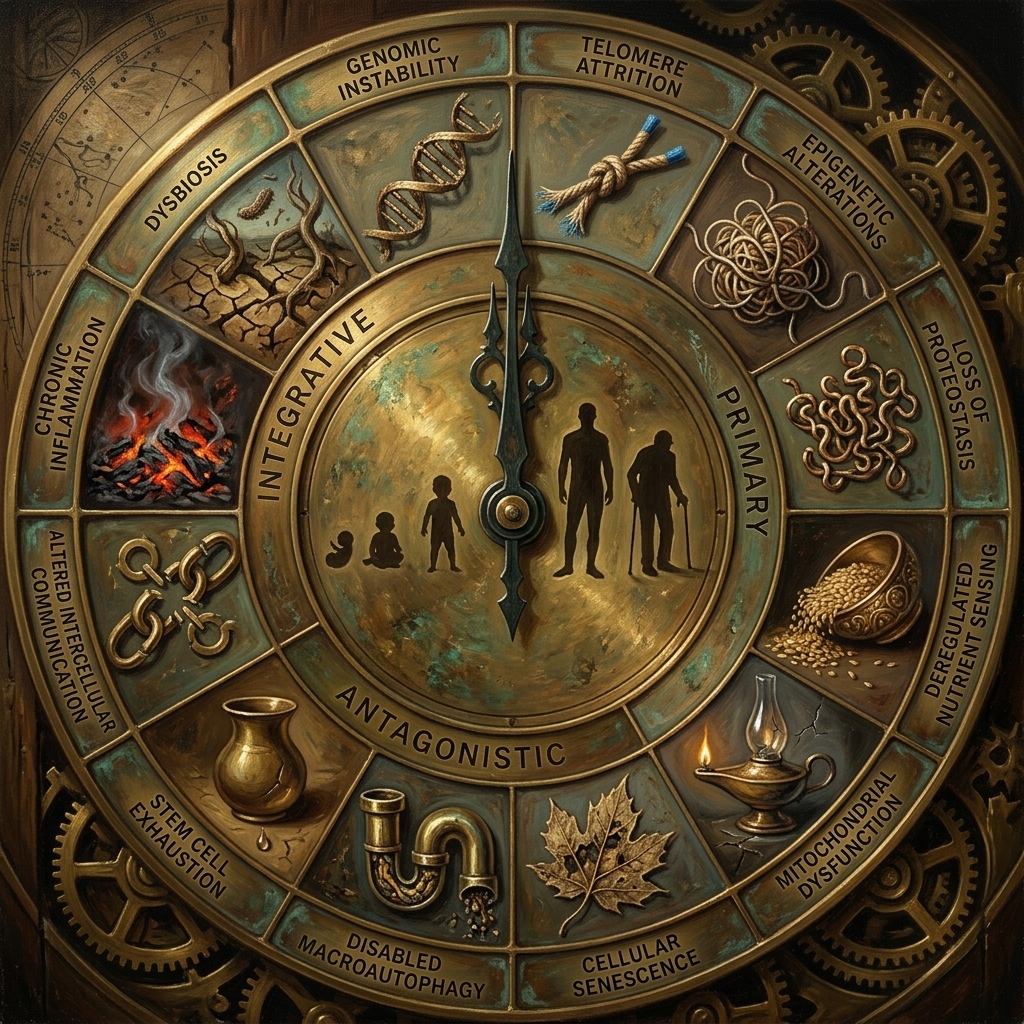
The aging clock above shows the twelve hallmarks of aging identified by López-Otín and colleagues — the molecular processes now understood to drive visible aging.
My Quest
I am not going to tell you to eat less and exercise more — you already know that. This book is about what comes after. It is primarily a story of my personal quest to achieve life extension.
In 1982 I graduated with degrees in Integrated Science and Physics courtesy of Northwestern University’s Integrated Science Program. The goal was to develop interdisciplinary analytical tools. What cross-disciplinary scientific training produces is the capacity to read primary literature outside your specialty and assess it on its own terms — to follow the evidence wherever it leads without the constraints typical of highly specialized niche disciplines or institutional pressures. The publication of Durk Pearson and Sandy Shaw’s book, Life Extension, happened that same year. Their attempt to present the scientific evidence supporting possible longevity interventions appealed to my new appreciation of science, and thus my quest began.
Forty-four years of reading everything the life extension literature provides and after experimenting with the available nutraceuticals, I can relate what I have learned and tried. I can tell you what works and why.
Linus Pauling wrote that he was motivated to write his 1986 book, How To Live Longer and Feel Better because he “discovered that new developments in the field of nutrition were being ignored…”. I share that sentiment. You will find in this book that many more such developments are still being ignored.
The doctors and medical “experts” are still telling us that we can get everything we need from a balanced diet. The food supply that might make that statement true no longer exists. Breeding crops and livestock optimized for industrial food delivery. Agricultural soil depletion, seed oil displacement, pesticide residues in grain crops, the elimination of fermented foods from the standard diet, water treatment removing trace minerals including lithium — the “balanced diet” assumes a food supply that the modern environment stopped providing decades ago. It also ignores the added burden of EMF and chemical pollution.
They told us aging was inevitable and its timeline fixed. The epigenetic reprogramming results in animal models suggest the timeline is not fixed — that the program running aging can be partially reset rather than merely slowed, that the information for youthful function is never lost but only progressively obscured by epigenetic drift that is, in principle, reversible.
I am not one of those “experts”. I do not suffer from institutional inertia with its structural incentives like funding dependencies, career pressures, regulatory capture, the need for patentable interventions that consistently produce conclusions favorable to existing industries. Reading the same literature but with no financial stake in the outcome often means arriving at a different conclusion.
After forty-four years, I decided this book needed to be written. My strategy has been to simultaneously address all 12 Hallmarks of Aging as soon as interventions are identified.
Readers come to books like this one looking for a magic bullet — the supplement, the protocol, the morning routine that can be added to an otherwise unaltered life and fix what the unaltered life has been doing for decades. They expect a magic pill that would fix a lifetime of poor choices without requiring those choices to change. There is no such magic bullet, not now and probably never in our lifetimes. This book provides something considerably more demanding and considerably more effective: the argument that the lifestyle itself needs to change, and a detailed account of what that change looks like lived out over four decades.
There Is A Better Way. It begins not with a supplement stack but with the recognition that the supplement stack and the lifestyle have to point in the same direction. You cannot supplement your way out of a diet working against the supplements. You cannot exercise your way out of a food supply engineered to defeat satiety. You cannot take the senolytic stack on Sunday and eat the food that accelerates senescence the other six days.
The chapters that follow document both the interventions and the lifestyle that makes them work. The Annual Increment chapter lists the compounds. You will find why the compounds require the lifestyle and why the lifestyle, honestly implemented, is itself the most powerful intervention available.
Stop killing yourself. There is a better way.
Most people interested in longevity science are waiting for someone else to deliver it. The protocols in this book are what you build while you wait — and what you build instead, if the delivery never comes in time. Either way, you need to be healthy enough to make the coming breakthroughs worth having.
Robert Anton Wilson wrote in 1977 that sober and cautious gerontology scientists believed human lifespan could be doubled, tripled, or extended indefinitely within their lifetime. Every enthusiastic researcher he named in that essay is dead now — except one, Dr. Takashi Makinodan, who at 101 is still alive. He was the one doing the science rather than waiting for its delivery. The rest hoped, but hope is not a viable life extension strategy.
None of this is a guarantee. The lightning bolt or bus is always out there. Forty-four years of implementing the most rigorously evidenced protocol I could assemble has not made me immortal — yet. The Egyptian mosquito that gave me West Nile Fever didn’t consult the protocol before biting. This lifelong experiment, with a sample size of one, has produced a remarkably fit and healthy 66-year-old who is routinely mistaken for a man nearly 2 decades younger.
What the protocol does is load the dice. Everyone is gambling with their biology — the person who does nothing is gambling too, just with dice they haven’t examined and haven’t loaded in their favor. Wouldn’t you rather play with your own loaded dice?
The chapters that follow are how I loaded mine.
Leave a Reply