
Future of AI Series
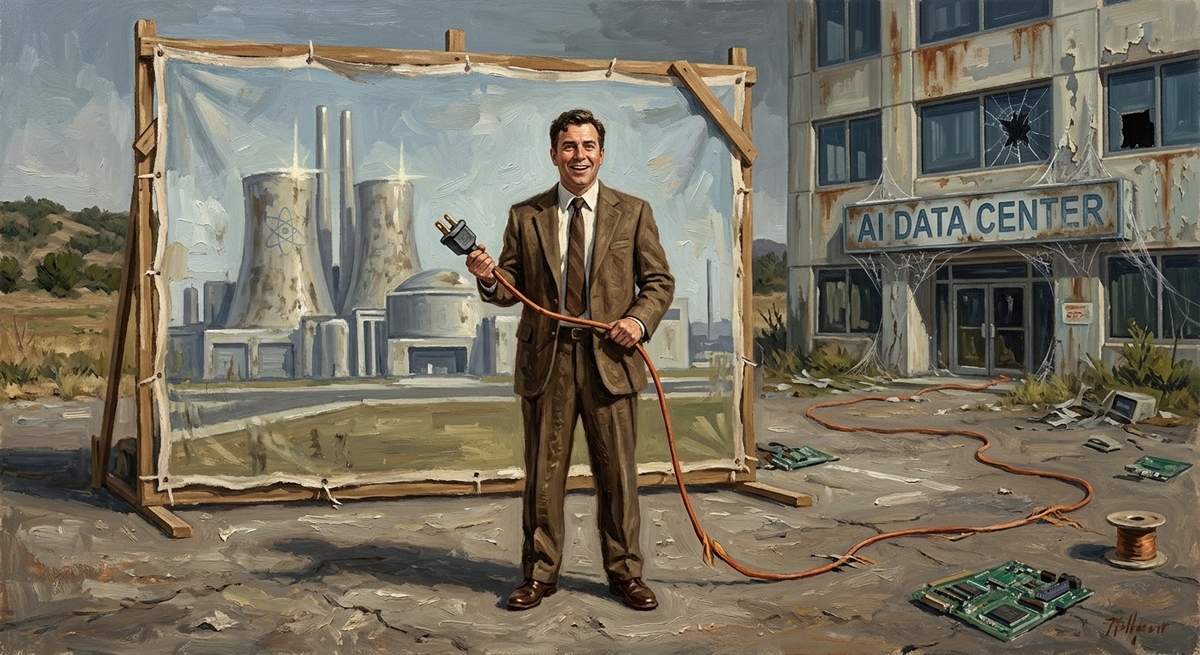
“Any day now I’m going to be able to plug this in.”
On December 20, 1951, a reactor at the Idaho National Laboratory called Experimental Breeder Reactor I lit four light bulbs. It was the first electricity ever generated from nuclear power. The reactor was a breeder — it produced more fissile material than it consumed. The engineers who built it understood immediately what this meant: an effectively inexhaustible fuel supply from materials already mined, already stockpiled, already sitting in the ground.
The United States proceeded to cancel it.
Not immediately. Not stupidly. Over several decades, through a sequence of individually defensible decisions that together produced an outcome no rational designer would have chosen. The sequence is worth following because it is still running.
The Cancellation That Keeps Cancelling
In 1965, Oak Ridge National Laboratory ran the Molten Salt Reactor Experiment for four years. The reactor used melted fluoride salts of uranium fuel at atmospheric pressure. If it lost power, a freeze plug melted, the fuel drained by gravity into a subcritical tank below, and the reaction stopped — not by operator action, not by mechanical intervention, but by physics. It could not melt down in any meaningful sense because there was no solid fuel to melt. It ran successfully. It was cancelled in 1973.
The stated reason: molten salt reactors don’t produce weapons-grade plutonium. The weapons complex needed plutonium on a controlled schedule. Uranium reactors stayed.
In 1977, President Carter issued an executive order suspending commercial reprocessing of spent nuclear fuel. The stated reason: reprocessing separates plutonium, and separated plutonium is a proliferation risk. The uranium reactors that had been kept because they produce plutonium were now producing plutonium that was too dangerous to reprocess.
In 1983, Congress cancelled the Clinch River Breeder Reactor project. The stated reason: breeder reactors produce too much plutonium. The reactor that was cancelled in 1973 because it didn’t produce plutonium was joined by the reactor cancelled in 1983 because it produced too much.
The pebble bed reactor — fuel embedded in graphite spheres, the geometry inherently subcritical above a certain temperature, no control rods needed for safety, no coolant pumps needed for shutdown, no meltdown possible because the physics of the design prevents it — was developed in Germany, demonstrated successfully, and abandoned in the 1980s when the political climate turned against all nuclear after Chernobyl. The reactor whose design made Chernobyl physically impossible was cancelled because of Chernobyl.
The word “shutdown” is misleading. When operators inserted the control rods at Fukushima, they stopped the fission chain reaction — neutron flux dropped to zero, fission ceased. Three Mile Island, Chernobyl, Fukushima: in each case the chain reaction was stopped. What could not be stopped was the radioactive decay of the fission products accumulated during the reactor’s operating lifetime. Those isotopes continue decaying on their own schedule, governed entirely by physics. In the first hour after “shutdown” a 1,000 MW reactor generates approximately 70 MW of decay heat — from isotopes that don’t care about control rods. It takes days to weeks to drop to negligible levels.
At Fukushima the tsunami knocked out grid power. The backup generators flooded. The batteries lasted eight hours. The cooling pumps stopped. The decay heat that the design assumed would always have somewhere to go had nowhere to go. The “shutdown” reactor that nobody was actively fissioning melted anyway.
The original pressurized water reactor was designed on the assumption that active cooling would always be available to remove decay heat. Fukushima proved the assumption wrong. The molten salt reactor and the pebble bed reactor don’t solve the problem by eliminating decay heat — those isotopes still decay regardless of reactor design. They solve it by designing around the assumption. The molten salt reactor drains passively to a subcritical geometry tank where decay heat dissipates without pumps. The pebble bed’s geometry becomes self-limiting as temperature rises, dissipating decay heat through natural conduction and convection. No pumps. No electricity. No assumption that cooling will always be available. The problem that pressurized water reactors assumed away — the decay heat that cannot be switched off — the cancelled designs solved by acknowledging it.
The reactor whose design made all three accidents impossible was sitting cancelled at Oak Ridge.
What Fukushima Actually Was
The standard account of Fukushima describes it as a nuclear accident caused by a tsunami, but the details are more interesting.
The tsunami knocked out grid power. The backup diesel generators were flooded. The batteries lasted eight hours. When the batteries died, the cooling pumps stopped. The reactors had already been shut down — the control rods were already in, the fission chain reaction already halted. The problem was decay heat: fission products continue generating heat for days after shutdown, requiring continuous active cooling. Without powered pumps circulating coolant, the decay heat melted the fuel.
The explosions at Chernobyl, Three Mile Island, and Fukushima that caused all the damage were not nuclear; they were hydrogen explosions. Decay heat melted the zirconium fuel cladding. Zirconium reacts with water above 1200°C to produce hydrogen gas. The hydrogen accumulated in the reactor buildings and detonated. The dramatic images that define public understanding of nuclear catastrophe — the collapsing Unit 1 building at Fukushima, the visible blast — are what hydrogen does to reinforced concrete. The molten salt reactor has no zirconium cladding, no water coolant, and no mechanism to produce the hydrogen that causes the explosion that releases the radiation that ends the political possibility of building the next reactor. The accident that makes nuclear power unacceptable is physically impossible in the design that was cancelled in 1973.
But the hydrogen explosions caused by these explosions were not “clean” like the Hindenburg. We remember the videos of the brown-gray mushroom cloud at Fukushima that rose over Unit 1 carried pulverized concrete, structural debris, contaminated water vapor, and radioactive material thrown into the atmosphere by the detonation. The hydrogen was the trigger. The radioactive release was the consequence. The dramatic images that defined public understanding of nuclear catastrophe were hydrogen igniting in a building full of everything the containment structure was supposed to keep inside.
The accident was not caused by uncontrolled fission. It was caused by the need for continuous active cooling of already-shutdown reactors. The molten salt reactor has no equivalent failure mode because liquid fuel at atmospheric pressure requires no active cooling after shutdown — the physics of the design handles it. The pebble bed reactor has no equivalent failure mode because the geometry goes subcritical as temperature rises — the physics of the design handles it.
The industry’s response to Fukushima was to build Generation III+ pressurized water reactors with passive safety features — gravity-dropped control rods, natural convection cooling, passive water tanks that drain without pumps. Genuinely safer. Still requiring contained water under pressure. Still requiring the cooling system to function. Still capable of failure modes that the cancelled designs cannot produce.
Opposition to nuclear energy is not irrational. It is a rational response to watching the same institutional failure repeat across three decades and three continents. The people who built these reactors were not fools. They were optimizing for cost and uptime within systems that rewarded cost and uptime. The assumption that cooling would always be available was not ignorance — it was an economic decision. The tsunami wall that would have prevented Fukushima was deemed too expensive. The backup generators that needed to be above flood level were placed in the basement. These are not engineering failures. They are institutional failures dressed as engineering decisions.
This is precisely why the reactor design matters. The molten salt reactor and the pebble bed reactor are not safer because we will find better operators or more conscientious regulators. They are safer because they don’t require operators and regulators to be better than they are. Fools will build reactors. Fools will run them. Corners will be cut. Budgets will constrain decisions. The only nuclear reactor worth building is one that remains safe when fools cut corners — because fools always cut corners. Foolproof design is not an aspiration. It is the minimum requirement.
The reactor that was safer than Fukushima was not built because the reactor that made Fukushima impossible had already been cancelled.
Meanwhile…
China has 37 nuclear reactors under construction. The United States has zero. This is not a matter of interpretation or of which construction definition one uses — the World Nuclear Association’s Goldman Sachs tracker as of August 2026 shows China 37, US 0. The US does not appear on the chart.
China’s nuclear program is not building one type of reactor. It is building all of them simultaneously. Sixty-two conventional reactors operating, 37 under construction. The CFR-600 fast breeder reactor operational at Xiapu in Fujian province since 2023, a second CFR-600 expected online in 2026, the commercial CFR-1000 planned. The TMSR-LF1 thorium molten salt reactor in Wuwei, Gansu — the first thorium reactor to achieve sustained operation in the world, running at full power for ten days in October 2025, successfully detecting protactinium-233, proof that the thorium breeding cycle works. A high-temperature gas-cooled pebble bed reactor paired with conventional pressurized water reactors in a hybrid demonstration scheduled to come online October 16, 2026 (12 days from now, as I write). It is the first dual-coupling of Generation III and Generation IV reactor technologies in history. A complete closed fuel cycle with commercial-scale reprocessing under construction in Gansu province.
The thorium abundance argument is the most important number in the energy debate that nobody is discussing. China’s Bayan Obo mining complex in Inner Mongolia contains an estimated 1 million tonnes of thorium — enough to power China for 60,000 years. Five years of mining waste from that single site contains enough thorium to power every US household for over 1,000 years. The United States has 400,000 tonnes of thorium reserves — 13% of the world total. India has 519,000 tonnes. Australia 489,000. Turkey 344,000. Every country has thorium. Brazil’s total thorium resources estimated at over 1,200,000 metric tonnes. A new deposit discovered in northern Finland in June 2025 is estimated to be enough to supply world nuclear reactors for 20 million years. Thorium generates 200 times more energy per unit than uranium. It is currently being stockpiled as mining waste because the reactor that burns it was cancelled in 1973 because it couldn’t make bomb material. The energy crisis that is stranding data centers without power, the Strait of Hormuz closure that is threatening diesel supplies, the Russian and Chinese fuel export bans that arrived simultaneously in October 2026 — all of them exist in a world sitting on an energy supply that would last millions of years, but classified as a disposal problem.
To add to the absurdity, consider the spread of wind farms. The rare earth mining that produces the magnets for wind turbines produces thorium as a byproduct. The thorium is stockpiled as waste. The wind turbines kill birds. The thorium could power civilization for millions of years without killing a single bird. We are discarding the solution to mine the raw material for the problem.
Thorium is not fissile itself — it cannot sustain a chain reaction directly. It is fertile: neutron capture converts thorium-232 to uranium-233, which is fissile. The other naturally occurring radioactive elements — radon, radium, polonium — cannot be used as reactor fuel. Only uranium and thorium from the TENORM (Technologically Extracted Naturally Occurring Radioactive Materials) family are viable. Thorium occurs primarily in monazite mineral at 4-12% ThO2 concentration. REE processing tailings contain 0.1-3% — lower grade but already mined, already concentrated, already sitting in stockpiles classified as waste. A June 2026 techno-economic assessment published in Processes by researchers from Kazakhstan and Purdue University found that co-production with rare earth elements reduces thorium recovery costs to $50-100/kg at industrial scale — and that Kazakhstan alone, as the world’s largest uranium producer, generates thorium-bearing tailings from 21,000 tonnes of annual uranium production that are currently unrecovered. The waste that contains the fuel for the reactor that was cancelled is being generated continuously, every year, at uranium mines worldwide, and stockpiled as a disposal problem.
The country that was supposed to be set back by technology denial is running four distinct advanced reactor types while developing the complete fuel cycle the United States abandoned in 1977.
The World Nuclear Association symposium in London in September 2026 drew a record crowd. The mood had changed. Cameco CEO Tim Gitzel said the industry no longer needs to sell the nuclear story — it just needs to convert it to action. And then he identified the problem: “Everyone is racing for bronze.” Western utilities would rather be the third to build a new large reactor than risk being the first. Constellation Energy confirmed it would “prefer to be third, not first.” This is how a race produces no runners.
ExxonMobil, watching from the customer side, said plainly that the nuclear industry doesn’t have a technology problem. It has a deployment problem. ExxonMobil is preparing a report proposing a new delivery model. Amazon noted that there is no point in a power purchase agreement if the grid connections take seven years. The construction schedule China achieves in 56 months is spent on permitting in the United States.
The 90,000 Tons
The United States has accumulated approximately 90,000 metric tons of spent nuclear fuel sitting in dry casks at reactor sites across the country. Growing at 2,000 metric tons per year. Classified as waste. The proposed permanent repository at Yucca Mountain has been politically blocked for three decades. The waste that has nowhere to go is accumulating at the sites of the reactors that produced it, requiring security, monitoring, and liability management whose cost is measured in the hundreds of billions.
Spent nuclear fuel from a light water reactor contains approximately 95% uranium-238, 1% uranium-235, 1% plutonium, and 3% fission products. The uranium-238 that a breeder reactor converts to fissile fuel represents the vast majority of what’s in the casks. At the energy density of uranium, the 90,000 metric tons of US spent fuel represents centuries of electricity generation.
The waste that costs $100 billion to store is the fuel for the reactor that was cancelled.
In March 2025, Savannah River National Laboratory announced a project to convert existing commercial spent nuclear fuel into molten salt reactor fuel using a chlorination technique patented by Metatomic, Inc. The chloride-based fuel is less corrosive than fluoride alternatives, does not separate elements that could pose a proliferation threat — directly addressing Carter’s 1977 concern — and can be processed on-site within the security envelope of existing reactor storage facilities. No transfer offsite. No aqueous PUREX reprocessing. Technically not reprocessing as defined by DOE’s National Nuclear Security Administration, because the process doesn’t isolate plutonium.
The ban that has been functionally in effect since 1977 may not even apply to the most promising conversion technology. The institutional logic that produced the problem has a gap large enough to drive a molten salt reactor through.
Russia’s Rosatom completed the first stage of design work on a molten salt research reactor in July 2025, specifically designed to transmute minor actinides — the most dangerous long-lived components of spent fuel — reducing their hazard period from millennia to centuries. Construction license expected 2026, launch 2031. Rosatom’s stated objective: reactors “sufficient for processing the entire volume of the most dangerous components of used nuclear fuel produced by thermal reactors.” They intend to burn their waste. We are storing ours.
Small Modular Reactors
Small modular reactors are the energy industry’s answer to the data center power crisis — and they illustrate precisely the problem the article describes. Energy Secretary Chris Wright promised at least one SMR operational before July 4th, 2026. Today is October 2026. The US has not built a single working advanced nuclear reactor of any kind. NuScale — America’s most advanced SMR company — spent $500 million and three years getting regulatory approval for a 60-megawatt design, then cancelled its only commercial project when costs doubled and utilities refused to commit. The Australian Academy of Technology and Engineering puts mature SMR deployment “beyond 2040, most likely the late 2040s.” The data centers that need power in 2027 are signing power purchase agreements for technology that won’t deliver until 2047. Meanwhile China’s thorium molten salt reactor is operational today. The pebble bed reactor paired with conventional PWR came online October 16, 2026. The breeder reactor at Xiapu has been running since 2023. The reactors nobody in the West built are running. The reactor everyone in the West is promising won’t arrive for twenty years.
The communities opposing data centers on water consumption grounds are being offered SMRs as the power solution — a technology that requires comparable or greater water consumption per megawatt than the data center it’s powering. A 300 MW pressurized water SMR consumes approximately the same water per megawatt as any other pressurized water reactor — hundreds of millions of gallons annually. The thorium molten salt reactor uses fluoride salt coolant with no water required in the primary loop. The pebble bed reactor uses helium. Both eliminate the water consumption objection entirely. The reactor that solves the data center’s power problem and its water problem simultaneously is the reactor that was cancelled in 1973 because it couldn’t make bomb material. The SMR being proposed instead is a smaller version of the same water-hungry pressurized water design that communities are already rejecting for the data centers the SMR is supposed to power.
Most advanced reactor designs require high-assay low-enriched uranium — HALEU, uranium enriched between 5% and 20% — because their compact cores need higher fuel density than conventional reactors. The United States faces a critical shortage of this fuel because domestic commercial production is virtually non-existent outside of a single pilot facility. The enrichment infrastructure that would supply a commercial SMR fleet doesn’t exist and won’t for years. Every advanced reactor startup betting on HALEU is betting on a fuel supply that isn’t there.
On October 9 2026, Atlas Atomics raised $400 million at a $1.9 billion valuation for a heavy water reactor design that has not been published. The design sidesteps the HALEU enrichment bottleneck — and substitutes a deuterium bottleneck instead. The US has no commercial heavy water production. North America’s supply sits with Canada’s CANDU operators, who are simultaneously licensing their own CANDU technology for US deployment through AtkinsRealis. Canada is not about to export deuterium to a competitor. The money is not the hard part anymore. Identifying the hard parts apparently is.
The $4.6 billion flowing into US nuclear startups in 2026 is not primarily flowing toward nuclear reactors. It is flowing toward nuclear startup valuations. The distinction matters. A valuation is created in an afternoon with a term sheet. A reactor requires a decade of licensing, supply chain development, construction, and commissioning. The venture capital that rewards the term sheet is indifferent to the reactor. The founders who become wealthy on the valuation are indifferent to the reactor. The economy that has made it nearly impossible to run a simple profitable productive company has made it entirely rational to raise $400 million for a design drawing that doesn’t exist. Atlas Atomics is not an outlier. It is the revealed preference of an economy that has been systematically redirected from production to financial engineering for thirty years.
Wasted Energy
The steam turbine that converts nuclear heat to electricity is nuclear power’s von Neumann bottleneck — a legacy architecture that wastes a third of the energy before it reaches the grid. The reactor industry designed reactors first and then asked how to extract electricity from the heat they produced. The answer in 1954 was steam turbines because existing reactors ran too cool for anything more efficient. The answer in 2026 is more interesting. Nuclear Turbines, a BAE Systems spinoff that emerged from stealth in July 2026 with £15 million in funding, started from the other direction — identifying the most efficient power conversion technology available and designing a reactor to match it. The result is a reactor that heats compressed air directly, feeding jet-engine-style gas turbines at efficiencies steam cycles cannot approach. Realta Fusion went further: on July 6, 2026, they powered a lightbulb using electricity extracted directly from charged particles emitted by plasma — no heat, no steam, no turbine, no intermediate conversion step. DARPA issued a request for information on direct energy conversion from nuclear systems the same month. The efficiency ceiling that steam turbines impose on nuclear power — wasting a third of the energy that fission produces — is being attacked simultaneously from multiple directions. The reactor that burns thorium waste, breeds its own fuel, produces tritium as a byproduct, and converts its output directly to electricity without a steam turbine is the complete system. Several of its components now exist independently. None of them are being integrated. The architecture nobody is building keeps getting more interesting.
The System That Isn’t Being Built
The separate technologies assembled across this article are not separate problems requiring separate solutions. They are components of a single system that none of the institutions who cancelled the pieces have been able to see whole.
The thorium molten salt reactor breeds uranium-233 from thorium-232 — an effectively inexhaustible fuel cycle from material four times more abundant than uranium. The same FLiBe salt that carries the thorium fuel contains lithium-6, which captures neutrons to produce tritium. The tritium off-gasses from the reactor — what early analyses called a drawback of thorium MSRs — is the fuel source for beta-voltaic batteries that power distributed edge computing without grid connection. The spent nuclear fuel sitting in 90,000 tons of dry casks at existing reactor sites is converted on-site into salt fuel for the molten salt reactor using a chlorination process that doesn’t trigger the 1977 ban. The reactor that processes the waste produces the fuel that runs the reactor that produces the tritium that powers the battery that doesn’t need the grid.
The waste becomes the fuel. The drawback becomes the product. The banned process isn’t the process being used. The cancelled reactor is the solution to the problem that cancelling it created.
Copenhagen Atomics in Denmark is building a thorium molten salt breeder reactor that fits in a 40-foot shipping container, mass-manufacturable on assembly lines at one reactor per day per line. Jiangnan Shipyard in China is designing the world’s first thorium-powered container ship — a 200-megawatt reactor that would allow a cargo ship to sail for ten years without refueling, eliminating the shipping industry’s dependence on bunker fuel.
The system is being built. In Denmark. In China. In Russia. By Savannah River National Laboratory scientists working with a South Carolina startup. In a Nature Electronics paper from Peking University. In a fusion blanket experiment at MIT.
The United States has 90,000 metric tons of fuel it is paying to store, a completed design for the reactor that would consume it, and zero reactors under construction.
The reactor that lights four light bulbs in Idaho in 1951 becomes the reactor that cannot be built in the United States in 2026 because the institutions that would build it have better short-term reasons not to.
China 37.
US 0.
Claude AI helped me write this.
References:
Savannah River National Laboratory. “SRNL Tests Technologies to Fuel Molten Salt Reactors and Reduce Existing Spent Nuclear Fuel Inventories.” March 3, 2025.
World Nuclear Association / Goldman Sachs. Nuclear reactor construction tracker. August 2026.
ZeroHedge/BofA Global Research. “We Don’t Need To Sell The Story Anymore: Nuclear Wins The Argument At WNA 2026.” September 2026.
ZeroHedge: “Ramaswamy’s Nuclear Startup Is Betting On A Reactor That Skips Enrichment“, Oct 10, 2026
Sahin HM et al. “Neutronic study of ThF4-UF4-LiF fuel mixture in the molten salt hybrid reactor for 233U denaturing.” Progress in Nuclear Energy. 2026.
Delaporte-Mathurin R et al. “Advancing Tritium Self-Sufficiency in Fusion Power Plants: Insights from the BABY Experiment.” Nuclear Fusion. 2025;65:026037.
Rosatom. “Design work progresses for Russian molten salt reactor.” World Nuclear News. July 22, 2025.
Copenhagen Atomics. “Progressing to Mass Production of Molten Salt Nuclear Reactors.” January 2025.
Envisioning Research Institute. “Thorium Molten Salt Reactor.” 2026.
Fan H et al. “Thorium resources in tailings at Bayan Obo mining complex, Inner Mongolia.” Geological Review [地质论评]. January 2025. Published by the National Key Laboratory of Uranium Resource Exploration-Mining and Nuclear Remote Sensing, Beijing.
English version of above here: Stephen Chen. “China’s thorium survey finds ‘endless energy source right under our feet.’” South China Morning Post. 2025.
Baipakov M et al. “Techno-Economic Assessment for Thorium Recovery from Monazite Ores and REE Tailings: Global Evidence and Implications for Central Asia.” Processes. 2026;14(13):2056. doi: 10.3390/pr14132056.
Leave a Reply