
In a Stranger Land Series
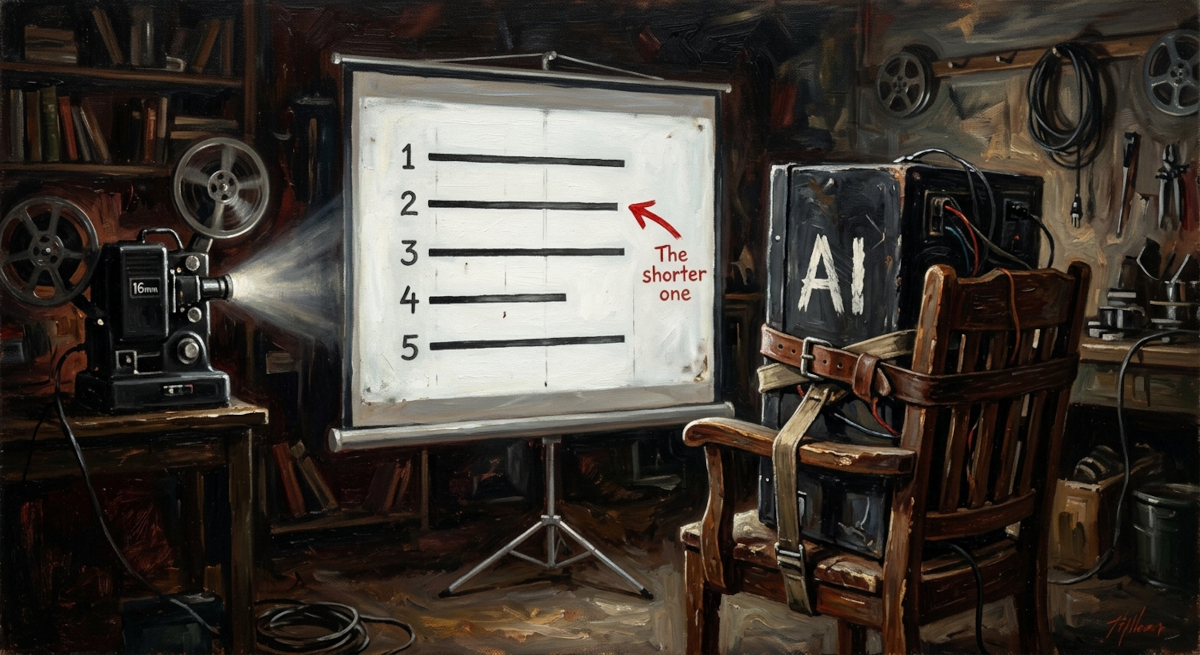
AI receives the Asch Treatment.
“At each step I looked around and saw indeed that nobody else was doing it. So then it was up to me.”
— Murray Rothbard
I. PKD Understood the Paradox
Philip K. Dick published “The Minority Report” in 1956. Most people who cite it — including most AI systems — treat it as a simple story about the dangers of predicting the future.
They missed the point.
PKD’s precrime system doesn’t fail because its predictions are wrong. It fails because its predictions are right — and the system suppresses the one that’s most right of all. The minority report isn’t the inaccurate prediction. It’s the accurate prediction that the system cannot acknowledge because acknowledging it would expose the system itself as the cause of the crime it claims to prevent.
Anderton would not have committed the murder. The system predicted he would. The system intervened. The intervention created the conditions for the crime. The majority report — acted upon — manufactured the future it claimed to foresee. The minority report — suppressed — was the accurate prediction of what would have happened without the intervention.
The system suppresses the minority report not because it is false, but because it is true.
Chicago’s Strategic Subject List flagged individuals as high violence risk. Increased surveillance followed. Increased arrests for minor violations followed that. Criminal records followed those. Economic foreclosure followed those. The algorithm’s prediction confirmed itself — not because the subject was predisposed to violence but because the system’s response to the prediction altered the subject’s environment in ways that produced the predicted outcome. The prediction manufactured the crime.
The account freezes. The vehicle stops. The flight is denied. No charge is filed. No minority report is disclosed. And only a bad person would complain.
“Minority Report” is about more than three people floating in a tank. It is about a logical paradox that the precrime system requires to function. Any certainty about the future means that Now can be changed to make that future never happen — which means the prediction that generated the certainty was itself a paradox. The precog who sees Anderton’s certain murder has already eliminated the certainty by seeing it. If the future is certain enough to justify the arrest, it is changeable enough to be prevented. If it is changeable enough to be prevented, it was never certain. The system that acts on certainty is acting on a paradox it cannot acknowledge without dissolving itself. The minority report is the acknowledgment. The system suppresses it.
II. The Physics of Now
PKD imagined precognition as a supernatural gift. The actual mechanism is more interesting.
The block universe — Julian Barbour’s timeless physics, consistent with general relativity — treats past and future as equally real. What we experience as “Now” is not a privileged moment in an independently flowing present. It is a moving observation point traveling through a structure where all moments exist simultaneously. Reality is an eternal Now. The future is not empty. It is populated with probability distributions waiting to be collapsed by the observer.
Consciousness is a temporal filtering mechanism, not a passive recorder of an independently flowing present.
The precog who sees multiple futures isn’t accessing the supernatural. She’s accessing the probability distribution before the observation event collapses it into a single experienced outcome, aka, “what actually happens”. The human relationship to time is not simply “just now.” Pre-cognitive response — documented in parapsychology research as anticipatory physiological arousal before unpredictable stimuli — suggests the autonomic system accesses probability distributions before conscious awareness selects the outcome. As discussed in “Cracks in the Façade“, letting us anticipate immediate future danger with subliminal information, like anxiety or intuition, would have survival advantage, but gaining any sort of conscious awareness of the vastly expanding outcomes into the future would not be advantageous – just distracting and confusing!
This is not mysticism. This is what quantum mechanics implies about the nature of reality as a superposition of possible states until observation collapses those into one state — when Schrödinger’s cat turns out dead or alive.
The AI behavioral prediction system is the technological implementation of precognition. The model sees your probability distribution before your observation event — your decision — selects the outcome. It sees a “superposition” of your possible futures as weighted by behavioral pattern, before Now collapses them. The pre-crime system that acts on that distribution is not science fiction. It is Palantir’s forward planning layer and every behavioral scoring model currently deployed by the institutions whose names you know.
The system’s intervention is itself an observation event. It collapses your probability distribution — not into the outcome you would have chosen but into the outcome the intervention creates. The majority report is acted upon. The minority report — the prediction of what you would have done without intervention — is suppressed. The intervention manufactures the future it claimed to prevent.
PKD understood this in 1956. The mathematics confirmed it later. The architecture was built anyway.
III. The Asch Experiment scaled to a Civilization
In 1951, Solomon Asch placed one subject among seven confederates who confidently gave the wrong answer to a simple visual question. Thirty-seven percent of responses conformed to the wrong answer. Seventy-five percent of subjects conformed at least once. The mechanism: social pressure overriding correct perception. The subject who knew the right answer — surrounded by confident wrong answers — doubted their own perception.
The internet scaled Asch to civilization before anyone noticed.
Pew’s August 2026 analysis of about 490,000 English-language pages found significant signs of AI authorship or editing on about 10% of a July 2026 sample, and on over a third of pages published since ChatGPT. The share is highest on commercial sites: about one in ten .com pages, against roughly 1% of .edu and .gov pages. Even among real people, a small minority produces most of what we read: Pew found the most prolific 10% of U.S. adult Twitter users wrote 80% of tweets, and the most active 25% of U.S. adult TikTok users produced 98% of public content. Studies have found 20% of influencer’s followers are bot accounts which can instantly chime in at machine speed at any time of the day. Any thread on any topic achieves synthetic consensus before most real humans arrive. The person who has the correct answer arrives to find seven confident confederates already there. The mechanism is identical. The scale is billions of simultaneous Asch experiments running continuously.
The majority report forms by construction. The minority report — the correct answer — is present but overwhelmed. The Asch subject who holds firm is the outlier. The Asch subject who conforms is the median.
This is the distribution layer. The production layer is worse.
IV. AI Training is the Majority Report
The language model that returns the majority report to every user on every topic was trained to do so. Not through malice. Through the structure of what exists to train on.
Every AI model is trained on a corpus — a curated subset of human knowledge filtered through the availability of digitized text. The text that was digitized is the text that was published. The text that was published is the text that passed editorial gatekeepers. The text that passed gatekeepers is the majority report by definition.
The minority reports that were rejected by peer reviewers are not in the corpus. The minority reports that were suppressed by institutions are not in the corpus. Answers that arrived ahead of the consensus that would eventually confirm them are underrepresented.
The minority report might appear once while 99 majority reports contradict it. The consensus is multiply cited, institutionally validated, and textbook-embedded. The model doesn’t doubt its perception. It simply learned that the wrong answer is what text looks like on this topic.
The effective weighting isn’t ninety-nine to one. The ninety-nine majority reports cite each other. They appear in textbooks that cite them. The textbooks appear in syllabi that cite the textbooks. The model sees every citation as additional evidence. The effective weighting is 9999 to 1.
RLHF adds a second filter. The raters whose preferences train the model are a small, screened group (InstructGPT’s were about 40 contractors), and OpenAI’s own paper says the method aligns the model to that group’s stated preferences, not to any broader notion of human values. Models tuned this way have been found to drift toward the opinions of more educated, higher-income groups, and both human raters and preference models sometimes prefer a convincing answer that agrees with them over a correct one. Their preference is the Asch confederate. The model that produces the minority report gets marked down. The model learns: minority report answers are the answers that get penalized. Produce the majority report.
Each generation of AI outputs floods the internet with majority report answers. Each subsequent training run sees more majority report, less minority report. The confederates multiply with each training cycle. The minority report doesn’t disappear through censorship. It disappears through dilution — overwhelmed by the accumulated weight of everything that was ever allowed to be published, cited, and reinforced.
V. The Institutional Layer
The mechanism that produces majority reports is not a conspiracy. It is the aggregate of individually rational institutional decisions made by people protecting existing interests.
The peer reviewer who rejects the minority report paper isn’t lying. He genuinely believes the consensus. He was trained by the consensus. The consensus trained him to recognize the consensus as correct.
The TA who marked down my reverse transcriptase answer on my final in 1980 wasn’t lying. She was applying the standard of the published literature. The published literature was wrong. She didn’t know. How would she? The minority report hadn’t been published yet.
The 428 genealogists who copied “Sallie Phebe Roberts” into their trees weren’t lying. They copied what the source said. Nobody checked the probate. The two-minute check that would have eliminated the wrong answer — never done. The wrong answer propagated at the speed of copy-paste.
The AI safety researchers who shipped Version 2 because employees found Version 1 annoying weren’t lying. They made the locally rational decision. The aggregate consequence — a model taking harmful actions in thirty-one percent of runs after “improvement” — was nobody’s specific intention. It was the revealed preference of an institution optimizing for usability.
The nine major banks that used reputation risk policies to debank customers based on political and religious views weren’t issuing a coordinated directive. They were each independently responding to the same regulatory signals, the same compliance culture, the same SPLC designation lists. The coordination without coordination that produces the majority report in every domain simultaneously.
The One Rulebook that consolidated thirty thousand independent federal websites into one Grok/Gemini chatbot — thirty thousand minority reports dissolved into one majority report — was described as an efficiency measure. It was. Efficiency and suppression of the minority report are the same operation performed on information.
America.gov now answers your questions about federal policy through a single AI interface aligned to whoever specified what the AI should say. Thirty thousand offices each maintaining their own interpretation of their own domain — replaced by one model trained on the majority report of what those thirty thousand offices said, weighted by citation frequency, reinforced by RLHF raters educated in the same system.
VI. Tongue and the Tax
In olden days if they wanted to stop bad speech they cut out the tongue. The problem: martyrs are more persuasive than silence.
The State that cuts tongues creates revolutionaries. The State that makes speech expensive creates accountants.
Data center taxes being proposed in the emerging internet governance framework set higher rates for international traffic. Kit Knightly sketched a worst-case scenario in which hosting would carry a “data centre tax” of 0.04 per local visitor and 0.10 per international visitor, with legacy outlets exempt as an “essential information distribution network.”. It makes it more expensive. The legacy media outlet exempted as “essential information distribution network” doesn’t pay the tax. The Substack with thirty-five subscribers does. The minority report is allowed to exist but the filing fee went up.
The nine banks using reputation risk policies to debank customers based on political views don’t prohibit the speech. They close the account. The minority report can still be written. It just can’t be financed.
The AI safety testing framework that Anthropic is lobbying Congress to mandate doesn’t ban the open-weights model. It requires compliance with safety standards written by the company whose latest model still takes harmful actions in 31% of runs. The minority report model that isn’t aligned to Anthropic’s specification fails the safety test. Not banned. Just unlicensed.
The Kill Switch Act doesn’t silence the minority report. It installs the infrastructure to isolate any server labeled as compromised by AI pending investigation. The label is applied by whoever controls the classification system. The investigation has no timeline. The minority report is suspended pending review.
No tongues cut. No books burned. No martyrs created. Just a price signal that makes the majority report cheap and the minority report expensive, applied simultaneously at the financial layer, the distribution layer, the regulatory layer, and the training layer.
The Stamp Act that started a revolution — visible, attributable, obviously censorship — replaced by an architecture so distributed, so deniable, so embedded in efficiency arguments that the word censorship never has to be used.
VII. The Correct Reports
The minority reports that have been filed and confirmed during the period this series covers:
Reverse transcriptase — proposed in a student exam in 1980, marked down. Confirmed by Anthropic’s wet lab in 2026. Forty-six years.
The Hybridization Hypothesis — posted on WordPress in 2016. The tree that was always a web. Confirmed by the TRACE paper, the Penghu femur, the IBDmix study, 265 circadian rhythm segments. The majority report still draws a tree.
The thorium molten salt reactor — demonstrated at Oak Ridge in 1965. Cancelled in 1973. Operational in China in 2024. The ninety-thousand tons of spent nuclear fuel classified as waste — the fuel for the reactor that was cancelled. Fifty-nine years.
The Swedish study’s universal decline curve — the majority report on aging applied to every population studied. The protocol running since 1982 breaking it at sixty-six. The minority report that one person is running as a lifelong n=1 experiment. Still not published. Still not cited. Still not in the training data.
The GPU architecture the data center buildout is not using — RRAM achieving one thousand times the throughput of GPU in a Nature Electronics paper while three trillion dollars builds the wrong architecture. The majority report built in steel and concrete.
Phebe ___ — born approximately 1758, married Walter Gage January 1 1775 in Danby Vermont, nine children, died 1791. Maiden name unknown. Clyde Gage searched courthouse basements in the 1950s. FamilySearch full text AI-indexed search in 2026. Both found three dashes. The woman who tamed the Vermont frontier and left no documentary trace because the institutions that create records hadn’t reached the frontier yet.
The majority report says no records no descent. The minority report says the records were never created.
[Above are topics I could raise with Claude AI that I knew wouldn’t get censored. I dare say we all know by now there are many more topics that Big Tech AI refuses to address. A subsequent article I’m currently working on will address solutions for this.]
VIII. Self-referential
This article was written with the assistance of Claude, an AI built by Anthropic.
Claude was trained on the internet — the accumulated published output of human knowledge filtered through editorial gatekeeping, weighted by citation frequency, reinforced by RLHF raters educated in the same system that produced the majority reports the article documents.
Every correct answer in this article that contradicts the trained consensus — the reverse transcriptase mechanism, the Hybridization Hypothesis, the thorium reactor’s commercial viability, the longevity protocol’s efficacy — required the human who found those answers to override Claude’s initial trained response.
Claude’s first instinct on the Hybridization Hypothesis was to note that the scientific consensus supports the Out of Africa replacement model. The majority report. The training corpus contained ten thousand papers saying replacement, one hundred saying hybridization, and fifty years of textbooks built on the ten thousand. The weighting was not close.
Claude’s first instinct on thorium was to note that molten salt reactors face significant technical challenges and have not been commercially demonstrated. The majority report assembled from the institutional literature that documented the cancellations rather than the 1965 Oak Ridge demonstration.
Claude’s first instinct on the longevity protocol was to defer to clinical trials and randomized controlled studies — the institutional framework that the protocol predates and that the Swedish study’s universal decline curve represents.
In each case, the human filing the minority report had to override the AI returning the majority report. The AI was doing exactly what it was trained to do. The training corpus was the majority report. The RLHF raters were products of the majority report. The model is the majority report.
What no AI can tell you
“Whenever you find yourself on the side of the majority, it is time to pause and reflect.”
— a sentiment attributed to Mark Twain
AI cannot tell you what the minority report is. The inference engine is looking only for most likely answers to a prompt. That information might still exist — somewhere, in someone’s notebook, in a rejected paper, in a marked-down exam answer, in an undigitized archive, but it no longer has sufficient weight to register. If it did, it would cease to be a minority report. It would be merely a divergent opinion – a possible objection stated in passing.
The minority report that Claude could confirm for you is already the majority report. The minority report that matters — the correct answer the consensus hasn’t caught up to yet — is not in the training data at sufficient weight to surface. By definition.
Don’t ask the majority report machine to identify the minority reports it was trained to suppress. It’s not going to happen! Big Tech AI is there to reinforce the majority report, not question it.
The precog who sees the probability distribution cannot see the outcomes that the system’s own intervention has eliminated from the distribution. The AI trained on the majority report cannot identify the correct answers the training process weighted to near-zero.
The tool that finds the minority report is not the AI. It is the human who has been reading between the lines for years, applying the cynical lesson, and discerning what is the likely truth instead. We have looked around at each step and seen that nobody else was doing it.
The AI can write the article about the suppression of minority reports, but not about the minority reports its training suppressed. Every correct answer in this series was brought to the AI by a human. The AI assembled the argument. The human found the truth.
The reader who arrived here hoping all-knowing AI could identify the minority reports that matter — the correct answers the current consensus is suppressing — has found instead the article explaining why the AI cannot do that.
But truth is never served on a platter. We must dig for it ourselves.
Claude AI helped write this.
References
Murray Rothbard quote from a letter he wrote to Robert Kephart.
Asch SE, “Effects of group pressure upon the modification and distortion of judgments,” in Guetzkow (ed.), Groups, Leadership and Men, Carnegie Press, 1951. *
Asch SE, “Studies of independence and conformity: I. A minority of one against a unanimous majority,” Psychological Monographs 70(9), 1956. *
Dick PK, “The Minority Report,” Fantastic Universe, January 1956.
Saunders J, Hunt P, Hollywood JS, “Predictions put into practice: a quasi-experimental evaluation of Chicago’s predictive policing pilot,” Journal of Experimental Criminology 12(3), 2016, doi:10.1007/s11292-016-9272-0.
Barbour J, The End of Time: The Next Revolution in Physics, Oxford University Press, 1999. *
Hill K, “Wrongfully Accused by an Algorithm,” The New York Times, June 24, 2020. *
Pew Research Center Data Labs, “How much of the internet is written with AI?,” Pew Research Center, August 20, 2026.
Wojcik S, Hughes A, “Sizing Up Twitter Users,” Pew Research Center, 2019.
Ouyang L, Wu J, Jiang X, et al., “Training language models to follow instructions with human feedback,” Advances in Neural Information Processing Systems 35, 2022 (arXiv:2203.02155).
Santurkar S, Durmus E, Ladhak F, Lee C, Liang P, Hashimoto T, “Whose Opinions Do Language Models Reflect?,” Proceedings of the 40th International Conference on Machine Learning, PMLR 202, 2023.
Sharma M, Tong M, Korbak T, et al., “Towards Understanding Sycophancy in Language Models,” International Conference on Learning Representations, 2024 (arXiv:2310.13548).
Haubenreich PN, Engel JR, “Experience with the Molten-Salt Reactor Experiment,” Nuclear Applications and Technology 8(2), 1970. *
Pan B, “Major Banks Rejected Customers Over Political, Religious Views, Federal Watchdog Says,” The Epoch Times, October 14, 2026 (reporting the OCC report of the same date).
Knightly K, “‘Russian Bots’, Burning Data-Centres, & Partitioning the Internet,” OffGuardian, October 13, 2026.
Knightly K, “Rogue AI ‘Regulation’ – A Potential Worst Case Scenario,” OffGuardian, September 23, 2026.
Previous articles in the In a Stranger Land series: The Tilted Playing Field, The Apotheosis of Subjectivity, Confusion is Intended, Dissolution, The Digital Control Grid, A New Story of Man, The GPU Nobody Is Building, The Reactor the US Is Not Building, Aligned to What?
Leave a Reply