
Speech by Dr. Patrick Newman
San Antonio, October 24, 2026
Opening remarks
Hello everyone. It is a pleasure, as always, to be speaking at the Mises Institute’s annual supporter summit, especially this year’s gathering in honor of Murray Rothbard. Rothbard is without a doubt the intellectual who has influenced me the most. Since my very early days, I’ve been a dedicated Rothbardian. Before I begin, I would like to express my sincere thanks to Scott and Kathy Ullery, who generously sponsored this talk and whose company is always a pleasure. I would also like to thank all of the donors of the Mises Institute, especially those here. Without you, all of this — the events, the conferences, the fellowships, the books, the articles, the outreach, and more — would not be possible. You are all playing a crucial role in keeping Austrian economics alive and in advancing the tradition of Mises and Rothbard. So thank you.
What is a paradigm?
All right, so the title of my talk today is “Cronyism: The Rothbardian Paradigm.”
What is a paradigm? The word was popularized by Thomas Kuhn in his 1962 landmark book The Structure of Scientific Revolutions, which greatly influenced Rothbard. In so many words, Kuhn said that a paradigm is a general approach or a group of theoretical models used by scientists for analyzing the world. So, think of the Keynesian paradigm — bear with me here, this will make sense, don’t worry.
Both Kuhn and Rothbard argued that scientific progress is not linear and neat and tidy. It has zigs and zags and ups and downs. What happens is that prevailing scientific paradigms often get exposed for having errors and contradictions, but these errors and contradictions have shunted science along the wrong path. And when enough of these errors get exposed, you have what are known as crisis situations that lead to scientific revolutions, where new paradigms hopefully become dominant.
So when Rothbard was writing, what was the prevailing paradigm used to study American history and current events? The overarching paradigm, if you will, could be called the public interest approach to government — or the public interest paradigm, in short. Governments or states are necessary, enlightened leaders are benevolent, and they pass policies that help the average person: from central banking, to responsible statecraft and foreign affairs, to progressive income taxes, to the social safety net, to business regulation, and so on. Government policies promote the public interest and increase living standards.
Rothbard’s inversion
Rothbard had a slightly different assessment, to put it mildly. To Rothbard, the state was not beneficial. It was not necessary for human flourishing. It was antithetical to those goals. The state, in Rothbard’s words, provides a legal, orderly, systematic channel for the predation of private property. Rothbard sometimes approvingly quoted a nineteenth-century American politician who stated that politics “is a struggle between the robbers and the robbed.” Such a great quote — the robbers and the robbed. The politician’s name was Sockless Jerry Simpson. That’s how much the people were robbed back then: the state stole Jerry’s socks. I guess that was his nickname, and that’s what he was known by — Sockless Jerry Simpson.
Momentously, Rothbard sought to drastically change the paradigm around the state and expose the state for what it was, and of course for what it still is. His goal was to expose the errors in the public interest paradigm, capitalize on the crisis situations in the public psyche, and usher in a new scientific revolution for studying governments. So although Rothbard never used the term “cronyism,” I think it can be reasonably argued that he sought to replace the public interest paradigm with what can be called the cronyism paradigm.
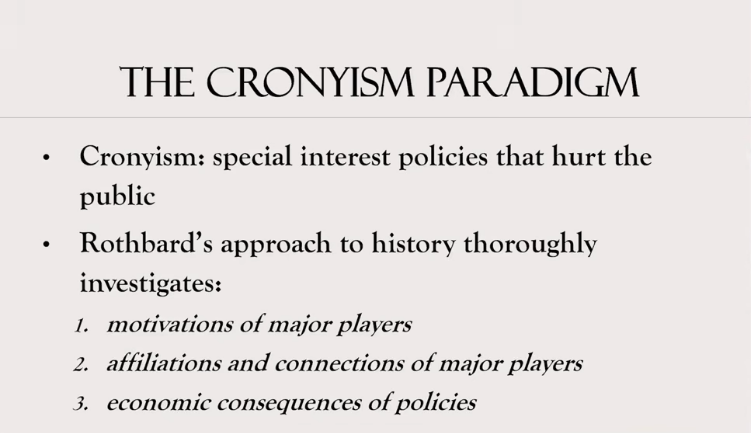
Cronyism, the actual term, refers to the umbrella term for the system of policies that benefit special interests at the public’s expense. Think of government subsidies, taxes, discriminatory regulations, new constitutions, wars, and other forms of special privilege. That’s the whole thing — they’re all special privileges. And cronyism is inherent in government because of the nature of the state and the fact that there must be a distinction between the ruling elites and the bamboozled public, or between the robbers and the robbed.
Rothbard’s method
So I want to spend the rest of my talk outlining Rothbard’s application of the cronyism paradigm to American history. We could call it the grand Rothbardian narrative of American history. He wrote it across several books and papers and discussed it at length in various lectures.
Rothbard’s method for history was both innovative and devastating in its effectiveness. In particular, Rothbard engaged in a thorough investigation of the motivations of the major players. They said they were acting for a certain reason — but why did they really act? What was in it for them? He also did a deep dive into the affiliations and connections that these actors had with businesses, unions, ideological movements, political parties, and so on. He was always trying to trace the web, so to speak. And then, third, Rothbard used economics to actually analyze the consequences of government policy. The government says this will do X — but what does it actually do?
And of course, analyzing these government policies using economics shows the harmful consequences imposed on the public. This unique approach allowed Rothbard to pen thoroughly iconoclastic histories that showed how powerful elites lobbied for and secured preferential and discriminatory policies that harmed the public. In every historical work you read of Rothbard’s, you’re always left with this very unique take that really changes how you view the historical episode.
What I want to do for the rest of my talk is jump into this grand Rothbardian history of the United States, from the founding — from the time of the American Revolution — all the way to the present, using the cronyism paradigm. We won’t be able to cover everything; some eras will be covered in more depth than others. But we will be able to paint some broad brushstrokes. And astonishingly, we’re going to do it in just three slides. That’s right — just three slides, in three hours of your time is all I’m going to need.
Early American history, 1607 to 1789
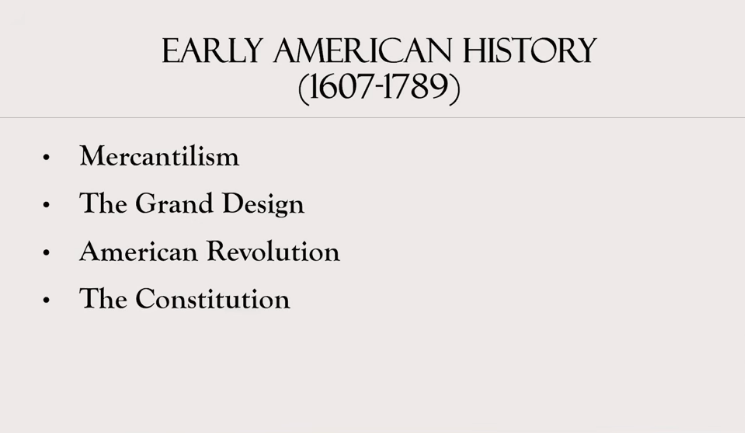
We’re going to take it from the very tippy top, starting with the colonial era. It all began in 1607, when the Virginia Company received a royal charter to establish Jamestown.
Broadly speaking, the public interest paradigm argues that governments were needed to colonize the New World. Historians recognize abuses, of course, but they say the state was still needed to get the job done and that these abuses were corrected over time. Rothbard, of course, set out to change that and to show how colonial settlement was “conceived in liberty,” so to speak.
The old order — England, Rothbard’s term — wanted to rule the colonies with an iron fist and subjugate them with mercantilism, which advocated granting special privileges to favored domestic businesses. The goal was to strengthen the mother country, England, at the expense of the colonial satellites and rival countries like France. And in a profound sense, all future systems of cronyism in America, all the way to the present, are just different forms of mercantilism, dressed in new jargon and better public-interest rhetoric.
Examples of mercantilism in the colonial era include monopoly corporate charters and the Navigation Acts — the latter being restrictive regulations and subsidies designed to benefit English shippers and shipbuilders. Fortunately, though, as Rothbard pointed out, due to a series of accidents — civil war in England followed by the Glorious Revolution, England’s preoccupation with European wars, the sheer abundance of space in the New World, colonial rebellion, and even a deliberate policy of salutary neglect by some leading British officials — mercantilism never really took hold in America. By the mid-1700s, Rothbard could say that Americans were de facto independent, and economic growth in the colonies flourished as a result.
The Grand Design and the Revolution
But then, in the 1750s, after the French and Indian War, Great Britain became the undisputed world superpower and wanted to reap the loot. They wanted to be the robbers. British officials realized the American colonists were too free and weren’t paying their share of taxes. And of course, they still had their socks — so the government was going to try to rob them.
King George III and Parliament — really Parliament — implemented what was known as the Grand Design: peacetime armies in the colonies, enforcement of existing Navigation Acts and taxes, imposing new ones, and restricting western settlement to benefit British land speculators and other interest groups.
Historians used to say, and many of them still do, that Americans were just being overly paranoid — Britain was actually being quite reasonable. The British were, in a profound sense, just beleaguered government overseers trying to make sure the rowdy Americans paid their fair share. But not according to Rothbard. He used newer historical research at the time — in the sixties and seventies — that showed Great Britain really did have a so-called Grand Design, and that they really were trying to clamp down on the colonists. The taxes Britain was proposing were lower than what we have to pay today, but the colonists recognized it as the foot in the door. Once they impose 2% taxes — 5%, 10%, 20%, 50% — that’s not far down the line.
So we all know what happened after that. As Patrick Henry famously said: give me liberty or give me death. And Patrick Henry is my favorite founding father, for reasons you can probably understand. I’ve always had a soft spot for Patrick Henry.
Then we had the American Revolution, the colonists seceded, and they kicked the British out — as we’ll be learning about today, it was really a secessionary movement. The Declaration of Independence was really a declaration of secession.
The postwar fissure and the Constitution
But as Rothbard taught us, a fissure emerged among the colonists. On the one hand, you had the radicals — genuine libertarians who wanted to create multiple, relatively limited governments with informal connections to each other. Think of Sam Adams in Massachusetts, Patrick Henry in Virginia, Thomas Jefferson in Virginia.
On the other hand, you had the reactionary conservatives, as they were known — the reactionaries and later the nationalists — who wanted to create an American-administered mercantilism. They were just upset that they couldn’t help administer Britain’s mercantilism. You had the Philadelphia merchant Robert Morris, General George Washington, and we can’t forget Washington’s aide, Alexander Hamilton.
The nationalists wanted a tariff, a national bank, and a permanent military caste through lifetime pensions. These privileges would benefit manufacturers, bankers, merchants, military officers, and government debt speculators. This was going to be a new American mercantilism — special privileges.
In the 1780s, after the war was won, the nationalists started calling themselves Federalists, and they said the new government they were proposing would be limited because of “checks and balances” and the separation of powers — of which Rothbard was not a fan. He famously called them a Montesquieu shuck — in his view, a mostly worthless item, smoke and mirrors.
So this brings us to the Constitution of 1787, seen as one of the most public-interested reforms in history. According to Rothbard, however, who engaged in a thorough analysis of the motivations of the drafters, the Constitution could actually be viewed as a crony coup. Rothbard didn’t think the Articles of Confederation — which I don’t have time to talk about — were perfect, but he said we should have stuck with the Articles instead of the Constitution. The Constitution looked limited, but in reality it was a Trojan horse, and that was the intention, since the nationalists had to get a hesitant public on board.
The backdoors to special privileges were the Necessary and Proper, General Welfare, and Supremacy Clauses. All of these would allow for higher taxes, more federal control, more spending, restrictive shipping regulations, a central bank, a standing army, generous land grants, etc. A veritable bonanza. Federalist tricks, coercion, and the promise of structural amendments that never really came out. The new Constitution was a fact by 1789, and the Federalists had taken control of the government. So cronyism, in Rothbard’s view, after a long and fitful struggle, had finally taken hold in the United States through the American Constitution. The foot was in the door, so to speak.
Middle American history, 1789 to 1896
So what comes next? What did Rothbard think came next in this narrative?
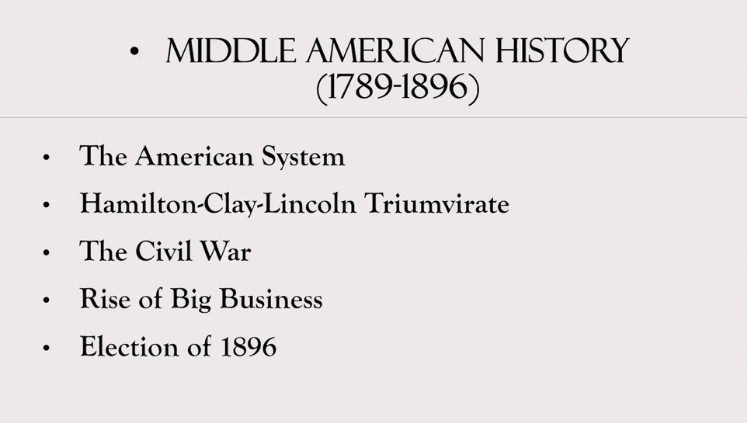
Robert Morris, Alexander Hamilton, and their Federalist followers had high hopes — particularly for the construction of a new American empire that could establish hegemony and dispense crony privileges to American business groups and elites. And they tried to do this over the next hundred-odd years. The repackaging of mercantilism in its various forms was called the American System, advocated in different forms by Secretary of the Treasury Alexander Hamilton, Congressman Henry Clay, and President Abraham Lincoln. We could call it a Hamilton–Clay–Lincoln triumvirate. They had their differences, but it was all variations on the same theme: central banking to subsidize banks and business borrowers; protective tariffs to privilege manufacturers; federally funded infrastructure to bind the country together and subsidize land speculators; imperialist diplomacy to create new colonial export markets and enlarge the empire.
But the system of special privileges that the Constitution enabled was not as easily implemented as special interests thought it would be. That was because the radical tradition of the American Revolution lived on through the Jeffersonian Republicans and the Jacksonian Democrats. As Rothbard recognized, these groups were able to strategically interpret the Constitution at various points to limit government power — and he recognized, especially, and I think this is to his credit, that the Jacksonian Democrats were really the last major laissez-faire party in the United States. They had some good success dismantling the American System: they got rid of the central bank, got rid of protective tariffs, paid off the public debt. And this dismantling of the American System, far from impeding economic growth, as the public interest paradigm asserts, actually encouraged economic growth and led to America’s industrial revolution, which truly began in the 1840s and 1850s.
Unfortunately, controversy around the annexation of Texas and the question of expanding slavery into the western territories in the 1840s sundered the Jacksonian coalition and the Democratic Party. Post-1848, there was really no more laissez-faire in the United States that could seriously make a dent in repealing cronyism. The Cleveland Democrats, of the 1880s, could at best hold back the tide, not reverse it.
The Civil War and the Neo-American System
So by the time of the Civil War, the new Republican Party had established one-party rule of the U.S. government, and under President Abraham Lincoln they could finally implement the neo-American System unimpeded. You had the National Banking Acts, designed to benefit Wall Street. Protective tariffs to privilege Midwestern and New England manufacturers. Transcontinental railroad grants to subsidize unscrupulous railroad promoters. And military force to prevent the southern confederacy from establishing their own rival American System.
All of this was done in the 1860s during the Civil War, and it all lasted in the subsequent decades. And in those subsequent decades, the 1870s and 1880s, you really saw the rise of big business as a potent force in the United States — businesses that operated across multiple states and were capitalized at tens of millions of dollars, if not more.
Some businesses emerged as a result of genuine market forces and entrepreneurial ingenuity, but others, as Rothbard pointed out, were bred by privileges granted in the neo-American System. You had railroads like the Northern Pacific, Central Pacific, and Union Pacific; Wall Street banks like J.P. Morgan and Company; you had Carnegie Steel, a prominent steel company, and so on. The goal of all of these businesses was to use the crony restrictions and subsidies they got in the Civil War to monopolize and cartelize markets, so they could restrict supply and jack up prices. That was their goal — “All right, well, now we want to use it to reap the loot.”
But problems emerged for big business. Not all was well. Against common perception, Rothbard showed there was still enough free-market competitive pressure to increase supply and lower prices. Markets were actually becoming more competitive, and new special interests were emerging to advocate for their own cronyism that was hostile to big business: antitrust, price controls, and so on and so forth.
1896 and the modern era
Many of these groups formed what became known as the populist coalition, and they captured the Democratic Party by the time of the presidential election of 1896. That’s when the Bryanite populists, led by William Jennings Bryan, kicked out the Grover Cleveland Democrats — the creation of the modern Democratic Party. When you think of William Jennings Bryan, think of Bernie Sanders, basically.
By the time of the election, Wall Street and big business, led by J.P. Morgan, realized they had to defeat Bryan and get the Republican William McKinley elected. And then they also had to change their tactics and lobby for new forms of cronyism that were a bit more sophisticated in terms of the public relations department, so to speak.
So now we get to the modern era. And yes, that’s right, I’m going to extend the modern era over 120 years and three centuries. But in all honesty, did we ever really leave the twentieth century, in a profound sense?
This is the era where cronyism has flourished the most. Economic growth and prosperity have occurred in spite of, and not because of, the penalty of government intervention. The public interest paradigm often labels the beginning of the twentieth century the Progressive Era because it was a time of great progress and reform — forward-looking and well-intentioned reformers who fought hard against resistant big business and corrupt political machines, and who fought to stop business cycles, end monopolies, reduce income inequality, and so on and so forth.
But as Rothbard showed, by actually looking at the motivations and key affiliations of major players and by using economics to analyze the consequences of progressive policies, the opposite was true. Big business, led by J.P. Morgan, was spearheading the drive. The Progressive Era should really be called the corporatist era, for it ushered in a new form of cronyism and an extension of the American System which we still live with today. It’s called corporatism: a system of government-sponsored and government-enforced cartels and monopolies, usually through regulatory agencies and commissions, in the name of curbing big business. These governmental bodies promote economic concentration and reward elites — and we’re still living under this system today, in a more modified form.
Corporatism and the corporate estate
During the Progressive Era, big business lobbied for new regulatory agencies: the Federal Reserve System, a strengthened Interstate Commerce Commission for railroads, the Federal Trade Commission, and so on — all to hurt competitors so they could restrict production and raise prices. Big business also brought in unions as junior partners and let them divvy up labor markets. They also hired court intellectuals, which led to the rise of the professional class: economists, accountants, lawyers, doctors, scientists, and so on.
So by the end of the 1920s, J.P. Morgan and Company and Wall Street and other elements of big business had successfully established the foundations of the corporate estate, which grew further in the New Deal and in the post–World War II era, as more regulatory bodies — the Securities and Exchange Commission, the Food and Drug Administration, the Civil Aeronautics Board, the Environmental Protection Agency, and so on — were created, all designed to benefit various special interests at the public’s expense.
There is another final stage in the evolution of cronyism in the United States, which, unfortunately — or tragically — Rothbard never really got around to chronicling in extensive detail, but he did provide us with many interesting clues. In a sense, this final transformation goes full circle back to England’s old-order empire during the colonial era.
The warfare-welfare state
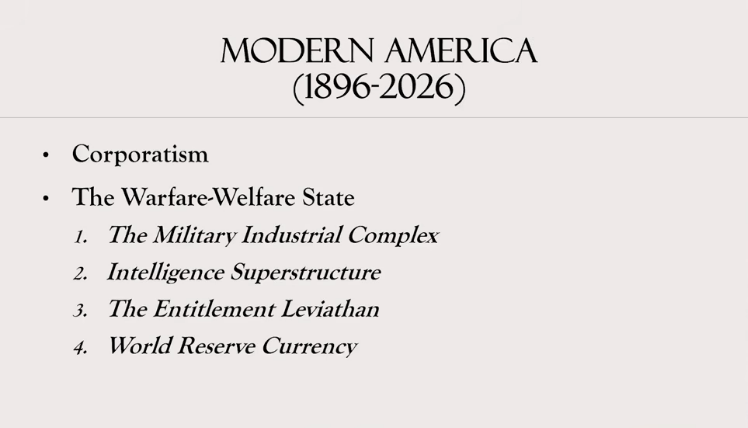
What should this final stage be called? Rothbard thought we could consider it the warfare-welfare state: a government that not only pursues corporatist policies, but also engages in massive tax and spending policies in both domestic and foreign affairs, all in the name of modern and sophisticated countercyclical fiscal and monetary policies. Important jargon — Keynesian jargon.
We saw the creation of a new power elite that dominated the United States and still does: the Eastern Establishment — large banks and manufacturing companies in the North and the Midwest — with the new rising Sun Belt from California to Florida, often connected with defense industries and so on, which we’ll talk about.
There are four key components of the warfare-welfare state that Rothbard always discussed, and when he did talk about this — and this is something I want to emphasize today in the rest of the talk.
First is the military-industrial complex, which we all know and love: a sprawling network of defense contractors, technology companies, scientists, hawkish intellectuals, and congressmen who use the Department of Defense to acquire large amounts of government funds and promote foreign policy adventures, all in the name of keeping America safe. Many of these companies are located in the Sun Belt — think of Lockheed Martin, General Dynamics. Even NASA was involved in this back in the day.
The second important component is the intelligence superstructure. This is very helpful for the military-industrial complex, but I think we could argue it’s distinct. Think of the Central Intelligence Agency, created after World War II, the Department of Homeland Security, and other governmental bodies which encourage foreign interventions, covert operations, and the spying on Americans and foreigners. These interventions are often done to benefit large multinational corporations and offload the risk of their investing in developing nations onto the taxpayer. We could talk about the Dulles brothers in the Eisenhower administration: Secretary of State John Foster Dulles and his brother Allen Dulles, who was head of the CIA. It’s kind of a little odd, but that’s how it worked back then.
Then we move on to the third component, the entitlement leviathan — this is the welfare part of the warfare-welfare state. Social Security, Medicare, Medicaid, and more programs that exist and were designed to lull the middle class into complacency. These programs require regressive taxes that hurt smaller businesses and the middle class and cause them to become dependent on the government. The Rockefeller interests, a key component of the Eastern Establishment, were often very prominent in creating Social Security, which led to Medicare and Medicaid and so on. The government cartelized and subsidized insurance industries, especially after Obamacare, is also an important adjacent sector — think of the large health insurance conglomerates, UnitedHealth Group, Aetna, and so on, that I’m sure many of us have had to frustratingly deal with over the years.
Then we have the fourth and final component of the warfare-welfare state: the world reserve currency. The dollar is dominant across the world to the benefit of American banks, financial institutions, and multinational corporations, at the expense of other countries — and, in many ways, of Americans who are encouraged to engage in risky behavior because the dollar is the world reserve currency. The institutions that benefit, of course, were Chase Manhattan Bank (now J.P. Morgan Chase), Bank of America, Citibank, Wall Street, etc., and of course the main engine of this whole component is the Federal Reserve System.
So this warfare-welfare state evolved and changed over the past, let’s say, seventy-five years — through the stagflation of the 1970s, through the financial crisis of 2008, and then of course through the Great Reset of 2020 and beyond.
Closing
So there we have it. I’m actually quite impressed I was able to get through all of that in this time. In short — or not so short — this is Rothbard’s cronyism paradigm applied to craft a grand narrative of United States history, right from the top to the bottom, from the beginning to the end. And the warfare-welfare state is what we are living in today.
Here are some books where Rothbard talks about this. We of course have the five-volume Conceived in Liberty, and we have The Progressive Era. Rothbard, unfortunately, never lived to write a complete history of the United States, especially a history of modern America, but his iconoclastic paradigm lives on. And with enough support and dedication, the grand narrative can be continued, and it can expose the crisis situations inherent in the public interest paradigm and usher in a new scientific revolution.
“Cronyism: The Rothbardian Paradigm | Patrick Newman” on youtube.
Leave a Reply