
A Derivative in Search of an Underlying Asset
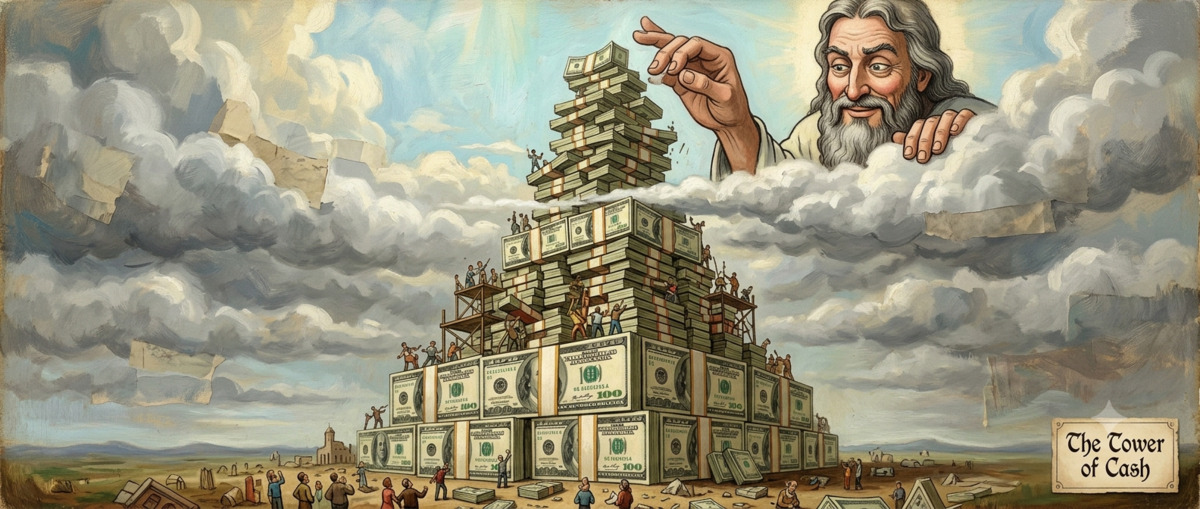
God has seen this particular mistake before.
“Now we see why governments are inherently inflationary: because inflation is a powerful and subtle means for government acquisition of the public’s resources, a painless and all the more dangerous form of taxation.”
— Murray Rothbard, What Has Government Done to Our Money?, 1963
I. What a Dollar Actually Is
Before we can discuss what’s happening to the dollar, we need to establish what it actually is — because the answer is not what most people assume.
A dollar is not money in any traditional sense. Gold is money. Silver is money. Historically, anything with intrinsic value that serves as a medium of exchange, store of value, and unit of account is money. A Federal Reserve note has none of these properties independently. It is a derivative instrument – a “debt-based” instrument. It is nothing more than an IOU.
A derivative derives its value from something else. Stock options derive their value from the underlying stock. Mortgage-backed securities derive their value from the underlying mortgages. The dollar derives its value from a specific underlying asset: the taxable productivity of Americans, enforced by the coercive power of the federal government.
The “full faith and credit of the United States” printed on every Treasury security is not an abstraction. It is a documented legal claim on future American economic output, collectible through the tax code, enforceable through courts and ultimately through armed agents. The dollar has value because the United States government can compel Americans to pay taxes in dollars, and because it maintains the institutional capacity to enforce that compulsion. Remove either the tax obligation or the enforcement capacity, and the dollar reverts to what it physically is: a piece of paper with numbers on it.
This is not a radical observation. It is the most accurate description of what a fiat currency actually is: the dollar is a derivative of the taxability of Americans. Understanding this changes everything about what we’re watching happen.
II. What Your Economics Professor Didn’t Tell You
The conventional narrative presents the pre-Federal Reserve era as chronically unstable — banking panics in 1819, 1837, 1857, 1873, 1893, and 1907 proving that gold-based systems require central bank management. The Federal Reserve Act of 1913 is presented as the solution.
The documented history runs backward. Murray Rothbard spent a Columbia University doctoral dissertation and two books demonstrating that every significant 19th century banking panic traces to a specific government intervention — not to gold. Loosely chartered state banks permitted to suspend specie payments. Federal bond-backing requirements tying the money supply to government debt. Reserve pyramiding concentrated in New York institutions. Congressional exemptions allowing trust companies to hold less reserves than national banks. Each intervention created the conditions for the next crisis. Rothbard called the pre-Civil War system precisely: “Decentralization without Freedom.”
The Federal Reserve was not the solution to monetary instability. It was the institutionalization of the interventions that caused it — with the power to repeat them indefinitely at larger scale. Mises and Hayek both publicly predicted the 1929 crash before it happened, on the basis of exactly this analysis. No Keynesian economist made the same prediction.
The case is documented in detail in the Read More section. If your economics professor told you gold causes panics, the primary sources tell a different story.
“The root of the boom-bust cycle is not in the free market, but in credit expansion engineered by authority.”
— Ludwig von Mises, 1931
III. The Austrian Prediction
Murray Rothbard spent his career documenting the mechanism by which governments systematically destroy money. What Has Government Done to Our Money?, first published in 1963, traced the decline of sound money from the classical gold standard through the Federal Reserve’s creation in 1913 through the New Deal’s domestic gold confiscation in 1933 — each intervention producing the next, each “solution” creating the conditions for the next crisis.
When Nixon closed the gold window on August 15, 1971 — ending the last formal connection between the dollar and any physical commodity — Rothbard updated his analysis in real time. His assessment was precise and unambiguous:
“The prospect for the future is accelerating and eventually runaway inflation at home, accompanied by monetary breakdown and economic warfare abroad. This prognosis can only be changed by a drastic alteration of the American and world monetary system: by the return to a free market commodity money such as gold, and by removing government totally from the monetary scene.”
Nixon framed the gold window closure as a temporary measure to protect the dollar against speculators. It was permanent. Nixon framed it as a defense of American monetary strength. It was the final severing of the dollar from any constraint on its creation. Nixon framed it as a patriotic act. Rothbard identified it as the beginning of the end of sound money.
The numbers confirm Rothbard’s verdict. On August 15, 1971, gold was fixed at $35 per ounce. As of 2026, gold trades near $4,500 — a 128-fold increase. The dollar that bought 1/35th of an ounce of gold in 1971 buys 1/4,500th of an ounce today. By the government’s own CPI measure, the dollar has lost 87% of its purchasing power since 1971. Measured against gold — the asset Nixon removed from the equation specifically because it constrained money creation — the dollar has lost approximately 99.2% of its value. These are not two different stories. They are the same story told from opposite sides of the same ledger.
Nixon called the closure “temporary.” There is nothing so permanent as a temporary government action.
The “drastic alteration” Rothbard called for never came. The alteration that did come went in precisely the opposite direction. What followed was fifty years of accelerating confirmation of everything the Austrian School predicted.
IV. 700 Years of Declining Real Rates
The death of sound money was not a sudden event. It was the endpoint of a 700-year trajectory.
The chart below, compiled by economist Paul Schmelzing from historical loan data spanning 1311 to 2018, shows something remarkable: a continuous decline in real interest rates — from 35% (Simon van Halen’s loan to Edward III in the 1340s) to approximately zero in 2018.

Real interest rates are the price of money after inflation. When real rates hit zero, money has no time value — lending earns nothing in real terms. When real rates go negative, holding money costs you.
The trajectory begins exactly when modern banking began — in the Italian city-states of the 14th century, when fractional reserve banking was invented. Seven hundred years of financial intermediation progressively extracted value from money itself, reducing the price of money to zero.
The 1971 Nixon Shock — the moment Rothbard identified as the final severing — is visible in the chart as an inflection point. After 1971, the long decline accelerated. The Volcker shock of the early 1980s temporarily reversed it, then the decline resumed faster than before. By 2018, the trend line had reached its endpoint: zero.
What happens when the price of money hits zero? Capital can no longer earn returns through lending. It must find returns elsewhere. The answer has been financial derivatives, asset price inflation, and most recently, automation that eliminates the human productive activity the dollar derives its value from entirely.
V. The Creation of Fake Money
In 1913, the Federal Reserve Act created a central bank with the power to issue currency and set interest rates. In 1971, Nixon closed the gold window — ending the last formal connection between the dollar and any physical commodity. At that moment, the dollar became a pure fiat currency: valuable because the government said so, backed by nothing except the ongoing capacity to tax.
What followed was the gradual construction of the most elaborate fake money system in human history.
The Federal Reserve can create dollars from nothing — by purchasing assets and crediting banks with reserves that didn’t previously exist. Since 2008, the Fed has created approximately $8 trillion this way. But the Fed’s creation is just the first layer.
Under the fractional reserve banking system, every dollar the Fed creates becomes the reserve basis for multiple additional dollars created by commercial banks. A 10% reserve requirement meant a $1 Fed reserve supported $10 in bank lending — $10 of money that didn’t exist before, backed by $1 of money that also didn’t exist before. Leverage of 10:1.
On March 15, 2020 — a date that will live in infamy — the Federal Reserve eliminated all reserve requirements. Not reduced. Eliminated. Set to zero. Banks can now create unlimited money from zero reserves. The 10:1 leverage became theoretically infinite.
The practical consequence: the $8 trillion the Fed created since 2008 supported, under the old 10% reserve requirement, approximately $80 trillion in bank-created money. As of 2024, the total market capitalization of all US publicly traded stocks is approximately $55 trillion. The number is not a coincidence. The market isn’t valued at $55 trillion because American companies are worth that in any productive sense. It’s valued at $55 trillion because approximately that much fake money was created and had to go somewhere.
The fake money didn’t inflate just one asset class — it inflated all of them simultaneously, because capital seeking yield under zero real rates flows into every asset with a positive nominal return. Total US real estate — residential and commercial combined — stood at approximately $27 trillion at the 2009 crisis low. It stands at approximately $65 trillion today. The physical stock of American buildings grew modestly over that period. The dollar value of those buildings increased by $38 trillion — not because they became better buildings, but because the money chasing them became cheaper and more abundant with every Fed intervention. The Fed didn’t just enable the inflation. It engineered it, purchasing $2.4 trillion in mortgage-backed securities directly to suppress rates and drive prices higher.
Cryptocurrency emerged in 2009 as a technical curiosity and achieved its first significant market value in 2013 — precisely five years into the Fed’s QE experiment, precisely when the liquidity flood had become large enough to seek entirely new asset classes to inhabit. It is pure belief derivative, with no coercive tax enforcement behind it whatsoever, no underlying productive asset, no claim on anything physical. It tracked Fed balance sheet expansion with almost comical precision — inflating to $3 trillion at peak QE, deflating with every tightening cycle. That an asset class of that magnitude materialized from nothing in the years following 2008 is not a statement about the genius of its inventors. It is a statement about the quantity of fake money that needed somewhere to go.
Gold and silver — the monetary metals that governments spent the 20th century systematically demonetizing precisely because they constrained money creation — responded as Rothbard predicted they would. Total above-ground gold was valued at approximately $4 trillion in 2008. It stands at approximately $29 trillion today — a $25 trillion increase against a 30% increase in physical supply. The other $20 trillion is the dollar’s debasement made visible in a mirror. Silver’s investable market has multiplied similarly. Both metals are telling you the same thing about the dollar. The markets understand what the Federal Reserve prefers not to state plainly.
Corporate debt exploded alongside every other asset class — US corporate bonds outstanding grew from approximately $5 trillion in 2008 to $11.5 trillion today, with the quality of that debt quietly deteriorating throughout. The lowest investment grade category — BBB, one notch above junk — now accounts for more than half of all corporate bond issuance, up from a third in the early 2000s, with the median BBB issuer carrying leverage a third higher than in 2008. Corporations didn’t borrow more because their businesses became more productive. They borrowed more because the Fed made debt artificially cheap, which made leveraged stock buybacks — borrowing money to purchase your own inflated shares — the highest-return activity available to a CFO operating in a zero real rate environment. The result is $11.5 trillion in corporate debt whose quality is inversely correlated with the duration of the cheap money that enabled it. When the rates that made it possible normalize, the BBB cliff — the mass downgrade from investment grade to junk that automatically forces institutional holders to sell — is the next forty-year invoice waiting to be presented.
The inflation that ordinary Americans experience at the grocery store and the gas pump is real but relatively modest — the CPI tells a story of 20-30% cumulative price increases since 2020, painful but not civilization-ending. This is because the fake money doesn’t primarily flow into consumer goods. Walmart’s suppliers compete globally; retail prices are disciplined by labor arbitrage and supply chain efficiency in ways that asset prices are not. The fake money flows upward into assets — housing, equities, crypto, data center debt — because assets are what the wealthy and institutional holders of newly created money actually buy. The Cantillon Effect, named for 18th century economist Richard Cantillon who first documented it, describes exactly this mechanism: those closest to the money creation capture the asset appreciation first, while those furthest from it — wage earners buying groceries — see only the eventual trickle-down price increases after the purchasing power has already been extracted. The result is that the fake money system functions as a wealth transfer mechanism of almost perfect efficiency: it inflates the assets the rich hold while only gradually raising consumer prices — the extraction made nearly invisible to those being extracted from.
Rothbard warned in 1963 that inflation is “a painless and all the more dangerous form of taxation.” By 2020, the taxation had become unlimited. The tower had no more constraints on its growth.
VI. Derivatives on Derivatives
The 2008 financial crisis was caused by derivatives on derivatives: Collateralized Debt Obligations (CDOs) were derivatives of mortgage-backed securities, which were derivatives of mortgages, which were leveraged claims on housing values, which derived their value from the productive capacity of American homeowners to make monthly payments.
When the underlying asset, American homeowners’ ability to pay, deteriorated, every derivative layer above it collapsed simultaneously. The losses propagated upward through the structure faster than any regulatory body could track, because the derivatives were deliberately opaque, deliberately complex, and deliberately distributed across institutions that were each “too big to fail.”
The critical legislative enabler: the repeal of the Glass-Steagall Act in 1999, which had separated commercial banks from investment banking since 1933. Glass-Steagall was enacted specifically to prevent banks from using depositors’ money in speculative derivative trading — the root cause of the 1929 crash. Its repeal allowed banks to operate as brokerage houses, using the full weight of the fractional reserve system as the capital base for derivatives speculation.
The response to 2008 was to paper over the system with the largest money creation in Federal Reserve history at that point. The system was not reformed. The derivative architecture was not dismantled. The banks were not allowed to fail. The executives were not prosecuted. The system was saved exactly as it was, with fake money, so it could continue doing exactly what it had been doing. What followed was Dodd-Frank — 2,300 pages of legislation passed under crisis conditions, written by the same regulatory apparatus that failed to prevent the crisis, administered by the same agencies that failed to see it coming. Its stated purpose was to end too-big-to-fail. Its actual mechanism was to institutionalize it: under Dodd-Frank’s bail-in provisions, a failing systemically important financial institution is not rescued by the government but recapitalized through its creditors — including its depositors. Under the 2005 Bankruptcy Act and UCC Sections 8 and 9, derivative and repo claims hold seniority over all other creditors, meaning in a systemic crisis the $1.5 quadrillion derivatives tower has legal priority over the deposits of state and local governments, pension funds, and ordinary account holders. The crisis transferred wealth upward. The legislation that followed transferred legal risk downward. This Ermächtigungsgesetz (Enabling Act of 1933 Nazi Germany) of American finance passed with bipartisan support and was signed into law on a Tuesday.
The Bank for International Settlements — the central bank of central banks, the primary source for global derivatives data — reports approximately $964 trillion in OTC derivatives notional outstanding as of mid-2025, with an additional $118 trillion in exchange-traded derivatives. Total regulated derivatives: approximately $1 quadrillion.
This is the floor. A 2017 peer-reviewed academic paper in the South-Eastern Europe Journal of Economics stated explicitly: “Estimates concerning the volume of the derivatives market range from 700 Trillion dollars to upwards of 1.5 Quadrillion dollars (including what is sometimes referred to as shadow derivatives)… Along with credit default swaps and other exotic instruments, the total notional derivatives value is about $1.5 quadrillion — about 20% more than in 2008, beyond what anyone can conceive, let alone control if unexpected turmoil strikes.”
Global gross assets across all major classes grew by approximately 50-70% between 2017 and 2025 — roughly double the rate of global GDP growth over the same period. The $1.5 quadrillion derivatives figure from 2017 would have kept pace proportionally, arriving somewhere between $2 and $2.5 quadrillion today. The productive economy that underlies all of it grew at half the rate of the paper built on top of it. The tower grows faster than its foundation by design — that is precisely what zero real rates engineered.
To put this in perspective: global GDP is approximately $110 trillion. The derivatives market — conservatively estimated at $1 quadrillion in reported instruments, and likely $2 to $2.5 quadrillion when unregulated and shadow instruments are included — is somewhere between eighteen and twenty-three times the entire productive output of the world economy in a single year. Since 2017 the asset base those derivatives nominally rest on has itself inflated by 50-70%, meaning the tower grew faster than its already-inflated foundation. When the music stops, only one chair will be taken for every twenty-two people left standing. The Cantillon Effect runs in reverse on the way down exactly as it runs forward on the way up: those closest to the exit get the chairs. Those furthest from it are left holding a blockchain entry pointing to a 404 error.
The BIS also reports the “gross market value” — what it would actually cost to replace all outstanding contracts at current prices: $21.8 trillion. That is what the tower is actually worth if you tried to cash it in. The gap between $1.5 quadrillion and $21.8 trillion is the measure of the fake.
The shadow derivatives and rehypothecation chains — where the same underlying collateral is pledged simultaneously across multiple contracts — do not appear in official statistics by design. The opacity is not accidental. The accountability gap was the point.
VII. Derivatives All the Way Down
The CDO is not the end of the tower. It is merely the layer visible enough to be regulated.
Above it — or perhaps beside it, in the same conceptual space — sits an entire ecosystem of newer derivative instruments that have emerged since 2008, each one a further abstraction from any underlying productive reality.
Prediction markets — Polymarket and Kalshi, the two dominant platforms — allow users to trade contracts on the outcomes of future events: elections, Federal Reserve decisions, geopolitical crises, sports results, whether a specific country will be at war by a specific date. Combined monthly trading volume reached $24 billion in April 2026, up from less than $5 billion in September 2025. The New York Stock Exchange’s parent company, ICE, invested $2 billion in Polymarket at an $8 billion valuation in late 2025 — the clearest signal that prediction markets have been institutionalized as a legitimate asset class. A Columbia University study estimated that approximately 25% of Polymarket’s historical volume was wash trading — artificial volume created by trading with oneself to inflate apparent market depth. The fake volume problem that runs through the entire derivatives tower appears at every layer, including the newest ones.
A prediction market contract is a derivative of a probability, which is itself a derivative of collective belief about a future event, denominated in dollars, which are derivatives of taxable American productivity. The chain of abstraction: four layers between the “asset” and anything physically real. The top open markets on Polymarket as of June 2026 are geopolitical bets on the US/Iran/Israel conflict — people trading fake money on whether the Strait of Hormuz closes, which affects the helium supply, which affects TSMC, which affects the AI data center buildout, which affects the $55 trillion stock market capitalization, which is built on the $8 trillion Fed balance sheet, which is a derivative of American taxable productivity being automated out of existence. The circularity is complete.
NFTs — Non-Fungible Tokens — are the tower’s most honest expression and its most spectacular recent failure. “Fungible” means interchangeable, tradeable, exchangeable for equivalent value. “Non-fungible” means none of those things. The asset class announced its own worthlessness in its name and still generated $25 billion in trading volume in 2021. What was being traded was a blockchain entry certifying that a specific wallet address “owned” a specific digital file — not the file itself, which can be copied infinitely, not any legal copyright claim, which the NFT explicitly doesn’t convey, and in many documented cases not even the file’s continued existence, since the URL the NFT certified now returns a 404 error. The NFT persists on the blockchain. The image it certified ownership of is gone. By 2023 trading volume had collapsed 95%. The dollar, when belief fails, still has the IRS and armed agents. The NFT, when belief failed, had a 404 error and a name that always meant worthless.
Everyone and their doge now has their own cryptocurrency. Bitcoin began as a single asset in 2009. Humanity responded by creating over 50 million variants of it — 49 million of which are now dead or abandoned — while Bitcoin and Ethereum still account for 75% of the entire market’s value. The 49 million dead coins are the NFT 404 error at industrial scale: belief formed, belief evaporated, blockchain entry persists.
Leveraged ETFs on cryptocurrency prices represent the next layer: a traditional financial instrument — the exchange-traded fund — applied to a derivative asset — cryptocurrency — with leverage multiplying both the gain and the loss. A 3x leveraged Bitcoin ETF doesn’t own Bitcoin. It owns derivatives contracts on Bitcoin’s price, multiplied by three. It is a derivative of a derivative of a belief system, available in your 401K.
Prediction markets on AI model benchmark scores — whether GPT-5 will outscore Claude on a specific test by a specific date — now trade real money on outcomes that the same AI companies being bet on can influence directly by adjusting their benchmark preparation. The underlying asset is a number that the house can move.
Carbon credits — certificates representing the theoretical prevention of a ton of CO2 emissions that may or may not have occurred — have generated a $2 billion market in fraudulent offsets, where the underlying asset is a counterfactual that cannot be audited.
The pattern is consistent: find a belief, issue a certificate, trade the certificate, leverage the certificate, package the leveraged certificates into a fund, and sell the fund to the 401K pipeline. The underlying asset becomes progressively more theoretical at each step until it disappears entirely — leaving only the certificate, the fee, and eventually the 404 error.
Dead Peasant Insurance
The most viscerally disturbing layer in the entire ecosystem requires no financial sophistication to understand, only a functioning moral sense. COLI — Corporate-Owned Life Insurance — known in the industry by its documented nickname “dead peasant insurance” — allows corporations to take out life insurance policies on their own employees, name themselves as the beneficiary, and collect the death benefit when the employee dies. The employee often doesn’t know the policy exists. The corporation has a direct financial interest in the employee’s death that the employee is never told about. Walmart, Dow Chemical, and major banks used COLI extensively throughout the 1990s and 2000s, collecting tax-advantaged death benefits on former employees years after they left the company. Congressional testimony documented the practice. The IRS eventually restricted the most profitable tax treatment. The practice continued in modified form.
The secondary market — STOLI, Stranger-Originated Life Insurance — extended the logic further. Investors identify elderly or terminally ill people, purchase their existing life insurance policies for a lump sum, and collect the death benefit when they die. The investor’s return depends entirely on the insured dying sooner rather than later. Goldman Sachs developed a trading platform for bundled life settlement securities in 2009 — immediately after the CDO collapse — using the identical securitization architecture that had just destroyed the mortgage market, applied to tranches of purchased death benefits rated by the same agencies that had rated the CDOs.
The derivative chain: a human life → a life insurance policy → a purchased death benefit → a bundled tranche of purchased death benefits → a rated security sold to pension funds. Five layers between “a person exists” and “an institutional investor holds a derivative of the probability of that person’s imminent death.”
No malice required at any individual point in the chain. Each participant optimizes for their own return within the rules of the game as they find them. The button gets pressed. The reward is a paycheck. The consequence — the person who died — is somewhere else.
That is the spectrum of the fake money tower in one paragraph: the dollar (derivative of coercive taxing power — durable), prediction markets (derivative of event probabilities — growing rapidly), NFTs (derivative of shared belief with no coercive backing — collapsed 95%). The durability of the fake money correlates precisely with the coercive capacity behind it.
PKD saw it coming in 1981: “They are poisoned as if with metal, metal confining them and metal in their blood.” The metal became paper in 1971. The paper became digits in the 1990s. The digits became prediction contracts and JPEG certificates in the 2020s. Each abstraction further from any underlying reality. Each layer requiring more faith in the shared hallucination that the number means something.
Derivatives all the way down — and the only ones that survive are the ones with a gun behind them.
VIII. The Apotheosis
“If God did not exist, it would be necessary to invent him.”
— Voltaire, 1768
The dollar has become the god needed to replace the ones man abandoned. It fulfills every theological requirement: universal authority, the measure of all value, the object of daily devotion, a priesthood to administer it, and the promise that faithful observance will be rewarded. Apotheosis is not a metaphor. It is the precise term for the elevation of a human invention to divine status. The Federal Reserve is the Vatican. The Treasury is the reliquary. Every price is a prayer.
Gold backing: severed in 1971.
Reserve requirements: eliminated in 2020.
Connection to productive lending: severed when real rates hit zero in 2018.
Glass-Steagall’s protection of depositors: repealed in 1999.
Connection to human labor as the underlying: being severed now through automation, as documented in the companion article “The Real Replacement.”
The apotheosis is complete when the map is worshipped as the territory. The dollar is worshipped as money. The $1.5 quadrillion in derivatives is worshipped as wealth. The $55 trillion stock market is worshipped as the value of American enterprise. None of these numbers correspond to anything physically real in the way the map implies. They are entries in databases, claims on claims on claims, derivatives of derivatives of derivatives.
The visualization of $1 trillion in $100 bills stacked on pallets next to a Boeing 747 is itself the apotheosis: it assumes the money exists in physical form somewhere. It doesn’t. It never did. It’s digits in computers — and not even particularly stable digits, since the same dollar can be in multiple banks’ ledgers simultaneously through the magic of fractional reserve accounting.
It’s all just digits. Poof.
Consider what happens when the music stops. The derivatives tower stands at approximately $2 quadrillion in notional claims. The global Rothbardian True Money Supply — genuine money, immediately redeemable at par on demand, stripped of savings deposits, money market funds, and time deposits that are credit instruments rather than money itself — stands at approximately $30-40 trillion. Divide one by the other. One real chair exists for every fifty to sixty-seven people standing. The M2 money supply, which includes instruments Rothbard would not recognize as genuine money, produces a more flattering ratio: one chair for every twenty people. Neither number is survivable for the people without chairs when the music stops.
Every person in the queue believes they are closer to a chair than the person standing next to them. The pension fund manager believes the sovereign bonds are chairs. The sovereign bond holder believes the central bank guarantee is a chair. The central bank believes it can create chairs from nothing — which is precisely what it has been doing since 1913, and with increasing abandon since 1971, and without any formal limit since March 15, 2020. The derivatives holder believes the counterparty has a chair. The counterparty believes the same thing in reverse.
Most of the chairs were never real. The gap between $30 trillion in genuine money and $2 quadrillion in derivative claims is $1.97 quadrillion in imaginary chairs, distributed across the global financial system with institutional solemnity, marked to market daily, carried on balance sheets as assets, and believed in with the devotional intensity that Voltaire’s invented god has always commanded from its worshippers.
The apotheosis is complete when the imaginary chairs are worshipped as real ones.
Rothbard saw it coming in 1963. The 700-year chart showed it in data going back to 1311. The Nixon Shock of 1971 was the inflection point Rothbard identified in real time. The 2008 crisis was the preview. The elimination of reserve requirements in 2020 was the removal of the last formal constraint. The $1.5 quadrillion in derivatives is the current state of the tower.
IX. The Tower of Babel
The dollar as derivative of American taxable productivity faces a specific and documented problem: the underlying asset is being systematically eliminated.
“The Real Replacement” documented the automation wave displacing human labor. The AI capex boom of 2023-2026 is accelerating it. When human labor is no longer the primary input to production, the taxable income that gives the dollar its value shrinks. The derivative becomes worth less. The response to dollar devaluation is more money creation, which further devalues the dollar, which requires more money creation. The Jevons Paradox applied to monetary policy: as the cost of creating money approaches zero, money creation accelerates, which makes money worth less, which requires more creation.
The endpoint was visible in the 700-year chart: zero. The price of money reaches zero when the underlying productive activity it derives value from has been fully captured by the derivative layer. At zero, the derivative must be replaced by something else — something that doesn’t require human productive activity as its underlying asset.
The cashless control grid documented in “The Digital Control Grid” is not the replacement for the dollar. It is the replacement for the need to have an underlying asset at all. Programmable money in a CBDC doesn’t need to derive its value from taxable productivity. Its value derives from the coercive capacity to require its use — the same underlying as the dollar, but stripped of the pretense that the coercion is grounded in anything beyond itself.
The Tower of Babel story is usually read as a story about hubris — builders reaching too high, punished by divine intervention. The more precise reading for our purposes is linguistic: the builders had a common language, and when it was taken from them, the project didn’t collapse dramatically. The builders simply stopped understanding each other. Trade became impossible. The integrated civilization that shared language had made possible dissolved into fragments.
The dollar is the lingua franca of global commerce — not because it is intrinsically superior to any alternative, but because enough powerful parties adopted it that everyone else had to learn it to trade. Bretton Woods in 1944 was the moment the world agreed to conduct international commerce in American, the same way medieval merchants agreed to conduct Mediterranean trade in the original lingua franca — a pidgin of Italian, French, Spanish and Arabic that nobody spoke natively but everyone used commercially.
When the dollar breaks down — not if, when, given the 700-year chart and the $1.5 quadrillion in derivatives built on top of it — every nation will revert to its own monetary language. China speaks yuan. Russia speaks rubles backed by commodities. The Gulf states are negotiating between petrodollars and petroyuan depending on who controls the Strait of Hormuz this week. The BRICS nations are actively constructing an alternative monetary vocabulary. The dollar’s share of global reserves has already declined from over 70% in 2000 to approximately 58% today — not a crash, a linguistic drift. Other monetary dialects gaining speakers.
The Tower is not a prediction. It is already falling — slowly, unevenly, without a single dramatic moment that makes the evening news. The dollar’s share of global reserves has declined from over 70% in 2000 to approximately 58% today, a 17% reduction without a single crisis. China’s CIPS alternative to SWIFT processed $12.5 trillion in 2023, up 50% year over year. Russia’s SPFS connects over 150 banks outside the dollar system. India settles oil trades in rupees. Saudi Arabia accepts yuan. The petrodollar arrangement that made dollar dominance self-reinforcing since 1973 is visibly fraying at every edge. BRICS nations representing over 40% of world GDP are building parallel payment infrastructure specifically because SWIFT revealed it had a gun behind it pointing in a specific direction. The lingua franca didn’t fail. It was weaponized — and the moment it was weaponized, every nation with the capacity to build an alternative had a compelling reason to do so. They are building. The Tower won’t fall. The builders are simply learning to speak different languages — and some of them are already fluent.
The tower builders are already moving on to other towers. The integrated global economy that the dollar made possible — the same integration that created the single point of failure at TSMC, the helium dependency, the InP wafer bottleneck — will dissolve not through dramatic collapse but through the progressive loss of a shared unit of account that everyone trusted enough to use.
That is the Babel moment. Not the tower falling. The common language breaking down.
Rothbard called it in 1971: “accelerating and eventually runaway inflation at home, accompanied by monetary breakdown and economic warfare abroad.”
He was right about the inflation. He was right about the monetary breakdown. The economic warfare abroad is the current state of the Persian Gulf, the Strait of Hormuz, and every sanction regime that uses dollar exclusion as a weapon.
The drastic alteration he called for never came. The one that did come went the other way.
This is the heart of their misfortune: service in error, to a wrong thing.”
— Philip K. Dick, The Divine Invasion, 1981
Read More
Austrian History of Pre-Fed Banking Crises
Murray Rothbard, The Panic of 1819. Columbia University Press, 1962. Free PDF: mises.org
Murray Rothbard, A History of Money and Banking in the United States. Mises Institute, 2002. Free PDF: mises.org
Joseph Salerno, “The Panic of 1893: An Austrian View.” Mises Institute, 2026. mises.org
Rothbard — Primary Sources
Murray Rothbard, What Has Government Done to Our Money? Ludwig von Mises Institute, 1963 (updated through 1990s). Free PDF: cdn.mises.org/what-has-government-done-to-our-money.pdf
Murray Rothbard, “The Case for a Genuine Gold Dollar.” cdn.mises.org/the%20case%20for%20a%20genuine%20gold%20dollar_rothbard_0.pdf
700-Year Interest Rate Chart
Paul Schmelzing, “Eight centuries of global real interest rates, R-G, and the ‘suprasecular’ decline, 1311–2018.” Bank of England Staff Working Paper No. 845, January 2020. bankofengland.co.uk
Derivatives Data — Primary Sources
Bank for International Settlements, OTC Derivatives Statistics, mid-2025. bis.org/statistics/derstats.htm
ISDA, “Key trends in the size and composition of OTC derivatives markets in the first half of 2025.” isda.org
Aleksandra Stankovska, “Global Derivatives Market.” South-Eastern Europe Journal of Economics, Vol. 15, No. 1, 2017. DOI: 10.1515/seeur-2017-0006
Nixon Shock — Primary Sources
Federal Reserve History, “Nixon Ends Convertibility of U.S. Dollars to Gold and Announces Wage/Price Controls.” federalreservehistory.org/essays/gold-convertibility-ends
Nixon’s August 15, 1971 address: available at the Miller Center, University of Virginia. millercenter.org
Glass-Steagall Repeal
Gramm-Leach-Bliley Act, Public Law 106-102, November 12, 1999. congress.gov
Reserve Requirements Eliminated
Federal Reserve Board, “Reserve Requirements,” March 15, 2020. federalreserve.gov/monetarypolicy/reservereq.htm
UCC / Bail-in architecture:
David Rodgers Webb, The Great Taking. thegreattaking.com — the ownership architecture documented in detail.
Ellen Brown, “Casino Capitalism and the Derivatives Market.” ScheerPost, January 2024. scheerpost.com/2024/01/15
Global asset growth 2017-2025:
Ocorian Global Asset Monitor, March 2026. ocorian.com — $246.8 trillion in eight major asset classes at end of 2024, up $25.5 trillion in one year.
Jesse Myers, global gross assets estimate ~$900 trillion, 2024. Referenced at sweatyourassets.biz
Global government debt:
Visual Capitalist, “Global Government Debt Hits $111 Trillion,” March 2026. visualcapitalist.com
Cryptocurrency count:
CoinMarketCap / various trackers — 50 million tokens created, 49 million dead or abandoned. demandsage.com
Companion Articles
“The Real Burden of Government” — the Birkarlar as the original extraction mechanism.
“A Misallocation of Capital” — where the fake money goes.
“The Real Replacement / After Work” — the automation of the underlying asset.
“The Digital Control Grid” — the programmable money replacement architecture.
“War Is a Racket, Updated” — the economic warfare Rothbard predicted.
Leave a Reply