
The Russian Mirror
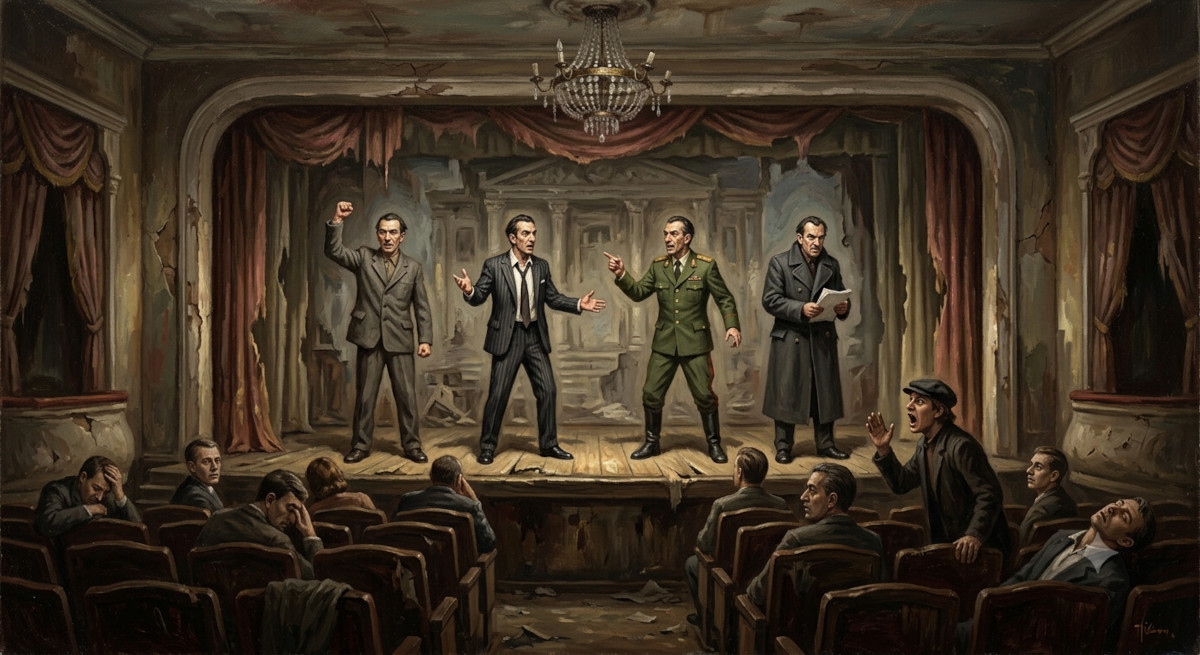
“Not this play again!”
“We are being de-modernized.”
— Russian lawyer, 1990s, as quoted by Catherine Austin Fitts
Series Context
This article is part of the “In a Stranger Land” series. It should be read alongside:
- Super-Governmental Organizations: Pseudopods of the Blob — documents the American privatization scam operating on a productive base larger than anything the Soviet reformers had access to
- The Financialization Coup — documents the extraction mechanism and the capital flight CAF’s insider named in April 1997
- The Apotheosis of the Dollar — documents the monetary architecture that made the American version possible
I. The Horrifying Epiphany
It happened slowly, in a London conference room, over the ordinary business of comparing notes.
Catherine Austin Fitts had spent years by then moving between worlds that weren’t supposed to overlap — a former Assistant Secretary of Housing at HUD, an investment banker, someone who’d watched capital move through both the federal government and Wall Street from the inside. She was in London for a private conference, the kind where people from different regions and different institutions sit across from each other and, without quite meaning to, start comparing what they’ve each separately seen.
What she heard didn’t come from a whistleblower or a leaked document. It came from colleagues describing, country by country, region by region, a pattern each of them had assumed was local to wherever they happened to be working. Russia. Eastern Europe. Asia. Latin America. And then, unmistakably, America. Different currencies, different governments, different languages for the same transaction — and underneath every one of them, the same handful of accounting firms. The same law firms. The same investment banks. The same small circle of people, moving through jurisdiction after jurisdiction, doing something that looked, once you saw it laid out across five continents rather than confined to one, less like the natural churn of global finance and more like a single operation running in parallel.
She wrote it down later, in words that haven’t lost their force:
“Slowly, as the pieces fit together, we shared a horrifying epiphany: the banks, corporations and investors acting in each global region were the exact same players. They were a relatively small group that reappeared again and again in Russia, Eastern Europe, and Asia accompanied by the same well-known accounting firms and law firms. Clearly, there was a global financial coup d’etat underway.”
That sentence is the spine of this entire article, and it’s worth being precise about what it does and doesn’t claim. It is not an argument that communism failed on its own terms, or that markets are inherently corrupt, or that any particular ideology is to blame. It is a factual observation about personnel and mechanism: an identifiable, relatively small group of institutions — the same names, doing the same kind of work, using the same tools — operating in every jurisdiction where the legal and regulatory infrastructure could be captured, regardless of what that jurisdiction called its economic system.
This matters because it is not what most Americans have been led to believe. The standard account of the Soviet collapse is a morality play: a corrupt, inefficient system finally buckled under the weight of its own contradictions, and a free market — however roughly applied — cleaned up the wreckage. It’s a comfortable story, because it comes with a built-in immunity clause. If Russia’s catastrophe was a communist problem, it can’t be an American one. The ideology is the protection.
This article exists to test that immunity clause against the documented record — not by arguing with it, but by laying the record next to it and letting the same players, the same firms, the same methodology, speak for themselves. What CAF glimpsed in that London conference room wasn’t a story about Russia. It was a story about a technique, and the fact that Russia happened to be where she was standing when she first recognized it.
Key primary sources:
- CAF, “Financial Coup d’État,” Solari Report, 2001/2009
- CAF, Schectman interview, January 2026
- Karen Dawisha, Putin’s Kleptocracy, 2014
- David Hoffman, The Oligarchs, 2002
- Paul Klebnikov, Godfather of the Kremlin, 2000
II. The Russian Patient — Before the Operation
What Russia actually looked like before 1991 — not the propaganda version, but the documented baseline:
- Male life expectancy: 64 years
- Industrial production: functioning, if inefficient
- Pension system: intact
- Healthcare: universal if imperfect
- Housing: provided
- Literacy: near-universal
- Food security: maintained
It’s important to establish what was destroyed. The de-modernization is measured from the documented baseline, not from an imaginary Soviet utopia.
The Soviet economy’s genuine problems — inefficiency, lack of price signals, technological stagnation — were real and documented. However, the crisis Russians experienced after 1991 was not a consequence of communist inefficiency. It was a consequence of engineered wealth extraction.
The baseline isn’t only statistical. Dmitry Orlov — a Russian-American engineer who made extended visits to the USSR through the late 1980s and early ’90s, then watched it come apart — is a direct eyewitness to this “before” state, not a theorist reconstructing it from data after the fact. His account in Reinventing Collapse corroborates the World Bank and Eberstadt figures from the ground: a functioning, if inefficient, society — not the caricature the “stupid commies deserved it” framing requires as its starting point.
Key primary sources:
- World Bank development indicators, USSR/Russia 1985-1995
- Nicholas Eberstadt, AEI, demographic analysis
- Novosibirsk Institute of Social Research, village documentation
- Dmitry Orlov, Reinventing Collapse: The Soviet Example and American Prospects, New Society Publishers, 2008 (2nd ed. 2011) — eyewitness account of the pre-collapse baseline
III. The Same Players
The operational cast of characters in the Russian privatization — named, documented, cross-referenced with their appearances in other jurisdictions:
The Harvard advisers: Jeffrey Sachs — shock therapy architect, USAID-funded Andrei Shleifer — Harvard economics professor, personally invested in the Russian market he was paid to objectively advise on Jonathan Hay — Harvard Institute for International Development, personally invested
US Justice Department lawsuit: Harvard paid $26.5 million to settle fraud charges. Shleifer personally paid $2 million. The self-dealing was documented, prosecuted, and settled — then largely forgotten.
The accounting firms: Price Waterhouse, Arthur Andersen, KPMG — the same firms appearing in every jurisdiction CAF identified in London.
The banks: Citibank, Credit Suisse First Boston, Merrill Lynch — providing the financial infrastructure for capital movement offshore.
The capital flow: Out of Russia → through Cyprus (documented offshore routing) → into New York Fed member banks → reinvested in the debt bubble the CalPERS president described as the destination in April 1997.
The same banks CAF identified at HUD. The same mechanism she watched operate in American communities. The same capital flight her insider described as scheduled “for the fall.”
Key primary sources:
- US DOJ lawsuit against Harvard/Shleifer: United States v. Harvard, Shleifer, and Hay
- Senate Foreign Relations Committee, Kerry Report, 1992 — BCCI and Russian money flows
- Paul Klebnikov, Godfather of the Kremlin: The Decline of Russia in the Age of Gangster Capitalism, Harcourt, 2000 — the deepest reporting on Berezovsky and the oligarch emergence; Klebnikov was murdered in Moscow in 2004, reportedly for this work
- Marshall Goldman, The Piratization of Russia: Russian Reform Goes Awry, Routledge, 2003 — specifically critical of the Harvard advisory team’s role
- David Hoffman, The Oligarchs — documents the individual oligarchs and their Western banking relationships
IV. The Privatization Scam
Privatization, as an idea, is not the villain of this story. Moving productive assets out of state hands and into private ones — exposed to price signals, competition, and the discipline of profit and loss — is a defensible, even necessary correction to the stagnation and misallocation that a command economy produces almost by design. Properly done, privatization should have made Russian enterprises more efficient, more responsive to actual demand, and more capable of generating the wealth an impoverished population badly needed. That is not what happened. Privatization was the excuse attached to a mechanism engineered to transfer ownership at the fastest possible speed to the smallest possible number of already-connected hands — a process closer to confiscation than to a “return to capitalism”.
The voucher program turned into a mechanism by which state assets worth trillions were transferred to oligarchs.
Every Russian citizen received a voucher representing their equal share of state enterprises — the democratization of capital, as presented. It wasn’t. You can’t eat a voucher. Within months, most vouchers had been purchased from desperate, hungry citizens for cash or vodka at a tiny fraction of their face value by people with capital and connections to accumulate them.
The documented prices:
- Gazprom — the largest natural gas company in the world — privatized at a valuation of $228 million. Current value: hundreds of billions.
- Norilsk Nickel — world’s largest nickel producer — acquired for $170 million in a rigged “loans for shares” auction. Current value: tens of billions.
- Yukos Oil — acquired by Mikhail Khodorkovsky for approximately $350 million. Peak valuation before Putin’s seizure: $40 billion.
These are not rounding errors. They are the documented prices at which a country’s productive wealth was transferred from its population to a small group of connected insiders — prices that could only exist because the “market” for these assets was controlled by the same people acquiring them.
The loans-for-shares scheme: The Russian government, short of cash, borrowed from the oligarchs using state enterprises as collateral. When the government “defaulted” on schedule, the oligarchs acquired the collateral. The default was the plan. The loans were the mechanism. The collateral was always the point.
The American parallel: The SGO article documented the American version: privatization as piracy, government assets transferred to private investors at below-market prices, private liabilities shifted back to government at no cost to the private liability holder. Same mechanism. Different scale. Fifty years instead of four. Obscured by the complexity of contractor networks, implementing partner NGOs, and the mandate economy rather than visible voucher auctions.
Key primary sources:
- Klebnikov, Godfather of the Kremlin — voucher privatization and oligarch emergence documented in detail
- Dawisha, Putin’s Kleptocracy — loans-for-shares documented
- Hoffman, The Oligarchs — individual asset acquisitions documented with prices
V. The Great Extraction: What Disappeared
The Privatization Scam documents how state assets changed hands. The Wealth Mirror will show how unequal the distribution of what remained became. Neither answers the harder question: how much of Russia’s actual wealth simply left, and never came back.
The most rigorous answer comes from economists Filip Novokmet, Thomas Piketty, and Gabriel Zucman, whose benchmark study reconstructed Russia’s national balance sheet from 1990 to 2015 using national accounts, tax records, and survey data — not journalistic estimation, but peer-reviewed economic forensics. Their central finding: Russia’s total national wealth barely grew at all relative to its income over this period — from roughly 400% of national income in 1990 to about 450% by 2015. What changed wasn’t the size of the pie. It was who held it. Public wealth — the state’s share, the shared property of the entire population — collapsed from 300% of national income to just 100%, falling from three-quarters of the country’s total wealth to barely a fifth of it. Private wealth absorbed almost the entire difference, rising from 100% to 350%.
The scale of what left the country entirely is even starker, and it shows up twice, in two independent measurements that agree with each other. First: the offshore estimate. By 2015, wealth held by rich Russians in Cyprus, Switzerland, and the UK amounted to roughly 75% of Russia’s entire national income — three times larger than the country’s official foreign reserves, and comparable in size to every ruble of financial wealth held by the entire Russian population still living inside the country. Second, and independently: Russia ran a cumulative trade surplus exceeding 200% of national income between 1993 and 2015 — the natural result of two decades of oil and gas exports. If that money had stayed home, Russia’s net foreign asset position should be enormous. Instead, it stood at just 26% of national income in 2015. The gap between the surplus that came in and the assets that remain is not a rounding error. It is the extraction, quantified a second way, arriving at the same conclusion as the offshore estimate: roughly half of everything Russia earned from its own resources during this period is unaccounted for inside the country.
The human distribution of that gap is exact and merciless. Between 1989 and 2016, the bottom half of Russia’s population saw their real income fall by 20%. The top 10% grew by 170% over the same span. This was not a rising tide lifting some boats faster than others. It was a very large sum of money moving from the bottom half of a country to a small fraction of the top, with a substantial share of the proceeds never touching Russian soil at all.
This is the piece of the story that resists a tidy villain. The oligarchs are the visible face of Russia’s 1990s — named men, documented fortunes, eventual arrests or exile. The offshore figure Novokmet, Piketty, and Zucman reconstructed, and the missing trade-surplus billions sitting alongside it, are not reducible to a list of names. They are the aggregate signature of an entire system — bankers, accountants, lawyers, and the jurisdictions that welcomed the money without asking where it came from — functioning exactly as CAF described it in that London conference room: the same players, doing the same thing, in a currency and a country that happened, this time, to be Russia’s.
Western financial institutions didn’t just advise the heist — they profited from it directly. Harvard’s own endowment, run by Harvard Management Company, was one of only two foreign entities permitted into the 1995 loans-for-shares auctions, walking away with stakes in Novolipetsk steel and Sidanko Oil. That same endowment stands at $56.9 billion today — effectively its own sovereign wealth fund, run by a university. Independent researchers have put Russia’s total illicit financial outflows during this era at over $200 billion. The Western entities that laundered the money undoubtedly made their “percentage”. Precisely how much is unknown, but what counts is the direction the money flowed, and who was standing on the other end of it.
Key primary sources:
- Filip Novokmet, Thomas Piketty, and Gabriel Zucman, “From Soviets to Oligarchs: Inequality and Property in Russia, 1905-2016,” NBER Working Paper 23712, 2017.
- Novokmet, Piketty, and Zucman, conference presentation, First WID.world Conference, December 14, 2017 — source of the exact public/private wealth and trade-surplus figures.
VI. The Human Cost
The numbers the “stupid commies deserved it” framing prevents the American audience from absorbing:
Life expectancy: Male life expectancy: 64 in 1990, 57 by 1994. Seven years lost in four. No war. No famine in the traditional sense. The largest peacetime male mortality catastrophe in recorded history outside of epidemic disease.
The number alone — seven years, in four — doesn’t convey why the collapse fell so specifically and so heavily on men. In a culture where a man’s basic social role was to provide — to be the one who brought home a wage, kept the family fed, held a stable place in a functioning system — the sudden and total removal of that role didn’t just cost income. It cost identity. A man with no job, no wage, and no prospect of either isn’t only poor. He’s been told, in the most direct way an economy can tell someone, that he is no longer needed. That is a psychological injury as much as an economic one, and it shows up exactly where the data says it did: not primarily in women, who could still garden, barter, and hold a household together, but overwhelmingly in men who drank themselves to death.
Excess mortality: 3-6 million excess deaths above baseline in the 1990s — documented in peer-reviewed epidemiology. The Lancet’s specific finding: the mortality spike correlated with privatization pace, not with communism’s collapse per se. Countries that privatized more slowly had smaller mortality spikes. Belarus, which retained more state infrastructure, had a smaller catastrophe than Russia, which privatized fastest.
The ideological implication: If the mortality catastrophe correlated with privatization speed rather than communist ideology, then the ideology doesn’t determine the outcome. The speed and method of asset transfer determines the outcome. Which means the American ideology provides no protection against an American version — what matters is whether the asset transfer is happening, not whether the country calls itself capitalist or communist.
The documented conditions:
- Hospital supplies exhausted. Doctors unpaid for months.
- Tuberculosis resurging from near-elimination to epidemic levels.
- Pensioners’ lifetime savings worth nothing within months of hyperinflation.
- Alcoholism increased dramatically.
- Villages documented by the Novosibirsk Institute: collective farm privatized, stripped, abandoned, community without employer, food distribution, functioning economy, or exit.
- People reverting to subsistence agriculture not by choice but by necessity.
The lawyer without electricity: CAF’s account of the Russian lawyer growing food to avoid starvation — not a metaphor, not an outlier, a documented condition affecting millions of educated professionals whose skills had no market value in an economy being stripped of its productive base.
Key primary sources:
- The Lancet, “Mass privatisation and the post-communist mortality crisis,” 2009
- Nicholas Eberstadt, AEI, Russia’s Demographic Catastrophe
- UNICEF, Children at Risk in Central and Eastern Europe, 1997
- Novosibirsk Institute of Social Research, village documentation
VII. The Wealth Mirror — What Happens During the Taking
The Gini snapshot is the wrong comparison. What matters isn’t how unequal Russia and America each are today — it’s what happened to wealth distribution during the actual transfer, in both places, and who besides the visible “oligarchs” profited from it.
The Russian spike, precisely measured: Russia’s Gini coefficient stood at approximately 0.26 at the moment the USSR fell — genuinely, measurably egalitarian, whatever else was wrong with the system. By 1996, five years into privatization, it had jumped to 0.408 — one of the fastest inequality increases ever recorded for any country outside of wartime. The top 1%’s income advantage over society as a whole went from 4-to-5 times in the Soviet period to over 20 times within the decade. The top 10%’s share of national income nearly doubled during the 1990s alone, stabilizing at roughly half of everything the country earned by the early 2000s — while the bottom half of the population saw their share of national income collapse over the same years.
It wasn’t only the named oligarchs. Every dollar (or ruble) captured by Berezovsky, Khodorkovsky, and the loans-for-shares insiders had a Western counterpart profiting from the same transaction: the accounting firms structuring the deals, the investment banks routing the capital through Cyprus, the Harvard advisers personally invested in the market they were paid to objectively reform. The visible oligarch is the character the story remembers. The invisible fee, commission, and management contract is where a comparable amount of the actual extraction happened, largely undocumented because it never needed a Russian name attached to it.
The American parallel isn’t a Gini number. It’s a legal mechanism already built and waiting. Former hedge fund manager David Rogers Webb’s 2023 book The Great Taking documents, using primary legal sources — UCC Article 8 and 9 amendments quietly adopted in all 50 states, the 2005 “safe harbor” bankruptcy provisions, and the Depository Trust Corporation’s dematerialization of physical stock certificates — a five-decade legal restructuring that replaced direct ownership of securities with a weaker legal status called a “security entitlement”: a contractual claim to a pooled, unsegregated share of whatever an intermediary still holds, rather than title to specific shares. In the event of a major clearinghouse or broker insolvency, secured creditors — banks, central banks — are legally positioned ahead of ordinary account holders. Equivalent laws and regulations were passed in all Western countries demonstrating the continutiy of agenda. Some bills requiring brokers to hold client securities in segregated, unpooled accounts have been introduced in Tennessee, South Dakota, and Florida since 2024 are too little, too late. A legal architecture doesn’t need a conspiracy behind it to be dangerous. It only needs a crisis large enough to activate it — which is precisely the position Russian citizens were in when loans-for-shares “activated” in 1995-96, using legal mechanisms that had also been sitting quietly in place for years before anyone needed them.
The endpoint, properly stated: Russia’s transition converted a roughly 4-to-5x elite income advantage into a 20x-plus advantage inside a single decade, through mechanisms — vouchers, rigged auctions, capital flight — that were each individually legal at the moment they were used. America’s own legal architecture for a comparable transfer is already built, tested only at small scale so far, and waiting on the crisis that would activate it at scale. The Russian Mirror’s lesson here isn’t a percentage. It’s that the mechanism precedes the event, every time, and is rarely recognized as a mechanism until after it’s already been used.
Key primary sources:
- World Inequality Lab, “What’s New About Income Inequality in Russia (1980-2019)?”
- European Parliament Research Service, “Socioeconomic Inequality in Russia,” 2018
- David Rogers Webb, The Great Taking, self-published, 2023 (free at thegreattaking.com)
- CAF, Financial Coup d’État, 2001/2009
VIII. The Immunity Illusion
The narrative that “stupid commies deserved it” needs to be addressed. The framing assumes that the Soviet collapse was a consequence of communist ideology, and therefore cannot happen in a capitalist country. The ideology is the protection.
Hans-Hermann Hoppe’s A Theory of Socialism and Capitalism (1989) gives us the actual metric the “capitalist vs. communist” framing lacks. Hoppe argues there are only two pure archetypes — capitalism and socialism — and that every real economy is a mixture, positioned on a continuum defined not by GDP share or income distribution, but by the degree to which private property rights are respected versus overridden. Direct state ownership, price controls, licensing, taxation, and regulation are all, in his framework, varieties of the same underlying phenomenon — differing in mechanism and degree, not in kind. And Hoppe said explicitly, in 1989, thirty-seven years before this comparison: “Even the United States, certainly a society that is relatively more capitalist than most others, is… amazingly socialist and has gradually become more so over time.” That sentence is the thesis of this entire section, written before most of the evidence below existed to support it.
Conventional accounts treat “property rights” in America as an unqualified constant, distinguishing it from Soviet expropriation as a difference in kind. It is, at most, a difference in mechanism. Fines, judgments, regulatory penalties, and civil asset forfeiture together account for a meaningful share of after-tax income Americans never really controlled to begin with — forfeiture alone has taken at least $82 billion nationwide since 2000, $57 billion of it federal, with the overwhelming majority of owners never charged with a crime, let alone convicted of one. Eminent domain, meanwhile, no longer requires a public purpose at all: the Supreme Court’s 2005 Kelo v. New London ruling held that transferring a family’s land to a private developer satisfies the Fifth Amendment’s “public use” clause so long as the government expects more tax revenue afterward — Justice O’Connor’s dissent warned that “the specter of condemnation hangs over all property,” and Justice Scalia later compared the ruling’s reasoning to Dred Scott. Susette Kelo’s own seized neighborhood, the actual grounds the case was fought over, sat vacant for the better part of a decade afterward; the promised development never came. Layer on top of this the steadily compounding restrictions on what an owner may build, rent, plant, or sell on land she still nominally “owns” — zoning, licensing, short-term rental bans, wetlands and endangered-species determinations — and the honest picture is not of a nation where property is secure until a court finds otherwise, but one where possession is provisional, subject to reversal by whichever official or private interest can currently make the better case to whichever body has final say. Soviet expropriation announced itself. The American version simply requires better lawyers.
What the Lancet finding shows: The mortality catastrophe correlated with privatization pace, not ideology. Countries that retained more state infrastructure had smaller catastrophes regardless of their ideological label. The variable that predicted the outcome was the speed of asset transfer, not the political system’s name.
What CAF’s same-players observation shows: The operators executing the Russian privatization were not Russian communists. They were Harvard economists, American accounting firms, American and European banks — the same actors who appeared in every other jurisdiction including America. They didn’t bring capitalism to Russia. They brought more efficient extraction methodology they had already been operating everywhere else.
What the American data shows: Male life expectancy declining since 2014 — the first sustained peacetime decline in American history. Deaths of despair: drug overdose, suicide, alcohol-related liver disease. Demographic most affected: working-age men without college degrees in deindustrialized regions. The same demographic. The same hopelessness. A slower curve than Russia’s 1990s catastrophe — but a curve in the same direction, driven by the same mechanism: productive economic base stripped faster than alternative opportunity develops.
The immunity illusion is not wrong that America is different from Soviet Russia. It is wrong that the difference is the protection. The difference is the speed. And the speed difference is narrowing.
Most Americans have never seen what Russia actually looks like today. The media image — Red Square, the Kremlin, Soviet-era apartment blocks, military hardware — is the architecture of a foreign policy narrative, not a documentary record of how ordinary Russians live. The Russia that emerged from the 1990s catastrophe has rebuilt its male life expectancy from 57 to 68, rebuilt its infrastructure, and produced a functioning urban society that looks, in its cafes and universities and middle-class neighborhoods, like any other European country. The population that went through hell in the 1990s has fully recovered — not because of anything the Western advisers who caused the catastrophe did, but despite them, and after they left. The same gap between media image and documented reality exists for Iran, whose capital contains upscale neighborhoods indistinguishable from comparable neighborhoods in the West, whose population produces world-class scientists and engineers, and whose lived experience of ordinary urban life bears no resemblance to the Jason Bourne location the American media uses to represent it. The selective framing is not accidental. A population that understands that Russians and Iranians are ordinary people living ordinary lives is a population much harder to mobilize for the sanctions, proxy wars, and military confrontations that serve the institutional interests documented throughout this series.
“What opened my eyes was working with a young Russian engineer at GE. He loved Putin. He owned his own house and paid 13% income tax. He had a beautiful wife and little girl. I learned that Russians and americans were identical in almost every way.
We have truly been brainwashed.”
A comment by Biff McLaurine on Substack.
IX. The De-Modernization Checklist
This section maps the documented Russian 1990s experience against documented current American trends, item by item, for an American audience inoculated against recognizing the parallel by the “stupid commies deserved it” framing. Each Russian item is paired with its American counterpart — not as prediction but as documented current reality.
The organizing structure below follows Dmitry Orlov’s five stages of collapse — financial, commercial, political, social, and cultural — from Reinventing Collapse. Orlov’s argument wasn’t just that these failures happen; it was that they happen in a specific sequence, each stage’s breakdown triggering the next as the population’s faith in the corresponding institution gives out: faith that the market will rise, then that it will provide, then that government will step in, then that one’s own community will, and finally faith in the basic goodness of other people.
Stage One: Financial Collapse
Faith that “the market shall rise forever” is lost.
Salaries not paid / workers without reliable income Russia: government workers, teachers, doctors going months without salary. Collections of glass bottles to buy bread. America: 78% of Americans living paycheck to paycheck (LendingTree 2024). Gig economy converting salaried positions to contractor relationships — no benefits, no guaranteed hours, no sick pay. The condition is the same. The speed and visibility differ.
The oligarch class emerging Russia: from zero billionaires to 86 with $500 billion combined wealth in under two decades, through documented asset stripping at pennies on the dollar. America: 66 billionaires in 1990 to over 700 today. Forbes 400 net worth from $290 billion to over $4.5 trillion — over the same fifty-year period during which the productivity-wage gap opened permanently and male life expectancy began its decline.
Stage Two: Commercial Collapse
Faith that “the market shall provide” is lost — distribution chains break down.
Infrastructure collapse Russia: hospitals without supplies, roads deteriorating, heating systems failing in apartment blocks, tuberculosis resurging from near-elimination to epidemic. America: American Society of Civil Engineers C- infrastructure grade. Lead-contaminated water in Flint, Jackson Mississippi, and dozens of other cities. East Palestine train derailment. Baltimore bridge collapse. Each individually explainable. The aggregate is infrastructure operating below first-world standard in the same regions where the productive economic base was stripped first.
Children going hungry Russia: children not eating for days. Stunted growth recorded permanently in bone density — children born during the transition measurably shorter than those born before or after. America: 1 in 5 American children food insecure per USDA. School lunch debt crisis. Documented correlation between food insecurity and academic performance, physical development, and long-term health outcomes in the same deindustrialized regions.
Stage Three: Political Collapse
Faith that “the government will take care of you” is lost — institutions lose legitimacy.
Healthcare access collapsing Russia: universal healthcare becoming fee-for-service overnight, patients paying out of pocket for hospital stays that had previously been free. America: 25 million uninsured. Medical debt the leading cause of personal bankruptcy. Life expectancy declining since 2014 specifically in deindustrialized regions — the same geography where the productive base was stripped.
The criminal class filling the institutional vacuum Russia: gangs controlling police, judges, prosecutors, jails. The “Wild Nineties” — an unprecedented amount of money and power changing hands while the population lacked the education and understanding of what was going on. America: regulatory capture of every major oversight institution by the industries being regulated — documented across the SGO article. The revolving door between Goldman Sachs and the Treasury Department. The pharmaceutical industry writing its own FDA approval guidelines. The defense contractors funding the think tanks that recommend defense spending. In Russia it was criminal gangs. In America it is done with business cards, law firms, and 501(c)(3) organizations. The outcome is the same: the institution nominally protecting the public serves the extracting class.
Institutional trust, directly measured: Gallup’s confidence-in-institutions tracking (running since 1979) found average confidence across the nine institutions measured continuously at a near-record-low 28% in 2025, with Congress and television news each drawing confidence from only around 10% of Americans. Unlike the Russian version, this collapse in legitimacy hasn’t triggered gang rule — it has triggered capture by more sophisticated, better-dressed actors instead.
Stage Four: Social Collapse
Faith that “your people will take care of you” is lost — local networks and mutual aid run out.
Suicide and deaths of despair Russia: suicide rate peaking at 40 per 100,000, alcohol poisoning, homicide concentrated in working-age men. America: Case and Deaton’s documented “deaths of despair” — drug overdose, suicide, alcohol-related liver disease — concentrated in working-age men without college degrees in deindustrialized regions. The demographic is identical. The causes are identical. The curve is slower but bending the same direction.
Prostitution and human trafficking Russia: engineers and teachers forced into sex work to feed children. HIV spreading explosively through sex work and intravenous drug use. America: documented explosion of transactional platforms — OnlyFans, sugar dating apps — as economic survival mechanisms for women who cannot make ends meet through conventional employment. Human trafficking statistics. The monetization of desperation through different channels, at different speeds, with better branding.
[See Section IX, The Resilience Gap, for the full treatment of why the American version of this stage has essentially no cushion left to run out of.]
Stage Five: Cultural Collapse
Faith in “the goodness of humanity” is lost — this is the stage Orlov thought would matter most and be hardest to reverse, precisely because it’s invisible until it’s finished.
Russia: the Soviet collapse never fully reached this stage at national scale — the informal social networks documented in Section IX absorbed the shock before trust in other people itself gave out.
America: three independent, converging lines of evidence suggest this stage is already underway here, ahead of where the checklist’s other stages would predict.
Interpersonal trust: the General Social Survey’s core trust question — “generally speaking, would you say that most people can be trusted” — has declined from 46% in 1972 to 34% as of the most recent Pew Research Center reading (2023-24), a steady, continuous decline across the full five decades of measurement, not a recent or post-pandemic development.
Literacy and the capacity for sustained, independent thought: fewer than half of American adults read a book of any kind in 2022; daily pleasure reading fell from 28% in 2004 to 16% in 2023 (Rose Horowitch, “The Age of Reading Is Over,” The Atlantic, August 2026). The stakes aren’t just cultural nostalgia — NYU philosopher Kwame Anthony Appiah’s warning, quoted in that piece, is that losing the capacity to read and write for oneself risks losing the capacity to interrogate one’s own views at all: “we’d stop being the kind of humans that we are.”
Consumer sentiment and institutional legitimacy: the University of Michigan’s Consumer Sentiment Index — the longest-running survey of its kind, with records back to 1952 — fell to 49.8 in April 2026, the single lowest reading in its 74-year history, worse than the depths of the 2008 financial crisis, worse than the 2020 pandemic shock. And the erosion isn’t confined to economic sentiment. A meaningful and vocal segment of the American political left has moved from criticizing the country’s institutions to explicitly rejecting the legitimacy of the country itself — not a fringe position anymore, but a visible, normalized one in significant parts of academia, media, and youth political culture. A population can’t be said to retain faith in “the goodness of humanity,” Orlov’s fifth stage, when a real fraction of it has concluded the entire national project deserves to be dismantled rather than reformed.
A population that can no longer trust each other, is losing the practiced capacity for sustained reasoning, and has lost confidence even in the country’s future direction is a population with steadily less capacity to even recognize the other four stages of this checklist happening to it — which may be the most dangerous item on this list, not because it’s the most visible, but because it’s the mechanism that keeps the other four invisible for as long as they’ve stayed invisible.
The summary paragraph:
The Russian de-modernization checklist reads like grotesque exaggeration until mapped against documented American trends. Workers without reliable income. Infrastructure failing. Healthcare unaffordable. Men dying of despair — the same demographic, the same causes, the same deindustrialized geography as Russia’s 1990s mortality crisis, on a slower curve. Children going hungry. Women monetizing their bodies as economic survival mechanisms. An oligarch class emerging from essentially nothing — 66 billionaires in 1990, over 700 today. The institutional vacuum filled not by criminal gangs but by regulatory capture — same outcome, better dressed. And now, a stage Russia’s faster, more visible collapse never had time to fully reach: the erosion of trust in other people and the shared capacity for independent thought that would let a population recognize any of the preceding four stages happening to it.
The Russian de-modernization happened fast enough that the population could see it. The American version is happening slowly enough that each element remains individually explainable. The aggregate, mapped against the Russian checklist item by item, is not individually explainable. It is the same process, running on the timeline that a more sophisticated legal and financial system makes possible — and a population more thoroughly inoculated against recognizing it.
Key primary sources for expansion:
- LendingTree, American Financial Distress Survey, 2024
- American Society of Civil Engineers, Infrastructure Report Card, 2021
- Anne Case and Angus Deaton, Deaths of Despair and the Future of Capitalism, Princeton University Press, 2020
- USDA Economic Research Service, Food Security in the US, 2024
- Forbes 400 historical data, 1990-2024
- Federal Reserve Distributional Financial Accounts
- SGO article companion — regulatory capture documentation
- Dmitry Orlov, Reinventing Collapse, 2008/2011 — five-stage collapse framework organizing this section
- Gallup, “Confidence in Institutions,” historical trend 1979-2025
- General Social Survey (NORC), interpersonal trust trend, 1972-2018; Pew Research Center, “Americans’ Declining Trust in Each Other,” 2023-24 reading
- Rose Horowitch, “The Age of Reading Is Over,” The Atlantic, August 2026
- University of Michigan Consumer Sentiment Index, April 2026 reading; The Conference Board, Consumer Confidence Index
X. The Resilience Gap
The Russian population survived the 1990s catastrophe for a reason that received almost no coverage in the Western press: they were prepared for it in ways that Americans are not.
Not prepared in the sense of having anticipated the specific collapse — nobody did. Prepared in the sense of having maintained, through decades of chronic shortage and systemic unreliability, the practical skills, social networks, and food production capacity that a population needs to survive when the formal economy stops functioning. You could say that decades of a poor formal economy forced Russians to develop informal alternatives.
This is Orlov’s central and most counterintuitive claim: the Soviet Union, for all its dysfunction, was in some ways better positioned to survive its own collapse than the United States would be for an analogous one — precisely because chronic Soviet scarcity had never let its population develop the total dependence on formal markets and centralized systems that American prosperity produced. Prosperity, in his argument, breeds fragility.
The dacha is the most documented example. When the heavily subsidized commercial agriculture collapsed with the demise of the USSR, dacha gardens survived and were the main reason why the Russian people did not experience a famine during the period. Russia’s own state statistics agency, Goskomstat, found that in 1999 dacha and household plots produced 38% of the country’s total agricultural output, including 91% of its potatoes, 76% of its vegetables, and 79% of its fruits — figures corroborated by a separate UNDP study showing urban gardening participation in Moscow rising from 20% of families in 1970 to 65% by 1991. One third of the Russian population owned a dacha. In the Moscow region alone, there were approximately one million such plots.
This was not survivalist preparation or deliberate resilience planning. It was a cultural practice maintained across generations — dacha gardening has been feeding the Russian people for a millennium — that happened to constitute exactly the distributed food production infrastructure needed when the centralized system collapsed. The distributed architecture of their farming system made it robust. The sharing of surplus food out of a sense of community abundance resulted in a resilient food network that is sustainable.
Beyond food, the Soviet population had maintained through necessity the practical skills and social networks that a formal market economy progressively makes unnecessary and then forgets: preserving food, repairing rather than replacing, multi-generational household networks physically proximate to each other, informal barter and exchange systems already functional because the official economy had always been unreliable. When the official economy collapsed, the informal infrastructure was already in place.
The American equivalent of any of these is difficult to find at comparable scale.
The percentage of Americans who grow any meaningful portion of their own food is in the low single digits. The American food system is among the most centralized and supply-chain-dependent ever constructed — the average meal travels 1,500 miles from farm to plate, and the COVID-era empty shelves demonstrated what even a minor supply chain disruption does to a population with no local food production backup. The practical skills that the Soviet population maintained through chronic shortage — food preservation, mechanical repair, construction, production of anything without market inputs — have been progressively deskilled out of the American population over the same fifty years the productive economy was being financialized. The social capital that Russian communities drew on during the collapse — the neighborly networks, the mutual aid infrastructure, the community organization — has been in documented decline in America since Robert Putnam measured it in 2000, and the trend has accelerated since.
What is truly newsworthy today is that we as a nation aren’t in as favorable a position if there were a similar catastrophic occurrence in our food distribution, power grid, or dollar value.
The Russian population survived the catastrophe at terrible human cost — but it survived, partly because it had not yet been fully modernized out of the practical capacities that pre-modern populations maintained as a matter of necessity. The American population has been more thoroughly modernized — more thoroughly dependent on supply chains, formal markets, centralized infrastructure, and specialized rather than general skills — than any population in history. Consequently, when the crisis hits, American de-modernization will be that much greater.
Homer Davenport, a relative of mine who lived on Clinch Mountain had no Social Security number, no formal economy dependency, was growing his own food and whittling walking sticks at 4,640 feet elevation. He was the last generation of Americans who maintained the kind of practical self-sufficiency the Russian population drew on in the 1990s. That generation is gone. What replaced it is a population whose food comes from Amazon Fresh, whose practical skills extend to their professional specialty and not much beyond, whose social networks are increasingly digital rather than physical and local, and whose experience of genuine scarcity is limited to the COVID week when the grocery store ran out of toilet paper.
The de-modernization checklist documents what is being stripped. The resilience gap documents what is not being maintained to survive the stripping. The Russian Mirror is a warning not only about what is coming but about the specific ways in which Americans are less equipped to survive it than the population that went through it first.
This is not an argument for despair. It is an argument for the dacha — for whatever the American equivalent of maintaining practical food production capacity, practical skills, local community networks, and informal mutual aid infrastructure looks like in the specific circumstances of where you live and what you can do.
CAF’s answer, “we can choose to invest our money in a system that is trying to help us thrive“, is the financial version of the same principle. The dacha is the physical version. Both point in the same direction: toward building the distributed, local, practical capacity that makes a population resilient to whatever the centralized extraction system does next.
Skin a buck. Run a trout line.
Key primary sources:
- Dmitry Orlov, Reinventing Collapse: The Soviet Example and American Prospects, New Society Publishers, 2008 (2nd ed. 2011) — source of this section’s central argument
- Goskomstat (Russian State Statistics Committee), “Private Household Farming in Russia,” 1999
- UNDP study on Moscow urban gardening participation, cited in “A ‘Dacha’ for Everyone? Community Gardens and Food Security in Russia,” 2020
- Robert Putnam, Bowling Alone: The Collapse and Revival of American Community, 2000
- Peter Jenkins, “Walk Across America“. See chapter “Homer’s Mountain” pg.66.
- Cal, “AMERICAN SPIN: 3 generations come down a mountain, to an uncomprehending world below“
XI. De-Modernized
The fast/slow distinction this section turns on is itself Orlov’s — his specific prediction, made in 2008 from direct Soviet observation, was that America would not get a single dramatic collapse event the way the USSR did, but a prolonged, low-grade unraveling, precisely because a wealthier and more institutionally complex system has far more slack — deeper debt capacity, more layers of institutional inertia, more mechanisms for deferring a reckoning — to absorb shocks before anyone is forced to notice.
The Russian de-modernization was visible because it was fast. The doctor without electricity knew what had been taken. The pensioner whose savings were zeroed out by hyperinflation knew when it happened. The workers who stopped being paid stopped going to work. The recognition came too late to stop it but it came.
The American de-modernization is less visible because it is slow. The factory worker whose plant closed moved to a service job at lower wages — gradual. The pension that became a 401K happened over a decade — gradual. The student loan that consumed the twenties — gradual. The reverse mortgage that consumed the house — gradual. The end-of-life care that consumed what remained — gradual. The per-capita debt that exceeds a working lifetime’s tax contribution — accumulated over generations.
Each step individually explainable. The aggregate identical to what happened in Russia in four years — just spread across fifty, distributed across enough separate mechanisms that no single moment of recognition was available.
CAF’s horrifying epiphany in that London conference room was the recognition that the same operation was underway in America, running on the slower timeline that a more sophisticated legal and financial system made possible.
The question that hung unspoken in that room:
“Once the bubble was over, was the time coming when we, too, would be ‘de-modernized’?”
The American male life expectancy curve bending downward since 2014 suggests the question is no longer entirely prospective.
In a future article I will address a similar wealth extraction that has been happening in the US for the past 30 years, only on a “slower timeline”, almost as if the bandits moved on from Russia to the US. The Global Warming/Green Energy scam has cost the US over $3 trillion. The endless wars in the MidEast have cost over $8 trillion. The COVID scam cost over $16 trillion.
Key primary sources:
- Dmitry Orlov, Reinventing Collapse, 2008/2011 — source of the fast-collapse/slow-collapse distinction this section develops
- https://www.warcosts.org/cost-of-war
- “USC Study: Mandatory business closures drove the economic decline during COVID-19 pandemic“, Jan 2023.
XII. What Comes After
The story doesn’t end with a 1990’s catastrophe. What came after adds another warning.
Putin’s consolidation — what actually happened to the oligarchs:
In the summer of 2000, 21 of the richest men in Russia exited their bulletproof limousines and entered the Kremlin for a historic meeting with the newly elected president. Putin reportedly told them: “I want to draw your attention to the fact that you built this state yourself, to a great degree, through the political or semi-political structures under your control.” The message was unambiguous: those days were over.
The documented fates of the 1990s oligarchs fall into four categories:
Fled with their loot: Vladimir Gusinsky fled to Spain in 2000, Boris Berezovsky fled to London in 2000 — both avoiding legal proceedings by leaving Russia. Berezovsky, who had claimed to have helped Putin ascend to the presidency, yet heavily critical of him in exile.
Imprisoned and assets seized: Mikhail Khodorkovsky — who had acquired Yukos for $350 million in a rigged auction and built it to a $40 billion valuation — was arrested in October 2003 on charges of fraud and tax evasion, sentenced to 9 years. Yukos was dismantled and its key assets were absorbed by Rosneft, marking state control over half of Russia’s oil production. Khodorkovsky subsequently fled to London where he now leads a foundation railing against the Kremlin.
Accepted conditional survival: Those who remained largely agreed to stay out of politics — but their economic power now buttressing Putin’s political power.
Replaced by Putin’s own oligarchs: A new breed of oligarchs arose under Putin — the siloviki, or “men of force” — mostly military men or former KGB officers like Putin himself. They made their fortunes through government contracts, Putin’s re-nationalization of extractive industries, and corruption.
The Western advisers — zero accountability: Harvard paid $26.5 million in civil settlement. Shleifer paid $2 million personally. Nobody went to prison. Both returned to their careers. The architects of the looting faced no criminal consequences in America — a civil settlement representing a fraction of the gains their advice facilitated, then tenure and book deals.
Putin’s oligarchs profited from state proximity — but the framing of “theft with permission” is not the only one available. A different reading, made by scholars studying the actual institutional collapse of the late Yeltsin years, holds that Russia’s oligarch structure by 1999 had no functioning mechanism for resolving disputes among the oligarchs themselves, no procedure for a presidential succession, and no meaningful check on capital flight — power flowed to whoever could buy access to an ailing, often incapacitated Yeltsin. The situation was reminiscent of the USA’s gangster era in the 1920’s. Historian Chris Miller notes that many ordinary Russians didn’t experience Putin’s crackdown as one criminal class replacing another; they believed, with real cause after what this article has already documented, that “Russia needed a strong hand to discipline the oligarchs, reestablish state authority, and reorient government toward the public interest.” A surge in oil prices in the early 2000s delivered a genuine, broadly felt improvement in ordinary living standards alongside the crackdown — which is why Putin’s popularity in this period was justly earned for a population exhausted by the previous decade. Even scholarship less sympathetic to the outcome concedes the starting point was closer to institutional collapse than functioning markets: years into Putin’s first term, the most important state and private companies remained “overwhelmingly in the hands of holdovers from the Yeltsin era” — meaning the new order Putin built didn’t spring from nothing, it grew inside the wreckage the 1990s had already made.
And the popularity wasn’t manufactured for Western consumption after the fact — it shows up consistently in Levada Center’s own independent polling, an organization the Russian state itself has designated a “foreign agent” precisely because it never became a Kremlin mouthpiece. Putin’s approval has run as high as 89% and sat at 74% as recently as June 2026 — a level of sustained public support no American president has come close to matching in the same office for anywhere near as long. American presidents typically govern in the 40s and 50s, often lower, and rarely for more than a single term before the public turns. Election results confirmed Putin’s popularity too despite the usual accusations of fraud.
The Faustian bargain the Russian population made:
The population that experienced the 1990s catastrophe — the suicides, the murders, the starving, malnourished children, the engineers without heat, the pensioners whose savings evaporated — accepted Putin’s consolidation specifically because the alternative was demonstrably worse. Authoritarian stability was preferable to anarchic looting. The authoritarianism was the price of the restoration of basic institutional function, and most Russians welcomed it.
Male life expectancy recovered from 57 in 1994 to approximately 68 by 2019. Infrastructure was partially rebuilt. The murder rate fell from 30 per 100,000 to approximately 6. The suicide rate declined.
It’s impossible to know what would have happened to Russia in an alternate universe where the nation’s transition was handled more gradually and fairly, and the oligarchs had never taken the helm. What is knowable is the sequence: shock therapy created the oligarchs, the oligarchs created the conditions for Putin, and Putin’s consolidation was the population’s rational response to what the oligarchs had done to them.
Orlov’s own prediction for the American endpoint was not a Putin-style centralized authoritarian consolidation. His argument in Reinventing Collapse leaned toward fragmentation and enforced localization instead — he thought the federal structure, an armed population, and America’s sheer geographic scale worked against the kind of clean re-nationalization Putin was able to pull off in a much smaller, more centralized state with a longer history of top-down rule. The honest position is that the two scholars this piece leans on most heavily — CAF’s documentation of the financial coup, and Orlov’s account of what collapse actually does to a population — agree closely on the cause but diverge on the American endpoint.
I personally think they will start with a national emergency and rush to adopt martial law with an authoritarian crackdown. They have spent years preparing for it and the covid plandemic was a trial run. We may have many years of our own hell before that too collapses.
The Russian population went through something worse than anything the American de-modernization checklist currently shows, but they recovered. Not because justice was delivered — it wasn’t, not in any form that would satisfy a serious accounting of what was done. Not because the architects of the catastrophe came back to fix it — they didn’t, they went home to tenure and book deals. But because the population that survived it rebuilt, using their own resources and their own capacity, on the other side of the catastrophe the advisers had engineered and then abandoned.
The Russian Mirror is not only a warning. It is also evidence that recovery is possible — that a population can go through the worst that the financial coup d’état produces and rebuild something on the other side of it. The cost is real, the timeline is generational, and the political price of the restoration is one that Americans should understand before they are presented with the same bill.
The population that went through hell in the 1990s has fully recovered. That is the most important thing the American media has not told you about Russia — not because it is complicated, but because a Russia that recovered undermines every narrative that requires Russia to be permanently broken.
Key primary sources:
- Karen Dawisha, Putin’s Kleptocracy, 2014
- Chris Miller, on Russia’s post-Soviet institutional collapse and Putin’s consolidation
- Chatham House, “Putin and the ‘Oligarchs’: A Two-Sided Commitment Problem”
- Levada Center, Putin approval rating historical series, 2000-2026
- CAF, Financial Coup d’État, 2001/2009
XIII. How to Prepare
Orlov’s own framework for what actually got Russians through collapse reduces to four things: food, shelter, transportation, and security. Everything below maps onto that structure, not onto speculation about what might come — onto what already happened, once, to a modern, developed, nuclear-armed population, within living memory.
1. Food — join a co-op if you don’t have land. The dacha wasn’t a fallback; Goskomstat’s own 1999 figures show it supplied 91% of Russia’s potatoes and 76% of its vegetables at the peak of the crisis. Most Americans don’t have a dacha, but the equivalent exists: a community garden plot, a CSA share, a local co-op — anything that puts you inside a real, physical food-production network before you need it, not after.
2. Supplies — think years, not months. Orlov’s own advice was to stockpile barter goods specifically because money itself may not hold value: basic medications, hand tools, bicycles and repair kits, razor blades and soap — durable, tradeable, non-perishable. The lesson from Russia’s collapse wasn’t a bad month or two of shortages; it was years of a broken distribution system. Plan on the actual timeline, not the comfortable one.
3. Security — expect the state to overreact, and prepare to be unremarkable. Every stage of Russia’s collapse in this article was followed by a harder consolidation of state power, not a softer one. Orlov’s own security advice was blunt: personal safety in a collapse depends on knowing who has what you need and staying out of notice you don’t want. That means practicing basic security culture now — financial privacy, discretion about what you have and what you know — while it’s still a choice rather than a necessity.
4. Decentralize, and use what’s local. Catherine Austin Fitts’s central answer to the entire mechanism this series has documented — settlement slush funds, secret businesses, an economy captured by concentrated interests — is the same one Orlov independently arrived at from the other side of the Iron Curtain: put your resources, your food, your networks, and your trust in things you can actually see and touch, close to home, rather than in systems built to be opaque by design.
5. Find your people before you need them. None of the above works in isolation — the dacha fed families because it sat inside a network of neighbors and relatives already sharing surplus, not because any one household grew everything itself. Building that kind of network from scratch during an actual crisis is far harder than joining one now, while it’s still just a conversation and a shared interest. A few places already doing this work, worth engaging with directly rather than just reading:
- Solari.com — Catherine Austin Fitts’s own platform, focused specifically on the “popsicle index” — building local, resilient community economies as a direct answer to the extraction mechanism this series documents.
- Decentralize.tv — practical resources and community connections built around exactly the theme of its name: local resilience and reduced dependence on centralized systems.
- PeakProsperity.com — Chris Martenson’s long-running community built around the “Crash Course” framework of economic, energy, and environmental resilience, with an active discussion community for finding like-minded people in your own region.
The Russian Mirror isn’t only a warning. Orlov’s own life is proof the warning has an answer: he sold a Boston apartment for a sailboat he calls his “survival capsule,” and two decades later he’s still writing, still sailing, still here. Collapse, when it comes, has never once been unsurvivable for the people who saw it coming and simply started — however modestly — to prepare.
Key primary sources:
- Dmitry Orlov, “Social Collapse Best Practices,” Long Now Foundation talk, 2009
- Dmitry Orlov, Reinventing Collapse, 2008/2011
- Goskomstat, “Private Household Farming in Russia,” 1999
“Slowly, as the pieces fit together, we shared a horrifying epiphany: the banks, corporations and investors acting in each global region were the exact same players. They were a relatively small group that reappeared again and again in Russia, Eastern Europe, and Asia accompanied by the same well-known accounting firms and law firms. Clearly, there was a global financial coup d’etat underway.”
— Catherine Austin Fitts, Financial Coup d’État, 2001
Read More
CAF Primary Sources
Catherine Austin Fitts, “Financial Coup d’État.” Solari Report, 2001/2009.
Catherine Austin Fitts, interview with Andy Schectman, Miles Franklin Precious Metals, January 2026.
Solari.com — Catherine Austin Fitts’s platform for local, resilient community economics.
The Russian Privatization — Primary Accounts
Paul Klebnikov, Godfather of the Kremlin: The Decline of Russia in the Age of Gangster Capitalism. Harcourt, 2000. — the deepest reporting on Berezovsky and the oligarch emergence; Klebnikov was murdered in Moscow in 2004, reportedly for this work.
Marshall Goldman, The Piratization of Russia: Russian Reform Goes Awry. Routledge, 2003. — specifically critical of the Harvard advisory team’s role.
David Hoffman, The Oligarchs: Wealth and Power in the New Russia. PublicAffairs, 2002. — documents individual oligarchs and their Western banking relationships.
Karen Dawisha, Putin’s Kleptocracy: Who Owns Russia? Simon & Schuster, 2014. — the most rigorous documentation of the loans-for-shares mechanism and capital flight routing.
The Resilience Argument Dmitry Orlov, Reinventing Collapse: The Soviet Example and American Prospects. New Society Publishers, 2008 (2nd ed. 2011). — five-stage collapse framework (financial/commercial/political/social/cultural); eyewitness account of the pre- and post-collapse USSR; source of the fast-collapse/slow-collapse distinction and the resilience-through-scarcity argument.
The Austrian Economics Framework Hans-Hermann Hoppe, A Theory of Socialism and Capitalism: Economics, Politics, and Ethics. 1989 (Mises Institute reprint, 2010). — the property-rights-based continuum this article uses to measure government control, independent of GDP share or Gini.
The American Parallel Mechanism David Rogers Webb, The Great Taking. Self-published, 2023. Free at thegreattaking.com. — documents the legal restructuring of securities ownership since the 1970s; read alongside its critics for the more speculative claims.
The Harvard Fraud United States v. President and Fellows of Harvard College, Andrei Shleifer, and Jonathan Hay. US District Court, District of Massachusetts. Settlement: Harvard $26.5 million, Shleifer $2 million, 2005.
The Mortality Evidence
David Stuckler, Lawrence King, and Martin McKee, “Mass privatisation and the post-communist mortality crisis: a cross-national analysis.” The Lancet, Vol. 373, January 2009.
Nicholas Eberstadt, Russia’s Demographic Catastrophe. American Enterprise Institute, 2011.
The Wealth Comparison
World Inequality Lab, “What’s New About Income Inequality in Russia (1980-2019)?”
European Parliament Research Service, “Socioeconomic Inequality in Russia,” 2018.
Federal Reserve, Distributional Financial Accounts. federalreserve.gov
The Trust, Literacy, and Sentiment Evidence
Gallup, “Confidence in Institutions,” historical trend 1979-2025.
General Social Survey (NORC, University of Chicago), interpersonal trust trend, 1972-2018.
Pew Research Center, “Americans’ Declining Trust in Each Other,” 2023-24 reading.
Rose Horowitch, “The Age of Reading Is Over.” The Atlantic, August 2026 issue.
University of Michigan Consumer Sentiment Index, April 2026 reading; The Conference Board, Consumer Confidence Index.
Putin’s Consolidation and Popularity
Chatham House, “Putin and the ‘Oligarchs’: A Two-Sided Commitment Problem.”
Levada Center, Putin approval rating historical series, 2000-2026 (via Statista).
Community and Resilience Resources
Solari.com
Decentralize.tv
PeakProsperity.com
Companion Articles
“Super-Governmental Organizations: Pseudopods of the Blob” — the American privatization scam documented
“The Financialization Coup” — the extraction mechanism and CAF’s insider account
“The Apotheosis of the Dollar” — the monetary architecture that made the American version possible
Leave a Reply