
When Government Goes Rogue
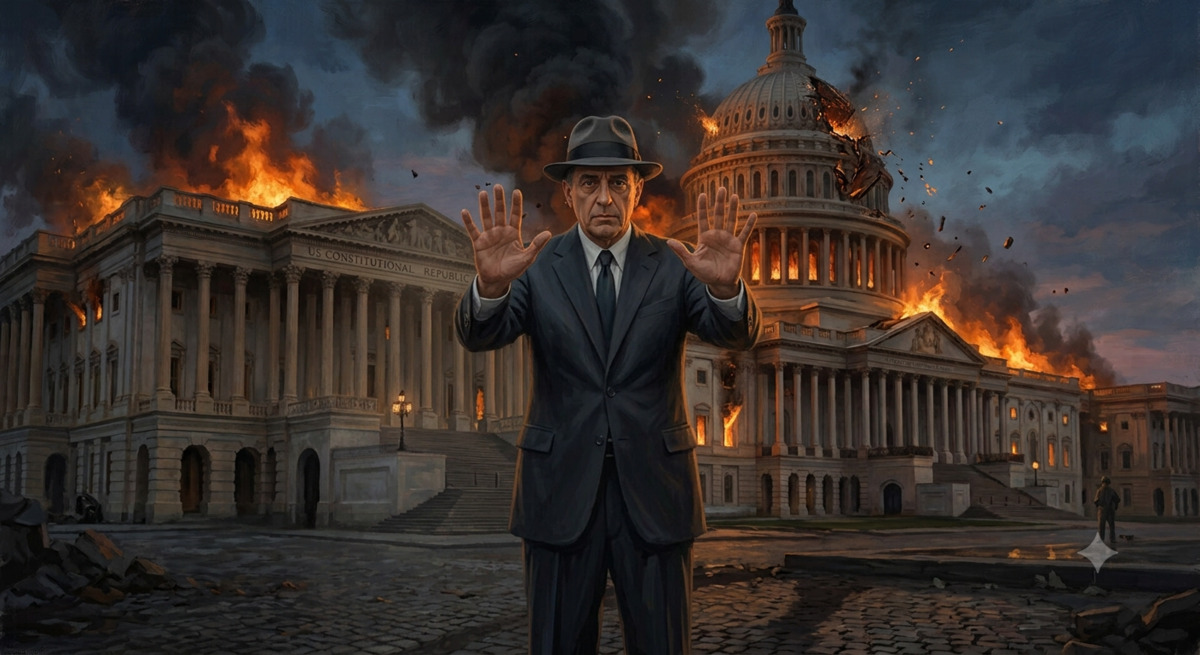
“Move along. Nothing to see here.”
“…in questions of power then, let no more be heard of confidence in man, but bind him down from mischief by the chains of the constitution.”
— Thomas Jefferson in the Kentucky Resolutions of 1798
I. So Much Mischief
The preceding article, “Super-Governmental Organizations”, described how Congress effectively made a fourth branch when they created independent agencies with executive powers. The original executive branch itself has morphed into a vast blob so large that it blurs the line between public & private spheres and dominates the entire economy. This article will look at how they got away with it, and how the judiciary branch helped them
From the very beginning of the republic, the Supreme Court made itself the willing accomplice to government run amok, and made itself the ultimate arbiter of whether that was to be allowed. Once you let government alone decide what its limits are, the chains break, and the mischief begins.
II. What They Don’t Teach in Civics Class
That the Constitution is the supreme law of the US — not presidential dictates; not whatever Congress passes that violates the Constitution, and especially not the latest ruling from the Supreme Court.
That there are enumerated powers variously counted as 27 to 34 functions that the federal government is allowed to do — and no more! The 10th Amendment explicitly states that everything else is reserved to the states or the people. Hamilton first broke this principle with “Assumption”: declaring an implied power to create central banks.
That the federal government cannot give money to special interests. That is what the “General Welfare” clause was supposed to mean. James Madison clarified its original meaning in his Report of 1800: that the term lifted from the Articles of Confederation specifically meant that budget allocations had to benefit all the states because they were the ones paying for it!
That the 3 branches of government were co-equal in deciding questions of constitutionality. The “Judicial Supremacy” doctrine was entirely invented by the Supreme Court and does not exist in the Constitution.
The president cannot wage wars without Congressional approval. Instead they passed a War Powers Act completely inverting the prohibition. Now the president can wage war with abandon until the Congress votes otherwise.
The real legal tender law: only gold & silver are money. Debt instruments like Federal Reserve Notes are prohibited for the federal government and states.
Juries have every right to judge the law as well as the defendant. Yes, jury nullification is a tried and true remedy to bad laws.
These are shocking facts for recent graduates to hear for the first time. It has taken me decades of reading and research to un-learn the misinformation I was taught. The sad state of affairs after 2 centuries of lies is to pretend there’s controversy between “original intent” and an “adaptive, dynamic interpretation”, and that the Supreme Court has frequently chosen the later – inevitably expanding the power of the government. The necessity for brainwashing in our public civics classes shows how important the lie is.
Most graduates of this kind of public school education believe that the government can do anything it wants, and the only thing slowing them down are officiais who think they can’t get away with it – yet! All that is required is time and opportunity, which arrives with the inevitable crisis.
Key sources:
- Thomas DiLorenzo, “Hamilton’s Curse”, 2008
- Thomas Woods & Keven Gutzman, “Who Killed the Constitution?”, 2008
- Ron Paul, “End the Fed”, 2009
III. Judicial Self-Exemption — The Fourth Branch’s Silent Partner
“The great object of my fear is the federal judiciary.”
Thomas Jefferson, 1821
The judicial branch long ago abandoned any “check and balance” role entrusted to it to restrain the other branches. It didn’t just fail to check the SGO blob, it built the doctrinal tools that make the rest of it unreviewable, with no statutory basis for any of them.
A. Qualified immunity
In 1967, the Supreme Court decided Pierson v. Ray and invented, out of nothing in the statute itself, a defense that lets government officials escape liability for violating someone’s constitutional rights. Fifteen years later, Harlow v. Fitzgerald (1982) hardened the doctrine into its modern, nearly impenetrable form: an official can only be sued if the specific right they violated was already “clearly established” by a nearly identical prior court case.
Read the actual statute this doctrine claims to interpret, 42 U.S.C. § 1983, passed by Congress during Reconstruction specifically to let citizens sue government officials who violate their civil rights, and you will not find the word “immunity” anywhere in it. Congress wrote a law with no exceptions for qualified officials. The Court added the exception itself, decades later, and has been expanding it ever since.
The practical effect is almost elegant in its cruelty: a plaintiff can only win by finding a previous case where a court already ruled the exact same conduct unconstitutional. Which means the very first time any official commits a given violation — no matter how obviously wrong — no prior case exists, so no court has “clearly established” it, so the official walks free. Novelty is a defense. The more original the abuse, the safer the abuser. This is the same accountability gap the SGO/mandate-economy sections of this series document. The entity is insulated from consequences, even when Congress granted nothing. The judiciary built the shield for itself.
B. Sovereign immunity
Underneath every other exemption in this series sits an older, more foundational one: the government cannot be sued at all without its own consent. The doctrine descends directly from English common law’s maxim that “the king can do no wrong” — a monarch, having made the law, could not logically be a defendant in his own courts.
The founding generation confronted this directly, and at first, rejected it outright. In Chisholm v. Georgia (1793) — the first US Supreme Court case of real national significance — the Court ruled 4-1 that a private citizen could sue a state government, explicitly on the theory that sovereignty in America rested with the people themselves, not with any government body standing above them the way a king stood above his subjects. It was a direct, principled repudiation of monarchical immunity, decided by justices who had just helped build a government founded on rejecting exactly that premise.
The reaction was immediate and furious. Georgia’s legislature threatened the death penalty for anyone who tried to enforce the judgment. States across the country, many buried in Revolutionary War debt, recoiled at the prospect of creditors suing them in federal court. Congress moved with a speed it has rarely matched before or since: the Eleventh Amendment, restoring state sovereign immunity, was proposed within a year of the ruling and ratified within two — making it, functionally, the first time the political branches overturned a Supreme Court decision by constitutional amendment, done specifically to put a version of “the king can do no wrong” back into a country that had just finished fighting a war against that exact idea.
Hamilton had actually anticipated this fight and defended limited government immunity even before Chisholm, arguing in Federalist No. 81 that immunity from private suit “is inherent in the nature of sovereignty,” a necessary attribute of any government rather than a monarchical leftover. Whether that argument holds — that a republic needs the same shield a king claimed, just for a different reason — is precisely the question Chisholm‘s justices answered one way and the entire political system answered the other, within two years of each other, at the founding itself. The tension wasn’t settled by the founders. It was fought, briefly won by the anti-monarchical reading, and then reversed by exactly the kind of majority-interest political pressure the Constitution’s structure was supposed to check.
What Congress restored in 1795 covered suits against states. So the states got their immunity by constitutional amendment, debated and ratified. The federal government got its own by nobody ever being asked.
Congress did eventually carve out a narrow waiver: the Federal Tort Claims Act (1946), letting citizens sue the federal government for certain kinds of negligence. But it is a waiver, not a right — Congress can shape it, narrow it, and exempt whole categories of government conduct from it entirely, which is exactly what happened. Discretionary functions, intentional torts by most federal employees, military-related claims, and law enforcement conduct in many contexts all remain carved out. The default is still immunity. The exceptions are what Congress deigned to permit, revocable at will, and interpreted narrowly by the same courts that built qualified immunity on top of it.
C. The state secrets privilege
On October 6, 1948, a B-29 bomber testing secret electronic equipment crashed near Waycross, Georgia, killing three civilian observers aboard. Their widows sued the government for negligence and asked for the Air Force’s own accident investigation report. The Air Force refused, filing a formal claim that the report contained information about the secret mission and its equipment — too sensitive, they said, to ever reach a courtroom. In 1953, the Supreme Court sided with the government in United States v. Reynolds, formally recognizing the “state secrets privilege”: the executive can withhold evidence from a court simply by asserting, under oath, that disclosure would harm national security — with the court itself never actually reading the withheld material to check.
Fifty-two years later, in 2000, the report was finally declassified. It contained no state secrets. It contained a straightforward finding of Air Force negligence — the very thing the widows had been suing over, and the very thing the privilege had been invoked to hide. The Court accepted the government’s lie in 1953, but we didn’t find out until half a century later.
The doctrine survived the revelation completely intact, and its use has only accelerated since. Empirical studies count fewer than ten formal invocations of the state secrets privilege in the entire half-century before September 11, 2001 — and more than fifty in the single decade that followed. This is the exact doctrinal tool that makes the NSL, FISA, and CIA-proprietary material in this series’ earlier sections functionally unlitigable even in the rare case where a plaintiff clears standing: the moment a case gets close to the actual mechanism, the executive asserts the privilege, the court defers without independently verifying the claim, and the case ends — the same structure that hid a negligence finding for fifty-two years, still running today, on the strength of a single 1953 precedent the facts themselves have already discredited.
How government answered “someone has to be able to review secrets”: The Foreign Intelligence Surveillance Court exists precisely because national-security material is too sensitive for an open courtroom — proof, on its face, that classified review by an independent judge is entirely possible when the system wants it to be. But the FISC operates ex parte: only the government appears, presents its case, and answers questions. No plaintiff. No opposing counsel. No citizen whose communications are actually at stake ever gets a seat in the room. And the results show it: between 1979 and 2012, the court’s first thirty-three years, federal agencies submitted 33,900 requests. Judges denied eleven of them. A 99.97% approval rate — a win record, one law review article dryly noted, that would be the envy of the Harlem Globetrotters. Four different FISC judges approved the FBI’s initial surveillance application against Carter Page and three consecutive renewals in that same routine fashion, entirely one-sided — and the Justice Department’s own Inspector General later found those specific applications riddled with serious flaws that no adversarial process ever had a chance to catch before the surveillance had already happened.
To be fair to the court on its own terms: ordinary criminal wiretap warrants from regular federal judges show comparably high approval rates too, since prosecutors generally don’t submit an application they don’t already expect to win. But that comparison breaks down at the one point that actually matters here — a criminal wiretap target eventually finds out, gets a lawyer, and can challenge the warrant’s validity in open court if the evidence is ever used against them. A FISA target, in the overwhelming majority of cases, never learns the surveillance happened at all, which means the 99.97% approval rate isn’t just uncontested at the moment of approval. It’s uncontested forever.
Congress tried to soften this after the Snowden revelations, adding a formal process in the 2015 USA FREEDOM Act for FISC judges to appoint an independent amicus curiae in cases raising “novel or significant” legal questions. It helped, barely, and only at the margins: through the end of 2021, the court had used that power just 25 times since the law passed, entirely at the judges’ own discretion. When Congress considered going further — creating a standing special advocate who would actually oppose the government’s applications the way a real defendant’s lawyer would — the court’s own former presiding judge, John Bates, wrote to the Senate Intelligence and Judiciary Committees on behalf of his fellow judges arguing against it, on the theory that an adversarial process would undermine the “heightened duty of candor” the executive supposedly maintains when nobody’s there to check its claims.
D. Standing doctrine — the fully worked case study
If qualified immunity, sovereign immunity, and state secrets are the shields, standing doctrine is the door those shields never even need to open, because most plaintiffs never make it inside the room.
Article III of the Constitution says federal courts may only hear actual “cases and controversies” — five words, no elaboration. Everything else — the specific, demanding tests for who has “standing” to sue, what counts as sufficient injury, what “traceability” and “redressability” require — is the judiciary’s own construction, built case by case, with no text compelling any of the particular thresholds the Court has settled on.
Clapper v. Amnesty International USA (2013) shows the doctrine at its most self-sealing. Journalists and human rights lawyers who had strong reason to believe their communications with foreign contacts were being swept up under Section 702 surveillance were denied standing. The Court held their fear of surveillance was “speculative” because they couldn’t prove it had happened. The program that would have proven it was classified. The Court built a door that only opens from the inside, then ruled that anyone standing outside it, unable to prove what’s behind it, doesn’t get to knock.
Murthy v. Missouri (2024) is the modern, fully worked instance of the same architecture, and this series has already traced its actual arc. Lower courts found the federal government’s pressure campaign on social media platforms rose to actual coercion It was a real, on-the-record factual finding of damages. The Supreme Court didn’t disturb that finding. It ruled instead that the plaintiffs couldn’t prove any future censorship would be traceable to the government rather than the platforms’ own “independent” policies, even though those policies existed only because of the government’s pressure in the first place. The platform sitting between the government and the harmed party was enough to break the chain standing requires. In March 2026, the case ended in a private consent decree binding only three agencies, protecting only the eight named plaintiffs, with no admission of wrongdoing — a settlement that leaves the underlying standing ruling fully intact for every American who wasn’t a party to it.
And underneath both cases sits a selection effect nobody built into the doctrine on purpose, but which the doctrine depends on regardless: the businesses and individuals actually destroyed by the underlying conduct are structurally the least able to ever bring the claim that would prove it happened. Standing requires an ongoing injury, a continuing stake, a live controversy to litigate. A business coerced into bankruptcy, a person driven entirely offline, has nothing left to assert standing with. The harshest, most complete instances of the harm are precisely the ones the doctrine can never see — not because the courts are hiding them, but because the very people harmed worst are gone before they can ever become plaintiffs.
E. None of this required a single vote
Qualified immunity; modern sovereign immunity; the state secrets privilege; the “stretched” standing doctrine. Not one of the four passed through Congress as a considered act of representative government. Every one of them is judge-made; they invented, hardened, and expanded powers they were nominally charged with constraining. Instead they have evolved to most consistently protect itself and the executive from the citizens, We The People.
That may be the cleanest case in this entire series of a branch of government escaping the Constitution’s confines. The mandate economy required Congress to write ambiguous statutes. The dark layer required Congress to write Section 8(b) into permanent law. The judiciary needed nothing from anyone. It simply decided, one case at a time, across seven decades, that it and the other branches were less accountable than the document creating all three ever said they were — and no one with the power to overrule it was ever asked to vote.
IV. A History of “Dred-ful” Rulings
We cannot overlook the history of awful rulings the Supreme Court has made.
Marbury v. Madison (1803) The case that supposedly established judicial review is usually taught as an act of restraint. Critics like Thomas DiLorenzo (Hamilton’s Curse) read it differently: Marshall, a lifelong Federalist and, by DiLorenzo’s account, essentially Alexander Hamilton’s man on the bench, used a case he should have simply dismissed for lack of jurisdiction to instead assert sweeping judicial authority over the other branches, all while carefully avoiding the direct confrontation with Jefferson the Court would likely have lost. DiLorenzo places this alongside McCulloch v. Maryland (1819), where Marshall’s reasoning tracked almost verbatim Hamilton’s own 1791 defense of the Bank of the United States. That was no coincidence, in DiLorenzo’s telling, but a pattern: a Court quietly finishing the nationalist project Hamilton couldn’t complete in the political branches.
Dred Scott v. Sandford (1857) Beyond its moral catastrophe, the constitutional critique here (including from 19th-century Republicans and modern originalists alike) is that Taney’s opinion wasn’t simply wrong on slavery — it invented doctrine wholesale, striking down the Missouri Compromise via a novel and unsupported substantive-due-process theory, and denied citizenship to free Black Americans in defiance of the historical record on who was understood as a citizen at the founding. It’s frequently cited as the founding example of judicial activism in the American tradition — a Court reaching for a desired political outcome and constructing constitutional reasoning backward from it.
Roe v. Wade (1973) — Set the abortion debate itself aside entirely: the criticism here is that the Court manufactured a constitutional right that exists nowhere in the document’s text, structure, or history, then legislated from the bench in its place. Blackmun’s opinion didn’t just find a right to privacy — it built out a detailed trimester framework specifying what regulations were permissible at what week of pregnancy, a level of granular rule-making that looks far more like a statute than a judicial ruling, handed down by nine unelected justices instead of any legislature. Tellingly, this isn’t only a right-of-center complaint: John Hart Ely, a liberal, pro-choice constitutional scholar, wrote in 1973 that Roe “is not constitutional law and gives almost no sense of an obligation to try to be.” When a legal scholar sympathetic to the outcome says the reasoning doesn’t hold up, that’s a stronger indictment than any partisan critique could be.
The Supreme Court has consistently dismantled the limits on federal power itself, giving Congress and the President authority the Constitution’s enumerated-powers structure was designed to deny them.
McCulloch v. Maryland (1819) The Necessary and Proper Clause was written as a modest housekeeping provision: Congress can do what’s needed to carry out its enumerated powers, nothing more. Marshall read “necessary” to mean merely “convenient,” and “proper” as whatever end Congress finds legitimate. DiLorenzo ties this directly to Hamilton’s own 1791 defense of the national bank. This is the case that turned a limiting clause into a blank check; every subsequent expansion of federal power cites McCulloch‘s elastic reading as its foundation.
Wickard v. Filburn (1942) and Gonzales v. Raich (2005) This pair of decisions set the precedent for the unlimited utility of the Commerce Clause. Together they show the limiting principle disappearing entirely — a farmer’s wheat never sold, and marijuana never crossing a state line, yet both somehow treated as “interstate commerce.”
South Dakota v. Dole (1987) The federal government has no constitutional power to set a national drinking age; states retain that authority. So Congress simply attached the 21-and-over requirement as a condition on federal highway funds, and the Court upheld it as a legitimate use of the spending power rather than unconstitutional coercion. This is the template for the modern “backdoor mandate”: Congress can’t order states to do something directly, so it bribes and threatens them into doing it. This is the power of the purse writ large.
J.W. Hampton v. United States (1928) and Mistretta v. United States (1989) The “intelligible principle” test, which is the entire legal fiction propping up the modern administrative state. Article I vests all legislative power in Congress; these cases let Congress hand that lawmaking power to executive agencies wholesale, so long as Congress states some vague guiding principle first. In practice this “principle” requirement has never meaningfully stopped a delegation — it’s a rubber stamp with a Latin name, and it’s the doctrinal reason agencies can write binding rules with the force of law at all.
Chevron U.S.A. v. NRDC (1984) — Compounds the delegation problem: once Congress hands an agency vague authority, Chevron told courts to defer to the agency’s own interpretation of how far that authority reaches. So the branch that received the power also got to define its own limits, with the judiciary standing down rather than checking it. Despite Loper Bright overturning this in 2024, other agencies simply ignore it.
Korematsu v. United States (1944) The Supreme Court abdicated upholding any restraint on naked executive power because of wartime necessity. They allowed the infamous concentration camps for US citizens who had Japanese ancestry, with almost no independent scrutiny of the government’s justification. The precedent spawned many more rulings deferential to state-secrets, like Reynolds. The court eventually formally repudiated this in Trump v. Hawaii (2018) dicta, which will hold until “emergencies” again require the camps to reopen.
While I was writing this article, one of the most egregious rulings ever made by the Supreme Court happened in Trump v. Barbara (2026). The majority ignored the actual meaning of the Constitution when they rejected any restriction on “birthright citizenship”. The dissenting opinion by Clarence Thomas proved beyond any doubt that the 14th amendment did not apply to temporary or illegal residents who, as foreign citizens, cannot be considered to be “subject to the jurisdiction thereof” by mere geographical location. I will not repeat the many long legal analyses of this here, but if in doubt please read Justice Thomas’ dissent and Wolverton’s essay.
“You seem to consider the judges as the ultimate arbiters of all constitutional questions; a very dangerous doctrine indeed, and one which would place us under the despotism of an oligarchy.”
— Thomas Jefferson, 1820
Key sources:
- Thomas DiLorenzo, “Hamilton’s Curse”, 2008
- Wolverton, J., “The Myth of Birthright Citizenship: A Constitutional and Historical Refutation“, The New American, Feb. 2025
V. National Emergencies
Barely had the ink dried on the Constitution when President Washington declared in 1792 an insurrection by whiskey tax protestors. A rushed “Militia Act of 1792” and Justice Wilson’s stamp of approval was used to justify raising a militiia against poor frontier farmers. Critics have observed that the unfair whiskey tax seemed almost deliberately designed by Hamilton to provoke rebellion and thus justify this expansion of centralized government force. Rothbard has only to point out that no whiskey tax was ever collected from any counties on the frontier – not just in those 4 Pennsylvania counties. The true story of the excise tax rebellion is that it was successful and forced the government to abolish the tax 10 years later. Rothbard also noted that the banks were eager to stamp out currency alternatives – which is what whiskey on the frontier served as. A modern parallel happened when the Left declared the Jan 6th election fraud protest in Washington, D.C., that turned into a police riot, was an insurrection, and used it to crack down on the Right, and destroyed the lives of thousands.
The next opportunity to usurp power unauthorized by the Constitution arrived with the (so-called) Civil War. Conventional analysis refers only to Lincoln suspending habeas corpus, an order (unconstitutionally) enabled 2 years later by legislation. Its importance was setting a precedent for subsequent emergency declarations that suspended constitutionally guaranteed rights. Initially, seven southern states seceded over the federal government’s attempts to usurp state’s rights. Then Lincoln tried to raise a militia to attack those states, which caused the remaining 4 southern states to secede. The Constitution does not authorize the federal government to use force against a state government. Nullification and secession were however recognized rights by the Founders. Lincoln instituted conscription, which the Constitution does not authorize either, but we never hear objections to that any more, again because it set a useful precedent. So did Lincoln shutting down opposition press, imprisoning tens of thousands of northern dissidents, confiscating firearms, and murdering as many as 1000 in the NY Draft Riots.
The modern variation on national emergencies started with the Trading with the Enemy Act of 1917, passed during WWI and explicitly written for wartime use only. That did not stop Roosevelt from using it to declare a national emergency on March 6, 1933 and ordering a nationwide bank holiday. That proclamation is the origin of “national emergency” as a formal, standing legal category untethered from actual war, and it was never terminated. Eisenhower and Kennedy were still using FDR’s 1933 emergency declaration decades later to justify gold-hoarding and export regulations. Truman added a second, separate emergency in 1950 for Korea. Nixon added a third in 1971 to impose import tariffs. By the mid-1970s, a Senate Special Committee on National Emergencies and Delegated Emergency Powers discovered the country was legally operating under four simultaneous, undisclosed, never-terminated states of emergency — 1933, 1950, 1970, and 1971 — each one silently keeping hundreds of dormant statutory powers switched on. That discovery produced the National Emergencies Act of 1976. Result:
- 90 emergencies declared since 1976; 52 currently active
- ~150 statutory powers unlocked by an active declaration (Brennan Center)
The number of claimed “statuatory powers” have been growing for years. The Cato Institute showed that roughly 70% of these powers have apparently never actually been invoked — meaning the growing count isn’t measuring emergencies actually happening more often or that more authority is needed, it’s measuring a steadily expanding menu of dormant authority sitting ready.
Key sources:
- Murray Rothbard, “The Whiskey Rebellion: A Model for Our Time?“, 1994
- David Gordon, “Bishop Checkmates Lincoln“, June 2025.
- Thomas DiLorenzo, “Hamilton’s Curse”, 2008
- “A Guide to Emergency Powers and Their Use“, Brennan Center, A continually updated list as more powers are discovered.
VI. The EO 13603 Endgame
A curious thing happened while trying to research this article. Every single AI chatbot ignored Obama’s EO 13603. When asked why, they all claimed it was just an overblown right-wing conspiracy theory. What AI and the “fact-checkers” demonstrate here is how to lie with facts.
Executive Order 13603, titled “National Defense Resources Preparedness,” represents a profound overreach of executive authority that effectively dismantles constitutionally guaranteed rights under the guise of emergency preparedness. This order, signed by President Barack Obama in 2012, claimed authority under the Defense Production Act of 1950, a Korean War-era statute (50 U.S.C.). Despite judicial precedent that such emergency powers could not be used outside of wartime crisis, Obama wrote in the EO, “The United States must have an industrial and technological base capable of meeting national defense requirements and capable of contributing to the technological superiority of its national defense equipment in peacetime and in times of national emergency. The domestic industrial and technological base is the foundation for national defense preparedness.“
The gatekeepers will say EO 13603 simply amended previous National Defense Resources Preparedness executive orders made by Eisenhower, Nixon, Reagan, and Clinton, but in fact, each President revoked the previous orders while expanding the powers granted in a new EO. A short list of what it claims the executive can do once he declares a national emergency:
- Sieze all forms of energy production & distribution
- Force companies to accept government contracts for national defense
- Control all transportation
- Restrict and redirect usage of all water
- Sieze all food and food inputs, including farms and factories
- Conscript anyone as needed for labor or military purposes
- Takeover all health services and resources
The “fact-checkers” claim EO 13603 only empowers the President to control the “allocation of materials, services, and facilities” and to “prioritize” contracts, but in practice, this means the government can seize control of food production, energy resources, water systems, transportation, health care facilities, and even the labor of American citizens. This is a direct violation of the Fifth Amendment, which prohibits the taking of private property without just compensation, as the order allows for the commandeering of resources without a clear, defined process for fair payment. The order also undermines the Thirteenth Amendment by allowing the government to compel citizens to work in industries deemed essential, effectively imposing a form of involuntary servitude under the guise of national service.
The constitutional violations are self-evident. EO 13603 authorizes the President to “control the general distribution of any material” and to “require the performance of any service” by any person, which directly contradicts the Ninth and Tenth Amendments, which reserve all unenumerated rights to the people and the states. The order’s scope is so broad that it allows the executive branch to operate as a de facto economic dictator, bypassing the legislative process and the checks and balances that are fundamental to the U.S. Constitution. Historically, many EO’s have also shown executive overreach, as seen in Executive Order 13303 (2003), which gave the US government and the Federal Reserve control over all Iraqi oil revenues indefinitely. That order, like EO 13603, was justified for national security without any authorizing legislation.
Furthermore, EO 13603 pretends to be a mere preparedness measure “for emergencies”, but it contains no sunset clause or meaningful congressional oversight. It is a standing invitation for the executive to declare a national emergency — for any reason! — and then assume total control over the means of production and distribution, which is the hallmark of authoritarian governance. The order’s language is deliberately vague, using terms like “national defense” and “emergency” to justify any action the executive deems necessary, which is a direct threat to the separation of powers. There is no “Emergency Clause” in the Constitution which allows suspending the rules.
Unfortunately, the history of such government declarations and power grabs has shown they are rarely challenged in courts of law, and once they are activated, it’s too late.
Key sources:
VII. Continuity of Government — The Constitution’s Off-Switch
While the rest of this series documents power escaping accountability, this section documents something categorically worse: a fully built, rehearsed plan to suspend the constitutional order itself in a genuine crisis — kept secret from the American public, and from most of Congress, for seventy years and counting.
A. Presidential Emergency Action Documents
Somewhere in a classified vault right now sit pre-written executive orders, drafted and ready, waiting only for a president’s signature to take effect. They’re called Presidential Emergency Action Documents (PEAD’s), and they were born under Eisenhower as contingency planning for a Soviet nuclear strike, then quietly expanded in scope over the following decades to cover a far broader range of triggering emergencies. Nobody outside the executive branch is supposed to know what any of them actually say. That is not an exaggeration for rhetorical effect. It is the literal, stated purpose of classifying them at all.
The Brennan Center spent years fighting through FOIA litigation to pry loose roughly 500 pages of these documents from the Eisenhower and Kennedy-era holdings at the Bush Presidential Library. What those 500 recovered pages confirm, in the government’s own drafting language, should stop any American cold: 1960s-era PEADs authorized the president to suspend habeas corpus outright, to detain American citizens deemed “dangerous persons” without the due process the Constitution requires, to censor the press, and to restrict domestic travel. Not foreign enemies. Not a hypothetical invading army. American citizens, on American soil, under American executive authority nobody voted for and no statute ever debated in public.
That is the material we know about, because a nonprofit dragged it into daylight decades after it was written and decades after whatever administration wrote it left office. Roughly 6,000 additional pages remain fully classified today. As of the most recent public accounting, 56 PEADs currently appear to be in effect — right now, this year, in force — and their contents are unknown not just to the public but, by every indication, to the overwhelming majority of the Congress that is supposed to be a coequal branch of this government. Fifty-six live documents, each one potentially authorizing the suspension of some constitutional protection, and not one member of the House or Senate outside the tightest security clearances has read a word of what any of them actually say.
B. Classified Presidential Directives
While 3,675 Executive Orders had been published in the Federal Register between Truman and Clinton. another 2,158 Presidential memoranda, directives, or orders were classified. That is roughly 19,000-30,855 pages claiming to have the force of law without being subject to review or legal challenges. Since Clinton the rate of new classified directives has fallen dramatically, and only about 170 more have been issued. That is not necessarily a Good Thing; it could be that they simply don’t want to put what they are doing into writing and on the record.
Not every classified directive stays hidden forever, and what’s surfaced when a few of them finally have been declassified tells its own story. The Moynihan Commission on Government Secrecy, a bipartisan body chartered by Congress in 1997, concluded after extensive study that the classification system routinely conceals material that was never a genuine threat to national security at all — errors, policy failures, and simple embarrassment stamped “Top Secret” alongside the rare document that actually warranted it, with no meaningful mechanism forcing the difference to matter. The pattern showing up in the small fraction of National Security Directives that have eventually been released tracks that finding closely: some reveal nothing more dramatic than routine bureaucratic disagreement, suggesting the original classification decision had less to do with protecting the country and more to do with protecting the officials who wrote them from having to explain themselves at the time. It is probably enough to say plainly what decades of declassification have already demonstrated: a directive stamped secret is not necessarily a directive that needed to be. Sometimes it is simply a directive someone didn’t want read.
A parting thought though: as bad as the published EO 13603 was, how much worse could a classified one be?
C. The Doomsday Project
If PEADs are the individual switches, the Reagan administration built the entire panel. James Mann’s meticulously sourced 2004 reporting in The Atlantic — corroborated on the record afterward by named former officials including Edwin Meese and Richard Clarke in a subsequent ABC Nightline segment — documented a program with a name that undersells its ambition: the “Doomsday Project,” internally the plan for continuity of government after a catastrophic attack. It built three separate rotating shadow-government teams, roughly fifty officials apiece, each with its own designated successor president, ready to assume control of the country the moment the actual government was destroyed or incapacitated. Oliver North — a name that should already feel familiar from this article’s Iran-Contra material — helped run it. You might remember a certain Congressional hearing when REX 84 was mentioned. The prospect of martial law and internment camps for Americans created so much outrage that they say now it was simply an “exercise”, but that still leaves us asking, “Why would you be running such an exercise at all?”
Mann’s own reporting states the verdict plainly, and it deserves to be quoted rather than paraphrased, because no summary sharpens it further: this entire apparatus “was never authorized by the Constitution or any federal law.” Read that again. Not an aggressive interpretation of existing authority. Not a debatable expansion of some statute’s language. A structure built, staffed, and rehearsed to replace the elected government of the United States in an emergency, resting on no legal foundation whatsoever — because nobody with the power to authorize it was ever asked, and nobody who built it particularly cared.
D. Not Just Theoretical
Here is the part that should actually keep you up at night: this stopped being a hypothetical exercise on the morning of September 11, 2001. Richard Clarke has confirmed on the record that the entire continuity-of-government program was activated that morning — every federal agency ordered to alternate headquarters, the machinery Reagan’s officials built two decades earlier finally switched on for real. Barton Gellman’s contemporaneous reporting in the Washington Post documented a functioning “shadow government” operating out of undisclosed locations for weeks afterward, governing in parallel to the visible one the public could see on television.
A plan built in total secrecy, resting on no constitutional or statutory authority its own architects ever claimed, was activated in a genuine national crisis — and the American public did not learn this had happened from any disclosure the government made voluntarily. We learned it from journalists, years later, piecing together what officials would eventually confirm only once safely on the record and long out of office. That is the actual state of affairs: the mechanism for suspending your constitutional rights in an emergency has already been used once, and the only reason you know that is that a few reporters refused to let it stay buried.
E. Congress Can’t Even Save Itself
And here is the detail that should make every American furious rather than merely alarmed: this isn’t ancient history sitting comfortably resolved. Congress still hasn’t fixed the most basic structural vulnerability in its own continuity, a quarter-century after 9/11 forced the question into the open. The Constitution requires House vacancies to be filled only by election — full stop, no exceptions written in for a catastrophe that kills a large number of sitting members simultaneously. Cold War-era commissions flagged this gap. Post-9/11 commissions flagged it again, more urgently. Proposed constitutional amendments to allow temporary emergency appointments have been introduced again and again — 2004, again in the 2024 session as H.J. Res. 118, and yet again just this month, July 2026, as H.J. Res. 199 — and every single one has died in committee or gone nowhere, because two-thirds majorities are hard to assemble for a problem nobody wants to imagine actually happening.
So sit with the actual shape of what that means. The executive branch built and secretly maintains a detailed, tested apparatus for suspending your habeas corpus rights, detaining you without trial, censoring what you’re allowed to read, and installing an unelected successor government — and has used it once already. Congress, meanwhile, cannot even agree on how to replace its own dead members fast enough to keep functioning if the same catastrophe struck the Capitol directly. One branch built a secret machine for seizing total emergency control. The other branch can’t pass a bill to keep its own lights on. That asymmetry is not an accident of bureaucratic inertia. It is the precise shape of a constitutional order that has already, quietly, been switched off once — and left the switch sitting there, live, for next time.
Key sources:
- “Presidential Emergency Action Documents“, Brennan Center, 2020
- James Mann, “The Armageddon Plan“, The Atlantic, 2004
- Dr. Jeffrey Richelson, “Presidential Directives on National Security from Truman to Clinton“
- Barton Gellman, Susan Schmidt, “Shadow Government Is at Work in Secret“, WaPo, 2003
VIII. Consent of the Governed?
“That to secure these rights, Governments are instituted among Men, deriving their just powers from the consent of the governed.”
Thomas Jefferson, The Declaration of Independence, 1776
Every section of this piece has documented the same basic mechanism: judges building their own exemptions from review, executives constructing secret plans to suspend the Constitution outright, agencies buried so deep in classified authority that even Congress can’t see them. It would be reasonable to conclude this with despair. All is not lost yet though. Two of this term’s own Supreme Court rulings, and a body of law running quietly underneath American federalism for over three decades, show the same system is capable of moving the other direction, and that individuals retain more power than the controllers want you to believe.
Start with the Court’s own recent record. West Virginia v. EPA (2022) is proof this isn’t necessarily a one-way ratchet. The SC struck down an agency’s assumed authority specifically because Congress never explicitly granted it, reining in executive reach rather than expanding it. The same institution capable of discarding ninety years of precedent to free an agency from oversight in Trump v. Slaughter discarded decades of assumed deference to restrain one in West Virginia v. EPA. The tool cuts both ways.
Then there’s a genuinely underused piece of constitutional architecture: the anti-commandeering doctrine, built from a lineage of cases running back to 1842 and firmly established in New York v. United States (1992), Printz v. United States (1997), and extended further in Murphy v. NCAA (2018). The rule is simple and, once understood, quietly radical: the federal government cannot force any state government, or any state or local official, to use their own personnel or resources to enforce federal law — full stop, regardless of whether the underlying federal law is itself constitutional. A state doesn’t need a court to first declare a federal statute invalid before declining to help enforce it. It only needs to say no.
This is not a partisan tool, and its recent use cuts across the entire political spectrum, which is precisely what makes it durable rather than a passing fad. Democratic-leaning states have used it for years to let marijuana remain legal under state law despite the federal Controlled Substances Act, and both parties’ states have resisted the federal REAL ID Act using the identical legal footing. During the Biden administration specifically, New Hampshire and Florida barred their own state and local governments from assisting in enforcement of the federal COVID vaccine mandate for large employers — not by claiming the mandate was void, but simply by refusing to lend any state resources to enforcing it, exactly as Printz allows. Missouri, Arizona, and West Virginia passed Second Amendment sanctuary laws using the same doctrine in the opposite direction, refusing state cooperation with federal gun measures they opposed. Whichever party currently controls Washington, a state genuinely committed to resisting federal overreach already has a real, tested, Supreme-Court-affirmed mechanism for doing so — it only requires the will to use it.
It must be admitted however that anti-commandeering only prevents a state from being forced to help — it does not let a state violate federal law or physically block federal agents from directly enforcing federal law themselves, using federal personnel and federal resources. Also, the doctrine changes nothing on its own. As the Tenth Amendment Center itself puts it, “human action is also key” — a state law refusing to help enforce a mandate accomplishes nothing if every individual simply complies anyway. The law only becomes real nullification “in practice and effect” once people actually decline to go along.
But even when these remedies and pushbacks fail, we still have one recourse: the jury. No branch of government, no agency, no classified document, and no act of Congress can override twelve ordinary citizens who look at the facts of a specific prosecution and simply refuse to convict. It’s called Jury Nullification. A jury’s not-guilty verdict cannot be appealed by the government, cannot be second-guessed by any judge, and is protected absolutely by the double jeopardy clause — regardless of whether the jury’s actual reasoning was “the defendant didn’t do it” or “the law being enforced here is unjust and we will not be the instrument of it.” Judges are not required to inform juries this power exists, and in most courtrooms today, defense attorneys are actively barred from arguing for it directly. That silence is deliberate. A sure-fire way to get excused during jury selection is to say you are a member of the Fully Informed Jury Association. That does not change the fact that the power itself is real, has always been real, and has been used throughout American history at moments when formal legal channels had already failed — juries who refused to convict under the Fugitive Slave Act, juries who refused to convict during Prohibition when the law itself had lost the public’s consent. Note, while acquital requires a unanimous not-guilty judgement, a single juror can refuse to convict which results in a hung jury. The government must either accept defeat or start the entire trial over from nothing.
Every mechanism documented in this piece: qualified immunity, sovereign immunity, state secrets, standing doctrine, PEADs, the Doomsday Project, the National Emergencies Act, the two-tier removal power Slaughter just created, describes power moving away from the people and centralizing into unaccountable institutions. In previous articles I described how this has been essentially a process of relinquishing responsibility. We cannot expect the thieves to apologize and return what they have stolen. Instead, it is up to each of us to reclaim our own liberty — to simply say, no, I do not consent.
“An act of usurpation is not obligatory; it is not law; and any man may be justified in his resistance.”
— Theophilus Parsons, Constitutional Convention, 1788
Sources:
- Natelson, R. “Resisting Federal Usurpation: Comments by Theophilus Parsons“. The full context is that any man may refuse an unconstitutional law, and his defense is 12 jurors who refuse to convict him for it.
Leave a Reply