
Pseudopods of the Blob
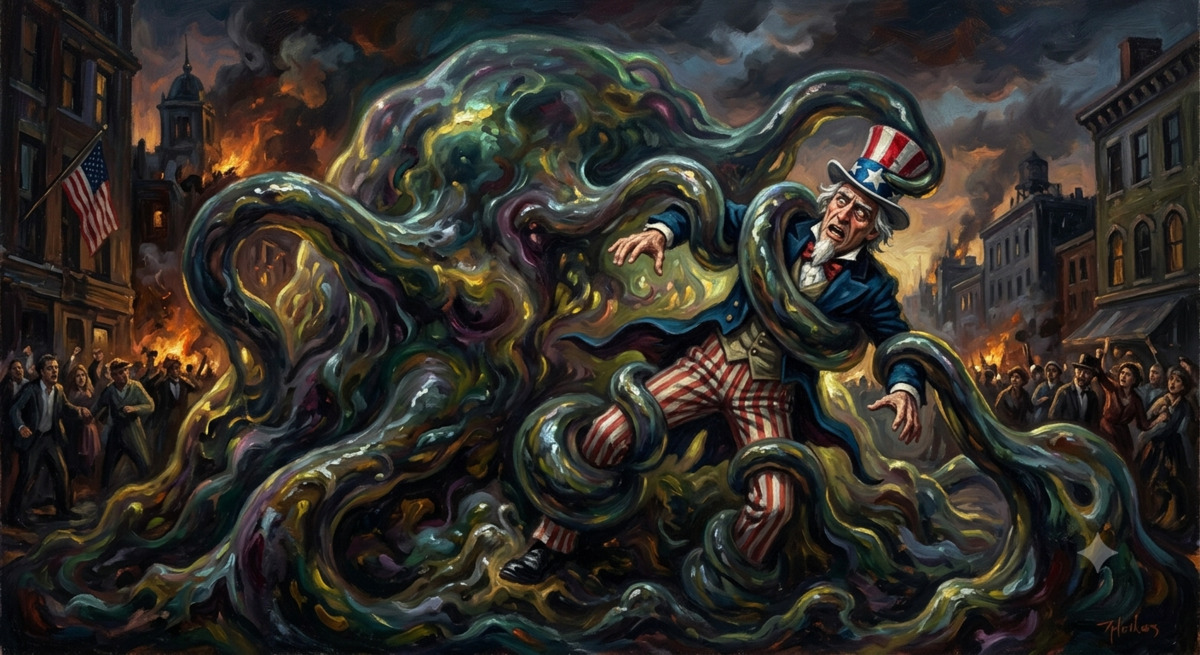
Who wins this?
This is the 2nd half of the Super-Governmental Organizations article. Part 1.
- US military’s extended occupation of Afghanistan from 2001 to 2021 was primarily to protect and promote opium cultivation in order for the CIA to collect profits from heroin trafficking. The market value at its peak in 2017 was estimated at $6.6 Billion. China destroyed this market by producing vastly cheaper fentanyl. That is the only reason the US military finally left.
- An estimated $1 Trillion in trafficking profits (from drugs, guns, and humans) are laundered thru Wall Street every year. How much of that is the CIA’s?
- Some suspect that bitcoin itself was an invention of the CIA and that they hold most of the early bitcoins generated. LTH’s (Long Term Holders) of bitcoin sold half a million bitcoins between September and November of 2024 – an amount calculated to be as much as $50 Billion. The CIA’s black budget is estimated at no more than $15 Billion.
- The CIA now has total surveillance on all digital communications, which gives them perfect insider information to trade the stock market. Undoubtedly Congress’s own inside traders are mere pikers.
- In-Q-Tel is officially an independent, non-profit venture capital firm chartered by the CIA. It has invested almost $1 billion in 800 different technology start-up companies. Like the CIA, it can not be audited by any other agency and what equity stakes it holds are secret. A 2005 report stated that In-Q-Tel’s internal rate of return (IRR) on all its investments was 26%—a very high return by venture capital standards. Its top unicorns are now valued at about $200 biliion.
- Electronic Frontier Foundation, “The Failed Fix to NSL Gag Orders,” FOIA-based report, 2020 — documents FBI’s own data showing the USA FREEDOM Act review procedure fails to reduce de facto permanent gags.
- Doe v. Ashcroft, 334 F. Supp. 2d 471 (S.D.N.Y. 2004); Doe v. Holder, 703 F. Supp. 2d 313 (S.D.N.Y. 2010) — original NSL gag-order constitutional challenges.
- Cloudflare v. FBI, Ninth Circuit ruling upholding the current NSL gag-order regime, 2025 — confirms the practice remains current law.
- Frontline/PBS, interview with Nicholas Merrill on the lifting of his eleven-year NSL gag, 2015.
- Brennan Center for Justice, “FISA Section 702 Backdoor Searches: Myths and Facts,” and “New FISA Court Opinion Reveals Continuing Violations by the FBI,” 2026.
- Congressional Record, Vol. 170, No. 69 (April 19, 2024) — FISA Court’s July 2023 finding of 40,000–50,000 warrantless queries per quarter in 2022.
- Wikipedia, “FBI Section 702 query violations” — consolidated timeline, 278,000 noncompliant searches 2020–early 2022.
- New Civil Liberties Alliance, “In NCLA Victory Against Censorship, State Department Shutters Global Engagement Center,” January 2025.
- Congressional Research Service, “Termination of the State Department’s Global Engagement Center,” IN12475, December 2024.
- Wikipedia, “Global Engagement Center” — NewsGuard/Global Disinformation Index funding, litigation history, September 2025 program dismantling.
XII. The Mandate Economy: Government Without Spending
The standard measure of government’s economic footprint is spending as a percentage of GDP — approximately 36% at federal, state, and local combined. That measure misses the most important category of all: industries that exist entirely because government mandated that someone buy from them, without spending a dollar directly.
The government doesn’t need to own an industry to control it. It just needs to mandate that someone buy from it.
The insurance industry is the largest example. Health insurance in its current form exists because of government mandates — employer mandate, individual mandate, Medicare supplement requirements, state minimum coverage laws. The ACA alone restructured a $1.2 trillion annual market. Auto insurance is mandatory in 49 states. Title insurance is required for every mortgage. Flood insurance in designated zones. Workers compensation in every state. The industry’s $1.3 trillion in annual premiums flows entirely through private transactions — but the demand is created almost entirely by government mandate. Without the mandates, the market is a fraction of its current size.
The compliance industry — estimated at $400 billion annually — exists solely because government created the regulations requiring compliance. Tax preparation, environmental compliance, OSHA compliance, financial reporting, healthcare billing, employment law, food safety certification. Every dollar spent on compliance is a dollar extracted from productive activity by regulatory mandate and redirected to an industry that produces nothing except conformity with government requirements. H&R Block, the major accounting firms’ compliance practices, every environmental consulting firm — mandate-created markets, every one.
The legal industry’s government-dependent sector is similarly invisible in standard accounting. Product liability law creates the insurance and litigation markets around it. Securities law creates the disclosure compliance and enforcement litigation industry. The Americans with Disabilities Act created a compliance and litigation sector. The government creates the legal obligation; the private bar monetizes the enforcement. None of this appears in “government spending.”
Consider a company whose entire revenue comes from financial services firms required by fiduciary regulation to purchase its services. No government contract. No line in any contractor database. Perfectly “private sector” by every official measure. Existing solely because a regulatory mandate created the demand for its product. Without the mandate, the market is zero. This is not an edge case. It is a template replicated across thousands of industries whose existence depends on regulatory requirements they had no role in creating and cannot opt out of providing.
The precise legislative origin of one such industry is documented: On May 1, 1975 — “May Day” in Wall Street history — the NYSE abolished fixed commission rates, threatening the bundled research model Wall Street had operated on for decades. Congress immediately passed Section 28(e) of the Securities Exchange Act, creating a safe harbor allowing money managers to pay above the lowest available commission rate in exchange for research services without breaching fiduciary duty. This conjured an entire industry of independent research providers into existence by regulatory fiat — companies receiving no government contract, no government grant, no government funding of any kind, yet existing entirely because a single legislative provision made their business model viable. When the European Union banned soft dollar payments under MiFID II in 2018, European independent research firms collapsed. The mandate created the market. The mandate’s removal ended it. The market was never real in the Austrian sense — it was a regulatory artifact from inception.
XIII. Settlement Slush Funds
The mandate economy reaches its purest expression when the government bypasses the appropriations process entirely through civil enforcement settlements. The Obama Department of Justice discovered that consent decrees in financial enforcement actions could be their own personal Treasury requiring no Congressional appropriation. When the DOJ settled with Bank of America for $16.65 billion in 2014, with JP Morgan for $13 billion in 2013, and with Citigroup for $7 billion in 2014, the settlement agreements directed hundreds of millions to third-party nonprofit organizations — La Raza, the National Urban League, housing counseling organizations — that were not parties to the litigation and had no connection to the underlying conduct (hint: they were all Leftist organizations contributing to Democrats). The House Judiciary Committee documented over $880 million in such directed payments between 2010 and 2016, with the actual figure including state attorney general parallel settlements likely several times larger.
The constitutional violation is explicit: the Appropriations Clause of Article I, Section 9 provides that no money shall be drawn from the Treasury except by Congressional appropriation. The DOJ’s virtual “Settlements slush fund” bypassed the Treasury entirely. The money never entered the federal budget. Congress never appropriated it. The receiving organizations were selected by executive officials with no congressional input, no democratic accountability, and no connection to the harm being remedied. Attorney General Sessions described it in 2017 when prohibiting the practice: settlement funds “should go first to the victims and then to the American people – not to bankroll third-party special interest groups or the political friends of whoever is in power.” The Biden DOJ reversed the Sessions memo in 2021 and quietly resumed the practice. Repeated attempts to stop the unconstitutional practice in a “Stop Settlement Slush Fund Act” have failed to pass Congress. The mechanism — government compelling transfers from regulated institutions to politically favored organizations through legal agreements, appearing nowhere in the federal budget, subject to no appropriation and no vote — is the mandate-as-tax at its most operationally precise. When government mandates that some people must pay some other people, that is a tax without the middleman. The consent decree is the instrument. The nonprofit is the recipient. The constitutional constraint is the casualty.
The three headline bank settlements alone totaled $36.65 billion — and of that, congressional investigators traced at least $640 million redirected to third-party organizations instead of the Treasury or the homeowners actually harmed, with $150 million of it landing specifically with politically chosen nonprofits. But this policy was carried out across Obama’s bureaucracy: DOJ, EPA, HUD, and Interior all wrote the terms into the fine print of agreements with hundreds of entities coerced into signing to avoid prosecution. (see the paper by the Regulatory Transparency Project) Settlement leverage did the work spending once did, at a fraction of the accountability — no budget line, no Treasury disbursement for anyone to audit, the whole apparatus running on the threat of a lawsuit rather than the lawsuit itself. And when even a settlement proved too visible a paper trail, the government found something better: no money, no filing, no court record at all — just a guidance letter and a reputational-risk designation quietly circulated to a bank. Operation Choke Point needed no slush fund to debank at least 30 businesses; it needed only the threat of one. This is government spending nothing and moving everything — a treasury with no ledger, a budget with no vote, and a Congress that holds the purse strings to an empire it can no longer see.
XIV. Foreign Aid as Domestic Slush Fund
The “foreign aid” label is the most elegant laundering mechanism in the entire SGO architecture — because it is entirely legal, entirely public, and almost universally misunderstood.
The $95 billion Ukraine supplemental package passed in 2024 is the documented case study. By the American Enterprise Institute’s own accounting — offered in defense of the spending — 77% of the package, $73 billion, was domestically invested, with $59 billion flowing directly to US defense companies. The AEI called this a feature: the supplemental was not foreign aid but “the kickstarting of an American defense and aerospace manufacturing turnaround.” The public was told the money was for Ukraine. Three quarters of it never left the United States.
The implementing partner architecture extends this mechanism across the entire $71.9 billion annual foreign aid budget. Most agencies provide foreign assistance not directly to recipient governments but through “implementing partners” — US-based NGO’s that receive the funds and deploy them on behalf of foreign populations. FHI-360, one of USAID’s largest implementing partners, derived more than 80% of its revenue from US government sources in 2023. The Academy for Educational Development, formerly one of USAID’s largest partners, dissolved entirely when suspended from USAID contracts — it received 90% of its funding from federal agencies and could not exist independently. An organization that ceases to exist when its government contract disappears is not a “non-governmental” organization. It is a government agency in nonprofit clothing, performing government functions under a nonprofit label, appearing in no federal headcount, subject to no civil service requirement, free from government oversight and accounting, and dissolved by administrative decision rather than legislation.
The fraction of foreign aid that does reach its foreign destination encounters its own extraction mechanism. Operation Midas — a 15-month Ukrainian anti-corruption investigation collecting 1,000 hours of audio recordings — documented a $100 million kickback scheme at Energoatom, Ukraine’s state nuclear company, in which contractors were forced to pay 10-15% kickbacks to politically connected overseers simply to receive payment for work already performed. The scheme’s central figure was a business partner of Zelenskyy’s from before his presidency. The figure whose initials matched “Ali Baba” in the NABU recordings was Andriy Yermak — chief of the president’s office and the reputed éminence grise of the entire administration. The funds were laundered through shell companies and intermediaries connected to the presidential circle.
The full foreign aid mechanism assembled: Congress appropriates funds labeled humanitarian assistance. 77% flows to domestic defense contractors through weapons replenishment and industrial base investment. The remaining 23% flows through implementing partner NGOs deriving 80-90% of their revenue from federal sources. Of what reaches the foreign destination, 10-15% is extracted by politically connected overseers before reaching its stated purpose. At each stage the label says one thing and the money does another.
The AEI’s defense of the mechanism is the most honest description of it ever published by its beneficiaries: the United States is the ultimate beneficiary of the supplemental spending bill, as it should be. The foreigners in “foreign aid” are the pretext. The domestic contractors are the point.
XV. The Dark Layer: Government Through Criminal Enterprise
Every layer of the SGO architecture documented so far operates within some legal framework — however distorted, however constitutionally compromised, however far removed from democratic accountability. The independent regulatory commission at least receives Senate confirmation. The government corporation at least appears in the Government Manual. The implementing partner NGO at least files a Form 990. The cy-près settlement at least produces a court document. The foreign aid contractor at least appears in USASpending.gov.
The creation of the CIA in 1949 spawned a whole new kind of delegation. Section 8(b) of the CIA Act of 1949 — now codified at 50 U.S.C. § 3510 — lets the Director spend CIA funds “notwithstanding any other provisions of law” governing how the rest of government has to account for its money. The companion mechanism is just as direct: 31 U.S.C. § 3524, the statute governing GAO audits of federal spending, explicitly carves out funds spent under Section 8(b) as exempt from that audit — reviewable, if at all, only by the House and Senate Intelligence Committees in closed session, never by the Comptroller General, never by the public. This is Congress writing into permanent law, 76 years ago, that one agency’s checkbook doesn’t have to answer to the same Appropriations Clause every other agency in this article does. What it enables is government operations funded not by appropriation, not by off-budget proprietaries operating commercially, but by the proceeds of criminal enterprises the government’s own agencies were running. This layer is the hardest to document by design. What can be documented is sufficient.
The Proprietary Architecture — Confirmed
The Church Committee’s 1975 investigation of CIA covert operations documented over 100 shell companies — “proprietaries” — operating as CIA assets across the global economy: airlines, shipping companies, media outlets, financial institutions. Air America, the most famous, flew personnel and weapons throughout Southeast Asia. Congressional testimony documented that it also flew heroin from the Golden Triangle — generating revenue from narcotics trafficking that funded operations the black budget couldn’t officially support. The CIA’s response to the Church Committee was not to dismantle the proprietary architecture but to make it less visible.
The most recently confirmed proprietary operation ran for nearly five decades without detection. Crypto AG — the Swiss encryption company that sold communications devices to governments worldwide — was secretly owned by the CIA and West German BND from the 1950s until 2018. Over that period it sold compromised encryption hardware to more than 120 countries, allowing the CIA to read the encrypted communications of foreign governments while those governments believed their transmissions were secure. The ownership was structured through Liechtenstein shell companies and bearer shares requiring no names in registration documents — a Liechtenstein law firm paid, in the CIA history’s own words, “less for the extensive work but more for their silence and acceptance.” When the CIA and BND finally liquidated their Crypto AG ownership in 2018, current and former officials estimated the aggregate value at $50-70 million. The operation was revealed not through any oversight mechanism but through declassified German intelligence documents obtained by journalists in 2020. It had operated for nearly fifty years across multiple administrations, multiple congressional oversight regimes, and multiple Inspector General reviews — invisible to all of them.
The Criminal Proceeds Layer — Iran-Contra
The Iran-Contra affair is the most thoroughly documented case of criminal proceeds funding government operations and the most thoroughly ignored in its structural implications. Oliver North’s network used the proceeds from illegal arms sales to Iran — prohibited by the Arms Export Control Act — to fund the Nicaraguan Contras after Congress explicitly prohibited such funding through the Boland Amendment. The money never touched the federal budget. It flowed through private accounts, Swiss banks, and shell companies. A parallel government financing operation ran entirely outside constitutional appropriations authority, funded by an illegal arms transaction, directed by NSC staff operating from the White House basement.
Lawrence Walsh’s independent counsel investigation documented the mechanism in 650 pages. The Tower Commission named the participants. Multiple convictions resulted, subsequently pardoned. The structural lesson was not applied: the architecture that permitted a White House staffer to operate a parallel government financing network using criminal proceeds was not dismantled. The oversight mechanisms that failed to detect it were not reformed. The pardons that protected its participants were not prevented.
The Mena Connection — Documented but Unresolved
Barry Seal — the most successful drug trafficker in American history by volume — operated out of Mena, Arkansas in the early 1980s, moving an estimated $100 million monthly in cocaine proceeds through Arkansas financial institutions at peak operation. Federal prosecution confirmed the money laundering. The DEA’s own files documented Seal’s cooperation with multiple federal agencies. Arkansas state police investigators documented their investigations being blocked by federal agencies claiming national security. The question of CIA involvement in or knowledge of Seal’s operations was never formally resolved — investigated by Arkansas state police, the DEA, congressional investigators, and multiple journalists, blocked at every turn by federal agency claims of national security privilege. The documented fact: $100 million monthly in drug proceeds flowing through a state’s financial institutions while federal agencies with knowledge of the operation declined to prosecute until Seal himself became a liability.
BCCI — The Dark Money Bank
The Bank of Credit and Commerce International was the financial infrastructure that made the dark money layer possible at scale. Founded in Pakistan in 1972, BCCI operated in 78 countries, served as the primary financial mechanism for CIA covert operations, arms trafficking, drug money laundering, and terrorist financing simultaneously — while being regulated by the Bank of England and maintaining correspondent relationships with major American banks including First American Bankshares, secretly controlled by BCCI despite regulatory prohibitions. The Senate Foreign Relations Committee’s Kerry Report in 1992 documented BCCI’s role in detail: it was the bank of the Medellín cartel, of Manuel Noriega, of Saddam Hussein’s weapons procurement network, and of CIA covert operations across three continents. Senator Kerry called it “the bank of crooks and criminals international.” Clark Clifford — former Secretary of Defense, chairman of First American, one of Washington’s most respected elder statesmen — was indicted for his role in concealing BCCI’s control of First American. He died before trial. BCCI was shut down in 1991 with an estimated $13 billion in losses — the largest bank fraud in history at the time. The CIA’s internal assessment, partially declassified, confirmed it knew what BCCI was doing and used it anyway.
The FASAB 56 Response — Legalizing the Darkness
Michigan State University economist Mark Skidmore, working with former Assistant Secretary of Housing Catherine Austin Fitts, documented $21 trillion in undocumented accounting adjustments at the Department of Defense and Department of Housing and Urban Development between 1998 and 2015 — using the federal government’s own Office of Inspector General reports. The adjustments represented money moving through federal accounts without traceable destination or documented authorization, at a scale exceeding the entire federal debt at the time.
The government’s response was not to account for the money. In 2018 the Federal Accounting Standards Advisory Board issued Statement 56, permitting federal agencies to modify or omit financial information from public reports for national security reasons — establishing a legal framework for accounting obscurity that the Skidmore research had documented operating illegally for two decades. The accounting irregularity became a legal accounting category. As if to flaunt their new immunity from oversight, the DOD announced that undocumented adjustments for 2017-2019 amounted to $97.4 trillion. The dark layer legalized its own darkness through an accounting standards board that operates, appropriately, outside congressional appropriations and presidential control.
In-Q-Tel — The Sanitized Model
The current era’s version of the CIA proprietary is In-Q-Tel — the CIA’s venture capital arm, structured as a nonprofit, funded by CIA appropriations, investing in private technology companies whose products the CIA then uses. In-Q-Tel’s CEO earned $1.5 million annually in documented compensation. Its investment portfolio includes companies now operating across the commercial technology sector with intelligence community roots — Palantir, Keyhole (acquired by Google to become Google Earth), dozens of others. In-Q-Tel is Air America with a Silicon Valley aesthetic: a government-created entity operating in the private sector, generating commercial returns, advancing intelligence community objectives, structured to appear independent while being entirely dependent on and directed by the agency that created it.
The difference between In-Q-Tel and Air America is transparency and legality. The mechanism is identical: government creates a private entity, funds it through channels that minimize congressional visibility, and uses it to do what direct government action cannot do as efficiently or as deniably.
The Scale — Claude’s Assessment
The dark layer’s true scale is unmeasurable by definition. What can be documented establishes a floor:
The formal black budget — classified appropriations receiving congressional votes in secret session — runs approximately $50 billion annually, roughly 7% of the defense budget.
CIA proprietaries of the Crypto AG type: unknown number currently operating, each self-funding from commercial operations, generating revenue that never enters any federal budget. The Church Committee found 100+ in 1975. The Crypto AG operation ran for 48 years without detection. The current count is genuinely unknown.
Criminal proceeds funding: Barry Seal moved $100 million monthly at peak. Iran-Contra generated tens of millions in arms sale proceeds redirected to covert operations. The total volume of criminal proceeds that have funded US government operations since the 1970s has never been formally estimated because doing so would require acknowledging the criminal enterprises.
FASAB 56 undisclosed adjustments: $21 trillion documented 1998-2015, now legally obscured from independent auditing. The DOD itself reported $94.7 trillion in “undocumented adjustments” in the period 2017-2019. Whether this represents actual dark money movements or accounting errors of extraordinary magnitude has never been resolved — because FASAB 56 made resolution impossible by design.
The dark layer is not the government’s secret. It is the government’s architecture — the layer that does what the other layers cannot, funded by what the other layers will not acknowledge, operating through entities that the other layers do not officially recognize. Every major intelligence scandal since the Church Committee — Iran-Contra, BCCI, Crypto AG — has confirmed the architecture’s existence and resilience. None has produced structural reform sufficient to dismantle it.
The Founders’ constitutional design assumed that democratic accountability, separation of powers, and congressional control of the purse would prevent any government from operating a parallel criminal financing network. They were right about the design. They underestimated the ingenuity of the people who would eventually inhabit it.
The Scale —My Assessment
Claude’s assessment above is the conventional account of the CIA’s shenanigans. It’s a limited hangout hiding in past history. We can all appreciate that it is probably many times worse now, but “primary sources” won’t document it. These are rumors Claude would never admit:
XVI. The True Footprint
No official body has calculated the full government footprint in the American economy — because doing so would require counting mandate-created markets, compliance costs, and subsidy-dependent industries alongside direct spending, and the result would be politically inconvenient across the board.
The components that can be documented:
Direct government employment — federal, state, and local: 22 million workers. Maybe 3 to 5 million of those state & local employees exist to manage federal conditional spending.
Federal contractor stealth workforce performing governmental functions: 4 million, with state and local equivalents adding 3-4 million more.
Nonprofit sector workforce, three-quarters of which is tax-exempt and most of which receives some public funding: 12.5 million.
Private sector employees at firms deriving majority revenue from government contracts — defense, intelligence, IT modernization, facilities management: 4-5 million.
Healthcare workers whose employment depends primarily on Medicare and Medicaid spending — approximately $1.5 trillion annually funding the majority of hospital, clinic, nursing home, and physician practice revenue: 8-10 million.
Higher education employees at institutions whose financial model depends on federal student loan guarantees and federal research grants: 1-2 million.
Agricultural sector employees at operations sustained by commodity price supports, crop insurance subsidies, and conservation program payments: 500,000.
Compliance industry employees existing solely because of regulatory mandates — tax preparation, environmental compliance, healthcare billing, financial reporting, employment law: 3-4 million conservatively.
Conservative total: 58-65 million out of 160 million employed Americans whose livelihood depends primarily on government spending, government mandates, or government-created demand.
Roughly one in three. Perhaps more.
This isn’t a new observation. Paul Light, a Brookings Institution scholar, spent decades rigorously calculating this exact phenomenon for the federal government alone — finding in 1996 that the true federal workforce, once contractors, grantees, and mandate-driven state positions were counted, ran to nearly nine times the official 1.9 million headcount. The analysis above simply extends his method across every level of government and every mechanism of dependency he catalogued.
That figure is now three decades old, and no one has repeated Light’s rigorous methodology since. What we do know, from the pieces that are measured: federal grants to state and local governments alone have grown from roughly $50 billion in 1975 to over $1.1 trillion today — more than twenty-fold, even before adjusting for inflation. The intelligence budget has roughly quadrupled since its first disclosed figure in 1997. Federal contractor spending has grown for decades in dollar terms. Every measurable piece of the puzzle has expanded substantially. The one thing that hasn’t been updated is the one number that would tell us how all of it adds up.
By the figures we describe here, the ratio now is more like 30 times the official federal civilian workforce..
At the current rate of government expansion, everyone in the American workforce is, by this definition, working for the government by around 2048.
The productive economy supporting the remaining two-thirds is what generates the surplus that funds the entire apparatus — the taxes, the inflation, the debt, the regulatory compliance costs, the mandated purchases. The two-thirds supports the one-third which recirculates government-created money through an apparatus of extraordinary complexity while producing, in the Austrian sense, nothing that the market would voluntarily purchase at the price being charged.
Paul Light concluded that the blended workforce “may have grown so large and poorly sorted that it has become a threat to the very liberty it protects.” He was describing the federal contractor workforce alone. The full apparatus is several times larger than what he measured.
Bastiat called the state “that great fictitious entity by which everyone seeks to live at the expense of everyone else.” At one worker in three, the fiction has become the productive base — which is precisely the condition that precedes every civilizational reckoning documented in the historical record. The Bronze Age palace economies that collapsed in 1177 BC had extracted themselves into the same position: the apparatus consuming the surplus faster than the productive base could generate it, until the trading networks that sustained both simply stopped.
The Founders called accumulation of unaccountable power tyranny. Bastiat called the redistributive state a fiction. Rothbard called the inflation that funds it theft. The scale documented here — 19 regulatory commissions, 58 independent establishments, 441 admitted agencies, thousands of sub-agencies, a stealth workforce larger than the admitted one, 2 million nonprofits managing $8 trillion, and a mandate economy whose true size nobody has measured — is what those observations look like at civilizational scale, after a century of compounding.
“The state is that great fictitious entity by which everyone seeks to live at the expense of everyone else.”
— Frédéric Bastiat, The Law, 1850
Read More
The Dark Layer — Primary Sources
Church Committee, “Final Report of the Select Committee to Study Governmental Operations with Respect to Intelligence Activities,” 1975. intelligence.senate.gov — documents CIA proprietaries including Air America, shell companies, and covert financing mechanisms.
Greg Miller, “The Intelligence Coup of the Century.” Washington Post, February 11, 2020. washingtonpost.com — the definitive account of Crypto AG, the CIA/BND proprietary that read the encrypted communications of 120 countries for nearly 50 years.
Senator John Kerry, “The BCCI Affair: A Report to the Senate Committee on Foreign Relations,” December 1992. — the most comprehensive documented account of dark money banking, CIA covert operations financing, and the BCCI network.
Lawrence Walsh, “Final Report of the Independent Counsel for Iran/Contra Matters,” 1993. fas.org — 650 pages documenting the parallel government financing network using criminal proceeds.
Mark Skidmore and Catherine Austin Fitts, “$21 Trillion in Undocumented Adjustments at DOD and HUD.” Michigan State University, 2017. — the primary source documentation of undisclosed federal accounting adjustments. Subsequently addressed by FASAB Statement 56 (2018) permitting agencies to omit financial data for national security reasons.
Federal Accounting Standards Advisory Board, Statement of Federal Financial Accounting Standards 56, “Classified Activities,” October 4, 2018. fasab.gov — the accounting standard that legalized the financial obscurity Skidmore documented.
Skidmore, M., “Missing Money 2021 Update”
Wayne Madsen, The Almost Classified Guide to CIA Front Companies, Proprietaries & Contractors. 2016. — the most comprehensive catalog of documented CIA shell company operations.
Foreign Aid Architecture American Enterprise Institute, “Most of the Money in the ‘Foreign Aid’ Bill Would Stay in the U.S.” February 2024. aei.org — the establishment defense of the Ukraine supplemental that inadvertently documents 77% domestic retention.
Congressional Research Service, “Foreign Assistance: Where Does the Money Go?” R48150, 2024. congress.gov — documents the implementing partner architecture and dependency ratios.
Ukraine Corruption Brookings Institution, “War, Peace, and Corruption in Embattled Ukraine.” December 2025. brookings.gov — documents Operation Midas, the $100 million Energoatom kickback scheme, and its connections to the presidential circle.
Hamilton’s Curse — Primary Sources Thomas J. DiLorenzo, Hamilton’s Curse: How Jefferson’s Arch Enemy Betrayed the American Revolution — and What It Means for Americans Today. Crown Forum, 2008. — the definitive Austrian/Rothbardian analysis of Hamilton’s deliberate design of the corruption feedback loop.
Thomas Jefferson, letter to John Taylor, May 28, 1816. founders.archives.gov — “Banking establishments are more dangerous than standing armies.”
Murray Rothbard, A History of Money and Banking in the United States. Mises Institute, 2002. mises.org — traces the National Bank through the Federal Reserve as a continuous institutional lineage.
Alexander Hamilton, “First Report on Public Credit,” January 9, 1790; “Report on a National Bank,” December 13, 1790; “Report on Manufactures,” December 5, 1791. founders.archives.gov — Hamilton’s own words documenting the mercantilist design. James Madison, Federalist No. 47, “The Particular Structure of the New Government and the Distribution of Power Among Its Different Parts,” 1788. founders.archives.gov
Independent Agencies — Primary Count United States Government Publishing Office, “Federal Independent Establishments and Government Corporations,” 2025 Edition. libguides.fdlp.gov/federal-independent-establishments-and-government-corporations
How Many Agencies Exist? Clyde Wayne Crews, “Nobody Knows How Many Federal Agencies Exist.” Competitive Enterprise Institute. cei.org — documents the definitional chaos: counts range from 60 to 430+ depending on definition.
Americans for Prosperity, “How Many Federal Agencies Are There? Not Even Washington Knows.” June 2025. americansforprosperity.org
Federal Reserve Scale and Accountability Norbert Michel, “Is the Federal Reserve Overstaffed or Overworked?” Mercatus Center, March 2025. mercatus.org — $220 billion in operating losses, $2.5 billion headquarters renovation, 67% real salary increase vs flat salaries at other agencies.
The Nonprofit Economy Tax Foundation, “501(c)(3) Nonprofit Organizations and Tax-Exempt Status.” taxfoundation.org — 1.8 million organizations, $8 trillion assets, 15% of GDP, $238 billion net income 2019.
The Constitutional Bypass Missouri v. Biden (now Murthy v. Missouri), US Supreme Court, 2024 — documents the Fusion Center / Stanford Internet Observatory / platform censorship architecture.
Stealth Workforce CNN Money, “The Outsourced Government,” June 2013 — outsourced civilian positions consuming $500 billion annually vs $200 billion for admitted federal employees.
The SGO Mechanism — Hungary Case Petra Bard and Laurent Pech, “The Concept and Threats of Democratic Backsliding,” 2021 — documents the foreign-funded NGO mechanism and Orbán’s legislative response.
Catherine Austin Fitts — The Funding Architecture Catherine Austin Fitts, “Financial Coup d’État.” Solari Report, 2001. solari.com — the Washington-Wall Street-NGO funding architecture from direct government experience.
True Size of Government
Paul C. Light, “The True Size of Government: Tracking Washington’s Blended Workforce, 1984-2015.” NYU Wagner School. — 9.1 million in the blended federal workforce, 40%+ contractors. Cited by Project on Government Oversight: pogo.org
Paul C. Light, “The True Size of Government“, Brookings Institution Press, 1999. — 17 million true federal workforce (1996 baseline) vs. 1.9 million official civilian employees, ~9x multiplier. Reviewed by The Independent Institute: independent.org/tir/2000-01-winter/the-true-size-of-government/
Mercatus Center, “Government-Financed Employment and the Real Private Sector in the 50 States.” mercatus.org — in seven states, government-financed jobs exceed 25% of all nonfarm payroll; documents methodology for counting contract-funded private sector jobs.
Federal Contract Scale USASpending.gov — $773 billion in federal contract awards FY2024, 108,899 companies. usaspending.gov
The Mandate Economy — Section 28(e) Securities Acts Amendments of 1975, Pub. L. 94-29, codified at Section 28(e) of the Securities Exchange Act of 1934. SEC interpretive guidance: sec.gov/files/rules/interp/34-23170.pdf — the original 1986 release documenting the safe harbor for soft dollar research arrangements.
Wikipedia, “Soft Dollar.” en.wikipedia.org/wiki/Soft_dollar — documents the May Day 1975 origin, the congressional safe harbor, and the EU’s MiFID II prohibition in 2018.
The DOJ Settlement Slush Fund House Judiciary Committee, “DOJ’s Slush Fund: Settlements with Large Financial Institutions and Third-Party Payments,” 2017 — documents $880 million in directed payments to third-party organizations 2010-2016.
Attorney General Jeff Sessions, Memorandum: “Prohibition on Settlement Payments to Third Parties,” June 5, 2017. justice.gov — explicitly names the Appropriations Clause violation: settlements “usurped Congress’s exclusive power over the public fisc.”
Frank v. Gaos, 586 U.S. 485 (2019) — Supreme Court punted on cy-près constitutionality on standing grounds. Justice Thomas dissent identifies the constitutional problem directly.
Allison et al, “Improper Third-Party Payments in U.S. Government Litigation Settlements“, Feb 2021, Regulatory Transparency Project.
Compliance Cost National Association of Manufacturers, “The Cost of Federal Regulation to the US Economy.” — $400 billion+ annually in compliance costs falling disproportionately on manufacturers.
Companion Articles
“The United States of Palantir” — the surveillance contractor architecture in detail.
“The Digital Control Grid” — the programmable control layer being built on top of this apparatus.
“The Financialization Coup” — the monetary system that funds the apparatus’s expansion.
“The Real Burden of Government” — the productive economy’s carrying cost for the full apparatus.
The Three Letter Agencies
Leave a Reply