
AI data centers have a power and water problem
Future of AI Series


This week the Danube River broke its own record. Not for volume or velocity — for absence. At Budapest the gauge read 23 centimeters. The previous record, set in 2018, was itself one meter below the hundred-year minimum water level used as the design reference for Hungary’s Paks nuclear plant.
The plant, which normally supplies nearly half of Hungary’s electricity, began shutting down. Downstream in Romania, both reactors at the Cernavodă nuclear plant followed. Romania declared a national state of emergency. Hungary warned the shutdown could last weeks.
The cause was not a mechanical failure, not a safety incident, not a regulatory problem. The cause was that the river the plants were designed to cool themselves with had largely stopped flowing.
The Water Problem Has Two Victims
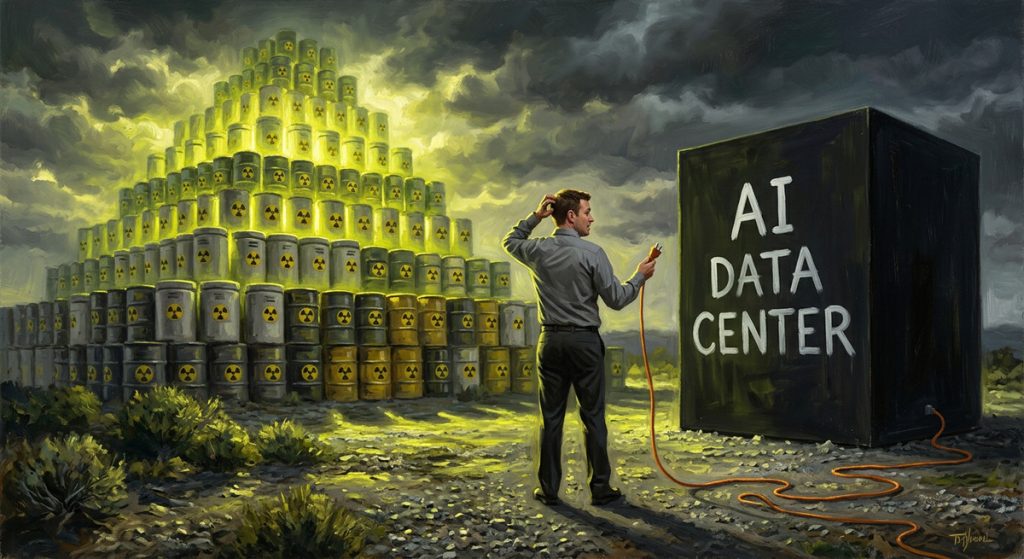
Here is the detail nobody has connected yet: the same fresh water constraint that is forcing Hungary and Romania to shut down their nuclear plants is the same constraint that is forcing moratoriums on AI data center construction across the American Southwest and Midwest.
Data centers use water the same way nuclear plants do — in enormous quantities, for cooling. Evaporative cooling systems at a large data center can consume millions of gallons per day. San Marcos, Texas banned new data centers outright. Hill County, Texas imposed a moratorium. Arizona suspended its data center tax exemptions for three years. Illinois and Ohio paused incentives. Governor Abbott moved to repeal data center sales tax exemptions statewide.
The Danube is not an isolated incident. This pattern has recurred during the 2022 European drought, a dry spell in 2024, and now again in 2026 with greater geographic breadth. The Rhine set its own record low in July. What distinguishes 2026 is that record lows are appearing simultaneously from Germany in the west to the Danube delta in eastern Romania.
The vulnerability, as one analysis noted, is structural: once-through river cooling is the dominant architecture at most European nuclear facilities, and it was designed around historical river flow rates that are now being exceeded with increasing frequency.
Nuclear was supposed to solve the data center power problem. But nuclear and data centers share a victim — and that victim is fresh water.
The Expensive Solutions
The AI industry has proposed several answers to the data center power problem. Nuclear and solar get the headlines and the hyperscaler partnership announcements. But on the ground, the most immediately deployed solution has been far less glamorous: fossil fuel generators — hundreds of diesel and natural gas units parked outside data center campuses, running continuously to fill the gap while grid connections are awaited, SMRs are planned, and solar farms are permitted.
The generator approach is honest about what it is, which is its only virtue. Communities surrounding data center campuses have pushed back hard — diesel generators running at industrial scale produce noise measured in the same decibel range as construction equipment, around the clock, alongside particulate emissions and nitrogen oxides that violate the clean-energy narrative the hyperscalers prefer to project. Several proposed installations have faced local opposition, permitting delays, and outright rejection on air quality grounds. And the generators themselves face the same supply chain pressure as everything else in the buildout — lead times for large industrial generator sets have stretched to eighteen months or more as every data center developer reaches for the same stopgap simultaneously.
Nuclear and solar are the presented long-term solutions. Both are promoted as clean, modern, and inevitable. Both are more expensive, more constrained, and more broken than their proponents acknowledge. And as we will see, both share a vulnerability with the very problem they were supposed to solve.
The nuclear answer is specifically Small Modular Reactors. Microsoft and Constellation Energy are spending more than $1.5 billion to restart Three Mile Island by 2028. Amazon is backing 5 gigawatts of SMR projects targeting 2039. Google has contracted with Kairos Power for 500 megawatts of molten salt reactors by 2035. Every major hyperscaler has a nuclear deal in some form.
The logic is superficially sound. Data centers cannot get grid connections — the interconnection queue backlog stands at 2,600 gigawatts nationally, with waits of up to twelve years. Nuclear provides firm, carbon-free baseload power independent of the grid. Build the reactor next to the data center, bypass the queue entirely.
The problem is the economics, which are worse than the proponents acknowledge.
The standard explanation for nuclear’s high cost is regulatory overhead — NRC licensing, safety analysis, environmental review, quality assurance documentation. This is real and significant: US regulatory costs are among the highest globally. But it is not the complete picture, and a physicist looking at the cost structure sees something the financial models obscure.
Nuclear’s dominant costs are not overhead in the manufacturing sense. They are intrinsic to the reactor regardless of size. Safety systems — containment, emergency cooling, control systems, redundant backups — do not scale down proportionally with output. A small reactor requires essentially the same safety envelope as a large one. Regulatory compliance is per-plant and per-design, not per-megawatt. Site preparation, exclusion zones, seismic analysis, security perimeters, waste handling infrastructure — all fixed per installation. Operational staffing — licensed operators, health physicists, security personnel — does not drop linearly with reactor size.
The SMR pitch was to move these fixed costs from site to factory. But the regulatory fixed cost stays at the site regardless. The economics of small are worse than the economics of large on a per-kilowatt basis, not better.
The data confirms this. NuScale’s 462-megawatt project went from a $5.3 billion cost estimate to $9.3 billion before a shovel touched the ground — and was eventually cancelled. SMR capital costs are currently running around $10,000 per kilowatt compared to $6,600 per kilowatt for conventional nuclear. A project financed at 8% cost of capital accumulates roughly 50% additional cost over a seven-year build. If construction slips by just two years, the economics deteriorate sharply.
A 2026 academic study found that SMRs could generate two to thirty times more spent fuel per unit of energy than large reactors, with some waste streams — irradiated graphite, chemically reactive salts — requiring entirely new handling infrastructure that does not exist yet.
And they still need water. The Danube problem does not go away because the reactor is smaller.
The solar answer sounds more elegant — no regulatory overhead, no exclusion zones, no waste streams. It is not. Solar power’s problems are different in character from nuclear’s but equally disqualifying at data center scale.
The arithmetic of solar is not complicated, but it is rarely stated plainly. Utility-scale solar installations produce roughly one megawatt per five acres of land — and that is nameplate capacity, meaning what the panels produce at peak noon on a clear day. The actual capacity factor for solar averages around 22%, accounting for night, clouds, seasons, and angle of incidence. To deliver one gigawatt of continuous average power to a data center, you therefore need approximately 4,500 megawatts of nameplate solar capacity, requiring somewhere between 22,000 and 45,000 acres of land. That is between 34 and 70 square miles — for a single large data center campus.
That land does not come from the desert. It comes from farmland, because farmland is flat, rural, accessible, and available in the quantities required. The American Farmland Trust has documented the accelerating conversion of prime agricultural land to solar installations, with projections suggesting one to three million acres lost by 2040. Food production capacity is being permanently converted to power production for data centers at a moment when global food supply chains are already under stress. The people making this trade are not the people who will feel its consequences.
The solar energy “solution” is literally diverting food from humans to AI.
Then comes the storage problem, which is where the economics become genuinely absurd. A data center runs continuously. The sun does not shine continuously. For every hour of darkness — on average twelve hours per day, and up to sixteen hours on a winter day at mid-latitudes — the data center must run on stored energy. One gigawatt of continuous power requires a minimum of 12 gigawatt-hours of battery storage for a single night, at an installed cost of approximately $300 per kilowatt-hour. That is $3.6 billion in batteries — for one night. Multi-day cloudy weather, which is not an unusual meteorological event, requires proportionally more. A three-day overcast period demands 36 gigawatt-hours of storage, costing over ten billion dollars at current prices. And lithium-ion batteries degrade; the entire installation requires replacement every ten to fifteen years.
Solar solves the daytime carbon problem while creating a nighttime economics problem that no amount of battery investment has yet resolved at data center scale. It also requires water — for panel washing in dusty environments, for inverter cooling, for the manufacturing process. The solution that was supposed to avoid the water problem turns out to need water too, just less conspicuously.
The Physics-Elegant Alternative
There is another approach. It has been understood for decades, demonstrated in working devices, and almost entirely absent from the AI infrastructure conversation.
It is called a betavoltaic battery.
Unlike a fission reactor, which splits heavy atoms to generate heat that drives a turbine, a betavoltaic battery generates electricity directly from radioactive decay — specifically from beta particles emitted by isotopes like tritium or Promethium-147. The beta particle strikes a semiconductor junction and is converted directly to current, with no moving parts, no heat cycle, no turbine, no cooling water, no steam.
No water at all.
The radiation shielding requirement is trivial. Beta particles are stopped by a few millimeters of plastic — a sheet of paper suffices. A betavoltaic battery can be handled with bare hands, shipped through the mail, installed in a consumer device. The regulatory overhead that makes fission so expensive essentially vanishes. There is no exclusion zone. There is no emergency planning radius. There is no river required.
The Chinese company BV100 made headlines in 2024 with a betavoltaic battery rated for fifty years of continuous output. Westinghouse’s eVinci microreactor uses heat-pipe cooling rather than water — a step toward the same principle at larger scale. The physics has been demonstrated. The devices exist.
The problem is power density. Tritium’s half-life is 12.3 years — fixed by physics, not engineering. You cannot make it decay faster. The energy release rate per gram is what it is: roughly 300 milliwatts per gram at most, declining as the isotope decays. Semiconductor conversion efficiency runs 5-10% under real conditions. And global tritium production is only a few kilograms per year, at a current cost of around $30,000 per gram, as a byproduct of CANDU reactors in Canada.
At those quantities and that price, betavoltaics are viable only for niche applications — pacemakers, deep-space sensors, remote monitoring equipment. The cost structure makes anything larger than a few watts impractical.
The Paths Nobody Is Funding
This is where the analysis gets interesting — and where the “waiting for fusion” objection collapses.
Fusion is one path to cheap tritium at scale. It is not the only one. At least three separate engineering approaches have been analyzed in the peer-reviewed literature, validated in simulation or early experiment, and then left on the shelf for lack of commercial funding. None of them requires fusion. None of them requires building a new reactor. Together they represent a portfolio of near-term pathways to the isotope supply that betavoltaics need — a portfolio that nobody in the AI infrastructure conversation has noticed.
Pathway One: Electron Linac Photoproduction
The first approach requires no reactor at all. High-power electron linear accelerators — the same technology used in medical radiation therapy, deployed in hospitals worldwide — can be aimed at metallic targets to trigger photonuclear reactions that produce beta-emitting isotopes on demand.
The engineering framework was published in the Journal of Radioanalytical and Nuclear Chemistry in 2015, with subsequent production studies at Argonne National Laboratory demonstrating that bombarding titanium dioxide targets with 30-43 MeV electron beams produces Scandium-47 via the ⁴⁸Ti(γ,p)⁴⁷Sc reaction, while zinc targets yield Copper-67 — both high-value beta emitters. A later study at Sandia concluded that a superconducting radio-frequency energy recovery linac offers a path to domestic isotope supply at costs lower than reactor-based production, with lower radioactive waste volume and lower ecological hazard. The accelerator can be turned on and off; there is no chain reaction; the regulatory footprint is a fraction of a nuclear plant’s.
The research exists. The accelerator technology exists. Commercial-scale deployment does not, because nobody has funded it.
Pathway Two: TPBARs in Existing Reactors
The second approach requires no new technology at all. Tritium-Producing Burnable Absorber Rods — TPBARs — are a drop-in modification to any existing commercial pressurized water reactor. Standard boron control rods are replaced with rods containing lithium aluminate ceramic pellets enriched in lithium-6. When the reactor operates normally, neutrons strike the lithium-6 and the reaction is simple: ⁶Li + neutron → tritium + helium-4. The tritium gas is captured in a zirconium getter inside the rod and extracted after each fuel cycle.
This is not a proposal. It is already operating. The Tennessee Valley Authority’s Watts Bar Unit 1 reactor has been running TPBARs for the U.S. Department of Energy’s Tritium Readiness Program for years. Each rod produces approximately 0.95 grams of tritium per reactor cycle; a single reactor can accommodate up to 2,500 rods. The DOE’s current production goal is 1,400 grams per unit per cycle — orders of magnitude beyond current global commercial supply — and NNSA is working to increase that figure further.
The modification does not meaningfully affect reactor operation. The power distribution, coolant flow, and technical specification limits all remain within existing bounds. America’s existing fleet of commercial PWRs could be producing tritium at industrial scale with no new construction, no new regulatory pathway, and no waiting for fusion. The constraint is not physics. It is not engineering. It is the absence of a commercial procurement structure that treats tritium as an energy input rather than a weapons stockpile concern.
Pathway Three: Transmutation of Nuclear Waste
The third approach solves two problems simultaneously — and the scale of the second problem makes the elegance of the solution almost embarrassing.
The DoE shows that the US is currently storing approximately 90,000 metric tons of spent nuclear fuel at more than 70 sites across 35 states, with another 2,000 metric tons added every year. By the time this article is published that figure is closer to 97,600 tons. A quarter of those storage sites no longer have an operating reactor — they are simply warehouses for material that has nowhere to go, costs billions to secure, and represents a permanent proliferation and safety concern. The DOE has been attempting to establish a permanent disposal solution since the 1980s. Yucca Mountain was proposed, funded, politically killed, and abandoned. The waste sits.
What almost nobody has noted publicly is that more than 90% of the potential energy in that spent fuel remains intact. It was not exhausted in the reactor — it was merely rendered inconvenient for continued use in conventional fission. It is not waste in any meaningful thermodynamic sense. It is stranded fuel.
LANL physicist Terence Tarnowsky presented a concept at the American Chemical Society’s fall meeting in August 2025 that treats it exactly that way. His accelerator-driven system fires a gigaelectronvolt proton beam at spent nuclear fuel dissolved in molten lithium salt. The beam generates spallation neutrons. The spent fuel acts as a neutron multiplier, reducing the energy the process requires. Those neutrons then transmute the dissolved lithium into tritium. Tarnowsky estimates the system could produce approximately two kilograms of tritium per year per installation — scalable upward by adding accelerators. The molten salt serves simultaneously as coolant and production fluid. The accelerator can be switched off, eliminating chain-reaction safety concerns. The basic physics has been understood since the 1990s; advances in accelerator technology make it more efficient now than when it was first seriously evaluated.
“The system we’re proposing,” Tarnowsky told reporters, “could very usefully upcycle nuclear waste in a commercial tritium mission that helps on-ramp the fusion economy.”
The feedstock — 97,600 tons of it, accumulating at 2,000 tons per year, stored at sites already equipped with security and handling infrastructure — is already paid for, already sitting there, already a liability on the national balance sheet. Pathway 3 turns that liability into the raw material for the betavoltaic battery supply chain.
The concept is currently in computer simulation. It has not been funded for construction.
Tritium’s 12.3-year half-life outlasts the useful life of the GPU it would power. The battery nobody is building would still be generating electricity when the hardware it runs has been replaced twice.
And Then There Is Fusion
Beyond these three near-term pathways sits the longer-term option that has received the most attention. A recent paper — “Production of Nuclear Battery β− Emitters Driven by Fusion Neutrons” — analyzes using the high-energy neutrons from Deuterium-Tritium fusion to transmute materials into beta-emitting isotopes industrially. A single one-gigawatt fusion reactor could produce over one tonne of Promethium-147 per year — roughly one billion Curies of activity. The dual-purpose aspect is elegant: fusion reactors already need a tritium breeding blanket to sustain their own fuel cycle, and that same blanket can simultaneously produce commercial battery-grade isotopes as a revenue stream.
Fusion is real and approaching. France sustained a fusion plasma for 22 minutes in 2025. The NIF achieved net energy gain. ITER is under construction. The timeline is genuinely uncertain, but “pie in the sky” is no longer the accurate characterization.
But the critical point — the one that should be embarrassing to the AI infrastructure investment community — is that fusion is not required. Three other pathways exist right now. One is already operating at an American nuclear plant. Two require no new reactors whatsoever. All three are underfunded. None has attracted a billion-dollar hyperscaler contract announcement.
A separate engineering improvement relevant to all these pathways: indirect betavoltaic conversion, where beta radiation first excites a phosphor to produce light, which a photovoltaic cell then converts to electricity, decouples the radiation damage problem from the semiconductor junction entirely. Sandia National Laboratories concluded this method has significant potential for volume and cost savings. The research dates to at least 1991.
One Observation
Billions of dollars are currently flowing into SMRs that inherit every overhead problem of conventional nuclear — fixed safety systems, per-plant regulatory costs, water cooling requirements — and into solar farms that convert farmland to panels and require billions more in batteries to survive the night. Meanwhile, three validated pathways to cheap tritium at scale sit in the literature unfunded, one of them already operating at an American nuclear plant, and a fourth arrives with fusion whenever fusion arrives.
The capital is chasing the politically visible solutions: SMRs with government contracts, NRC certifications, and billion-dollar IPOs; solar with tax credits, ESG mandates, and ribbon-cutting ceremonies. The betavoltaic pathway has none of those markers. It does not have a lobbyist in Washington. It does not have a hyperscaler partnership announcement. It does not have a ticker symbol.
What it has is better physics. And now, better than one path to the fuel it needs.
Hungary’s nuclear plants are shut down because the Danube stopped flowing. AI data centers cannot be built in Texas because the aquifers are running low. The expensive solutions being proposed for both problems still need water — the SMRs explicitly, the solar farms quietly.
The battery nobody is building does not.
Sources
- World Nuclear News. “Danube’s Record Low Leads to Hungary, Romania Nuclear Shutdowns.” July 30, 2026. https://world-nuclear-news.org/articles/danubes-record-low-leads-to-hungary-romania-nuclear-shutdowns
- Reuters. “Low Danube Escalates Power Crisis in Hungary and Romania.” July 31, 2026.
- Fortune. “The Dry Danube: Europe’s Legendary River Got So Low That a Cruise Ship Ran Out of Food and Water.” July 31, 2026.
- Institute for Energy Economics and Financial Analysis (IEEFA). “Small Modular Reactors: Still Too Expensive, Too Slow and Too Risky.” May 2024. https://ieefa.org/resources/small-modular-reactors-still-too-expensive-too-slow-and-too-risky
- Kim, Philseo and Macfarlane, Allison. “Challenges of Small Modular Reactors.” Progress in Nuclear Energy, 2026. https://www.sciencedirect.com/science/article/abs/pii/S0149197025003877
- IEEFA. “Eye-Popping New Cost Estimates Released for NuScale Small Modular Reactor.” https://ieefa.org/resources/eye-popping-new-cost-estimates-released-nuscale-small-modular-reactor
- Starovoitova, V.N., Cole, P.L., Grimm, T.L. “Accelerator-based photoproduction of promising beta-emitters ⁶⁷Cu and ⁴⁷Sc.” Journal of Radioanalytical and Nuclear Chemistry 305(1):127–132, 2015. https://link.springer.com/article/10.1007/s10967-015-4039-z
- Mamtimin, M., Harmon, F., Starovoitova, V.N. “Sc-47 production from titanium targets using electron linacs.” Applied Radiation and Isotopes 102:1–4, 2015. https://www.sciencedirect.com/science/article/abs/pii/S0969804315300130
- U.S. Department of Energy / NNSA. “Tritium Production in a Commercial PWR: Overview and Target Design Considerations.” ARPA-E presentation. https://arpa-e.energy.gov/sites/default/files/migrated/Tritium%20Production%20in%20a%20Commerical%20PWR,%20Overview%20and%20Target%20Design%20Considerations.pdf
- Tarnowsky, T. “On-ramping the fusion economy with kilogram quantities of commercial tritium.” Presented at ACS Fall 2025 Meeting, August 17–21, 2025. https://www.acs.org/pressroom/presspacs/2025/august/nuclear-waste-could-be-a-source-of-fuel-in-future-reactors.html
- Los Alamos National Laboratory. “Accelerator could produce commercial tritium.” LANL News Release, August 28, 2025. https://www.lanl.gov/media/news/commercial-tritium
- U.S. Department of Energy, Office of Nuclear Energy. “5 Fast Facts about Spent Nuclear Fuel.” https://www.energy.gov/ne/articles/5-fast-facts-about-spent-nuclear-fuel
- “Production of Nuclear Battery β− Emitters Driven by Fusion Neutrons.” (Cited in DeepSeek analysis of tritium production scaling.)
- Sandia National Laboratories. Indirect betavoltaic conversion research. (Documents dating to 1991, cited in DeepSeek analysis.)
- Data Center World. “Powering the Future.” https://datacenterworld.com/powering-future/
- SMR Intel. “How Much Do Small Modular Reactors Cost?” March 2026. https://smrintel.com/smr-cost-per-kwh/
The author is an independent researcher and writer based in Dallas. This is part of the Future of AI series.
Leave a Reply