
Chapter 1 of How To Live Forever


In 1827, the Imperial Chinese government sent official congratulations to one Li Ching-Yuen on his 150th birthday. Fifty years later, in 1877, they sent him congratulations on his 200th birthday. He died on May 6, 1933.
You can do the arithmetic.
Whether Li Ching-Yuen genuinely lived 256 years — or 197, depending on which birth record you accept — or whether the name was passed from father to son for generations, nobody can settle now. What cannot be dismissed is that the Imperial Chinese government thought his longevity real enough to officially celebrate, twice, fifty years apart. And what is impossible to ignore is the herb list he reportedly lived on for his first hundred years in the mountains.
He took lingzhi, goji berry, wild ginseng, he shou wu, and gotu kola.
I take four of those five every day.
This chapter is their story.
Nobody wants to hear from the ancients about longevity. They’re all dead. Some of them died at ages that are frankly embarrassing given the subject matter. And they had no randomized controlled trials, no molecular biology, no epigenetic clocks, and no Life Extension Foundation annual blood test sales.
What they had was time. Millennia of careful observation across populations large enough to make a Stanford study look like a rounding error. Empirical selection — what worked got preserved, what didn’t got forgotten — operating on a timescale that no modern research program can approach. And a motivated interest in the question, since the alternative to getting longevity right was dying.
The lesson is not that the ancients found the Fountain of Youth. They didn’t — we know this because they’re all dead. The lesson is that they observed what worked and kept with it, passing it down as wisdom through cultures that survived long enough to transmit it. When modern molecular biology eventually showed up to explain the mechanisms, it found that the observations had been largely correct.
This chapter is also, in ways that will become apparent, my story — because I have been taking the same herbs as that 256-year-old Chinese hermit, and growing the same plants that ancient India identified as consciousness itself, and drinking the same tea that Buddhist monks discovered kept them awake for meditation 1,200 years before L-theanine was isolated and named. I did not plan any of this. The evidence led there.
The Man Who May Have Lived 256 Years
In 1930, Wu Chung-chieh, a professor at Chengdu University, discovered something remarkable in the Imperial Chinese government archives: official records from 1827 congratulating Li Ching-Yuen on his 150th birthday, and further official documents from 1877 congratulating him on his 200th birthday. In 1928, a New York Times correspondent reported that many elderly men in Li’s neighborhood asserted that their grandfathers knew him when they were boys, and that he was already a grown man at that time.
The Imperial Chinese government, which had no particular motivation to falsify birthday congratulations, considered the 150th and 200th celebrations official enough to document. What cannot be dismissed is the documentation, the community testimony spanning multiple generations, and the 11 generations of direct descendants still living in 1928, distributed across what was reported as 14 to 24 marriages and at least 180 children.
Before his death, Li was asked for his secrets. His answer: “Keep a quiet heart, sit like a tortoise, walk sprightly like a pigeon and sleep like a dog.”
The physiological translation of that advice maps directly onto what the stress chapter, the sleep chapter, and the exercise chapter document mechanistically. Inward calm — HPA axis normalization, cortisol management, the ashwagandha protocol. Deliberate unhurried posture — parasympathetic nervous system engagement. Energetic ambulation — cardiovascular maintenance, lymphatic circulation, the vigorous exercise chapter’s argument in two words. And sleep like a dog — deep, uninterrupted, physiologically restorative, the melatonin-GH-REM cascade the sleep chapter describes running optimally.
He said this in the nineteenth century. The mechanisms arrived in the twentieth.
His last words as he was dying: “I have done all that I have to do in this world.” Whatever age he was, he did not experience his death as premature. The Tibetan tradition that Hilton drew on for Shangri-La recognizes the same phenomenon. The advanced practitioner declares the time of his departure and then departs with his body remaining coherent long after clinical death as a final expression of the same mastery that governed the living years. These traditions are not claiming that certain people escape biological aging. They may be claiming something more interesting: that the relationship between subjective time, biological state, and calendar years is more variable than Western medicine’s single clock acknowledges.
The Three Herbs
The formula historically associated with Li Ching-Yuen has been in my protocol for forty years — and the overlap with his herb list runs deeper than it first appears. Lingzhi, listed among his mountain diet staples, is reishi mushroom by its Chinese name. It appears in my morning coffee blend every single day. By the time the sublingual trio is counted, four of his five herbs are present in my daily protocol. I make an exception for the goji berry because it most likely was taken to supply vitamin C, which I take plenty of.
The herbs are simple to name and considerably less simple to source correctly. This is the part most people miss — and the part that determines whether you’re taking an effective intervention or an expensive placebo.
Korean Red Ginseng is not ginseng. Or rather, it is ginseng prepared through a specific process that transforms the root’s chemistry in ways that white ginseng and American ginseng do not achieve. The roots must be at least six years old — this is not marketing language, it is the biological reality of how ginsenoside profiles develop in Panax ginseng. A four-year root has a different and less active ginsenoside composition than a six-year root. You can tell by the flavor: properly aged, properly cured Korean red ginseng has a distinctive bitterness and warmth that younger or improperly processed material does not produce. I take it sublingually, which is why it’s in the sublingual trio and not swallowed — the buccal absorption of the ginsenosides begins immediately, bypassing first-pass liver metabolism.
What the ginsenosides actually do is the subject of a literature now spanning decades: Rb1 reduces mental and physical fatigue, inhibits amyloid aggregation, and has neuroprotective effects. Rg1 upregulates BDNF and stimulates neurogenesis in the hippocampus. Rg3 — the compound that appears uniquely in red ginseng through the steam-curing process — has anti-inflammatory, anti-cancer, and cognitive effects not found in the white form. The HPA axis normalization that makes ginseng a genuine adaptogen, rather than a stimulant, operates through mechanisms that took until the late twentieth century to characterize.
Li’s mountains produced wild ginseng of unknown age and preparation. My protocol specifies six-year Korean red, properly cured, because the mechanism demands it.
He Shou Wu — fo-ti in Western markets — translates not just as “black hair” but more precisely as “black hair on top.” Named after a Taoist practitioner who reportedly restored his scalp hair color and vitality through the root after years of illness. The name itself is the traditional claim, and the precision of its anatomical specificity turns out to be mechanistically interesting.
Fo-ti must be properly fermented with black bean paste — the traditional preparation that distinguishes he shou wu from raw fo-ti, which is hepatotoxic. This is not a trivial distinction. Raw fo-ti contains anthraquinones that can cause serious liver damage. The black bean fermentation process transforms these compounds through microbial activity, eliminating the hepatotoxic fraction while concentrating the active stilbene glycosides — principally 2,3,5,4’-tetrahydroxystilbene-2-O-β-D-glucoside (TSG) — that drive the herb’s documented effects. An improperly prepared fo-ti product is not merely ineffective; it is dangerous. This is the thyroid contamination warning of the TCM world. I have tried all sorts of fo-ti over forty years. The market is full of worthless or dangerous alternatives, and the difference between a correctly prepared product and an incorrect one is not subtle.
TSG’s documented mechanisms include AMPK activation. I take many other supplements to boost this critical cellular energy sensing pathway. Animal studies consistently show neuroprotective and memory-enhancing effects. The hair-darkening claim that gave the herb its name may reflect the melanogenesis-supporting activity of its antioxidant compounds on hair follicle melanocytes, where oxidative stress drives the graying process.
The traditional claim sounds like the kind of thing that gets sold on late-night infomercials. I can report from forty years of use that my ABA methodology produces an unambiguous result: within ten days of stopping quality fermented fo-ti, or of substituting an improperly prepared product, gray hair visibly increases. Resume the correctly prepared supplement, and the effect reverses. This has happened enough times, across enough different periods of inadvertent deprivation or product substitution, to constitute feedback rather than coincidence. The name He Shou Wu was not poetic license. It was an observation.
The anatomical precision of that name is worth pausing on. Gray beard hairs and white chest hairs are unaffected while scalp pigmentation responds. The ancient practitioners observed the same follicle-specific pattern — scalp follicles and beard follicles have different androgen receptor densities, different sensitivity to DHT, and different melanocyte populations — and named the herb after exactly what they saw. They didn’t say “black hair.” They said “black hair on top.” Because that’s what happened. Over centuries of use, the specificity made it into the name.
Gotu Kola will appear in multiple chapters of this book — in the Wake-Up Protocol as the second daily dose of neurite outgrowth and BDNF stimulation, in the Quick Brain Nootropic formula as a standardized extract. The Ayurvedic tradition calls it brahmi — a word that also means consciousness, which tells you exactly how seriously Indian traditional medicine took its cognitive effects. It was cultivated in my garden, which tells you how seriously I took it too.
Its asiaticoside and asiatic acid compounds promote neurite outgrowth, dendritic branching, and BDNF production with a consistency across the literature that the pharmacological mechanism would predict. The Ayurvedic claim that gotu kola supports consciousness and mental clarity, made empirically over centuries without knowledge of BDNF or neurite morphology, described the downstream functional consequence of exactly what the molecular biology later showed it was doing.
Li Ching-Yuen survived on these herbs for forty years in the mountains. The mountains provided the stress hormesis, the physical activity, the clean air, and the sun exposure. The herbs provided what his environment couldn’t. Modern analysis confirms that his selection, across a pre-scientific era, was essentially correct.
Astragalus: Where the Ancient and the Modern Converge Most Dramatically
Li’s herb list included lingzhi — reishi mushroom, which appears in the morning coffee blend for its neuroinflammation-reducing and sleep-architecture-supporting properties. But the most striking ancient-to-modern convergence in the TCM longevity tradition is a herb Li did not specifically mention: Astragalus membranaceus, known in Chinese medicine as huang qi, one of the most fundamental tonics in the entire pharmacopoeia.
Huang qi has been prescribed for immune support, energy, and longevity in Chinese medicine for over two thousand years. The mechanism nobody suspected until the year 2000: it contains cycloastragenol and astragaloside IV, compounds that activate telomerase — the enzyme that maintains telomere length, the protective caps on chromosomes that shorten with each cell division and whose attrition is among the most consistent markers of biological aging.
Subjects taking a low dose of TA-65 (a purified astragalus extract) in a randomized double-blind placebo-controlled trial significantly increased telomere length over 12 months by 530 ± 180 base pairs, while subjects in the placebo group significantly lost telomere length at 290 ± 100 base pairs. The same herb that two-thousand-year-old Chinese medicine prescribed as a fundamental longevity tonic turns out to be one of the only compounds ever demonstrated in a randomized controlled human trial to actually lengthen telomeres.
TA-65 was discovered in the year 2000 from an empirical screen of natural product extracts from traditional Chinese medicines. The researchers were not looking for telomerase activators in Chinese herbs. They were screening traditional longevity compounds for molecular activity. They found what the Chinese tradition had been pointing at for two millennia.
This is too new for studies to show lifespan increases in long-lived animals but it has been documented in species with short lifespans. (Yang, 2023)
The cancer caution is real and worth stating: telomerase reactivation is one way that tumor cells achieve immortality, and any compound that activates telomerase could potentially exacerbate those tumors. The short-term safety data is reassuring. The long-term picture is not fully characterized. This is one of the few areas in the protocol where the ancient confidence should be tempered by the modern uncertainty.
But the basic observation — that this herb does something relevant to the fundamental mechanism of cellular aging — is now documented in peer-reviewed human trials. The TCM tradition identified the right plant two thousand years before the mechanism existed to be found.
Ayurveda: The Science of Life
The Indian subcontinent developed Ayurveda — the “science of life” — as a comprehensive medical system over roughly 3,500 years, producing a pharmacopoeia that the subsequent chapters of this book draw on repeatedly without always acknowledging the tradition from which the compounds were borrowed.
Ashwagandha: hailed as the “king of Ayurvedic herbs,” prescribed for stress reduction, vitality, energy, and cognitive function across three millennia. Modern mechanism: HPA axis normalization through withanolide-mediated adrenal modulation, cortisol reduction, thyroid stimulation, testosterone support, BDNF protection, and GABAergic modulation through the allopregnanolone pathway. It appears in this book’s cognitive chapter, thyroid chapter, hormone chapter, and sleep chapter simultaneously — not because it was placed there deliberately, but because the single mechanism it operates through — normalizing the central stress response system — ramifies through every endocrine system that chronic stress damages. Ayurveda identified this as the king herb. Modern endocrinology explains why.
Gotu kola — brahmi, consciousness — already discussed above and throughout the book. Its Ayurvedic reputation as the herb of mental clarity and neural rejuvenation is mechanistically validated by BDNF upregulation, neurite outgrowth promotion, and dendritic branching stimulation that the Wake-Up Protocol chapter documents in detail.
Dandelion: dismissed in Western culture as a lawn weed, valued in Ayurveda for liver detoxification, digestive support, and hormonal balance. It appears in the post-workout stack’s Silymarin Complex with dandelion and artichoke for exactly those reasons — bile stimulation, hepatic support, liver enzyme normalization. The weed the herbicide industry is trying to eliminate from suburban lawns has been a functional medicine herb for millennia.
The Ayurvedic tradition was not guessing. It was observing, selecting, and transmitting. The mechanisms arrived later to explain observations that had been empirically validated across generations too numerous to count.
Methuselah and the Pre-Flood Diet
The Bible is not typically cited in longevity literature, for obvious reasons. But its account of pre-flood human lifespans is too interesting to ignore — particularly when you know that some scholars interpret the Hebrew word for “year” in the early Genesis accounts as potentially referring to seasons rather than solar years.
If Methuselah’s 934 “years” represent seasons rather than years, the arithmetic produces approximately 243 solar years. Still implausible by modern standards, but placing him in the same neighborhood as Li Ching-Yuen in ways that are difficult to dismiss entirely.
The speculation is unverifiable and should be treated as such. But the Biblical dietary detail is worth noting: Genesis 1:29 describes the pre-flood diet as exclusively plant-based — “every seed-bearing plant on the face of the whole earth and every tree that has fruit with seed in it.” The people who lived to implausible ages in the text were eating the diet described in the caloric restriction and vegetarianism chapters. After the flood, meat was permitted, and the documented lifespans declined dramatically toward modern ranges across the subsequent generations.
Whether this reflects historical reality, theological allegory, dietary observation encoded in narrative, or ancient numerology is a question this book does not attempt to resolve. The vegetarian diet connection is either a profound coincidence or an ancient observation transmitted through a document that was never intended as a longevity manual.
Not many other potential causes of super-longevity are mentioned early in the bible but there is one: the Balm of Gilead for which no modern species had been identified – until recently:
Sheba: The Resurrection of a Lost Medicine
The most remarkable story in this chapter involves a seed, a cave, a scientist, and a tree that shouldn’t exist.
In the late 1980s, archaeologists excavating a cave in the Judean Desert found an unidentifiable ancient seed. It sat in storage for decades before Dr. Sarah Sallon at Hadassah University Medical Center obtained it and attempted germination using specialized hormones. In 2010, the seed sprouted. The tree it produced — now ten to twelve feet tall and nicknamed Sheba — has been DNA tested and found to belong to the genus Commiphora, the myrrh and frankincense family, while matching no living species on Earth. It is an extinct regional taxon, the last surviving member of a lineage that disappeared from the Levant a thousand years ago.
Sheba is almost certainly the Judean Balsam — the legendary Balm of Gilead — that ancient writers described as more valuable than gold. The Hebrew orchards around the Dead Sea produced a resin so coveted as a healer, tissue-repairer, and elite medicine that it sold for twice its weight in gold. Roman and Jewish armies literally fought over the trees during the Jewish-Roman war of 70 A.D. — Jewish fighters attempting to destroy the orchards to prevent the wealth falling to Rome, Romans defending them desperately. Branches of the rare plant were later paraded through the streets of Rome as symbols of triumph.
The tree was finally driven to extinction by over-harvesting under Roman and Byzantine management, the ancient equivalent of the pharmaceutical industry depleting a natural resource to meet demand without thought for sustainability.
Laboratory analysis of Sheba’s leaves and resin confirms what the ancient texts described: extraordinary anti-inflammatory, antibacterial, and tissue-repairing compounds. The same tree whose resin Jeremiah referenced as the physical wound-healer of Gilead — “Is there no balm in Gilead?” — demonstrates unique anti-cancer activity when introduced to tumor cell lines in contemporary laboratory testing.
A 1,000-year-old seed, alive but dormant through a millennium, germinated into a tree carrying medicinal properties the ancient world valued above gold. The seed was not dead. It was waiting.
Maybe someday we will be able to achieve a similar suspended animation as the Sheba seed did and jump millenia ahead. The ancients were not wrong about the Balm of Gilead. They identified something extraordinary. They simply couldn’t sustain it. The medicinal intelligence was always there, locked in the chemistry of a plant that outlasted its civilization in the form of a single dormant seed.
The anti-inflammatory and tissue-repairing compounds confirmed in Sheba’s analysis belong to the same boswellic acid family present in Boswellia serrata — frankincense extract — which has been in continuous use as a joint and inflammation support supplement in modern longevity protocols. The tree drove Rome and Jerusalem to war over it. Its active compounds are available at any health food store today.
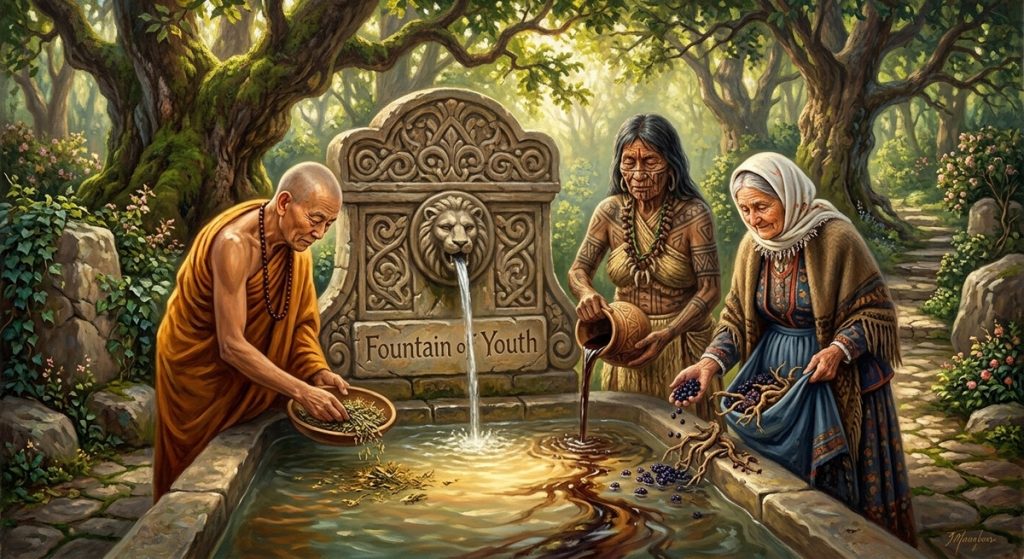
There is a lesson here. If there ever had been a Fountain of Youth, it would have long ago been drained dry.
What the World’s Longest-Lived People Share
Every documented longevity hotspot — the south-central highlands of China where jiaogulan tea, the “immortality herb”, is drunk daily, the Okinawan communities with their bitter melon and turmeric, the Sardinian villages with their moderate wine and pecorino and vigorous walking, the Seventh-Day Adventist communities with their plant-based diets, the centenarian populations of the Chinese provinces where green tea is the daily beverage — shares a pattern that no single longevity variable explains.
The Bama Yao county of Guangxi Province — home to the highest documented centenarian density in the world, 5.7 times the national average — was studied exhaustively for a hidden longevity factor in the water, soil, or genetics. None was found. The lifestyle though followed the pattern: plant-heavy diet of hemp seeds, sweet potatoes, leafy greens, and bitter vegetables; low caloric intake by default rather than intention; outdoor physical labor all day; tight multigenerational social networks. The tragic postscript is the most instructive detail of all: well-meaning outsiders, feeling sorry for what looked like poverty and deprivation, sent processed food. The centenarian density is declining. Their Fountain of Youth was not a secret; it was a lifestyle. And it turned out to be remarkably easy to destroy with outside help.
Periodic fasting or caloric restriction by default rather than intention. Vigorous physical activity maintained late into life as a natural part of daily existence rather than a scheduled gym session. Fermented foods — yogurt, kefir, kimchi, miso, traditional cheese — providing probiotic support before probiotics had a name. Herbs and spices embedded in cuisine rather than isolated as supplements: fenugreek in Armenian chili paste, turmeric in Indian cooking, ginseng in Korean preparations, green tea across East Asia, rosemary and garlic in the Mediterranean. Meaningful social connection and purpose extending through late life. Minimal processed food. Adequate sun exposure producing vitamin D in populations that had no need for a concept of vitamin D.
The yogurt and fenugreek that appear at the end of this list appeared at the beginning of this chapter in Li Ching-Yuen’s story, and they will appear again throughout this book in contexts that progressively make clear that the ancients were not distributing nutritional wisdom randomly. They were distributing what worked, selected by the only mechanism that has ever reliably identified what works: generational survival.
Before the Mechanism Arrived
I did not come to these herbs through Li Ching-Yuen or the Ayurvedic tradition or the Caucasian centenarian studies. I came through the primary literature, beginning in 1982, reading across disciplines that institutional science was keeping in separate boxes.
But the destination was the same. The ginseng I take sublingually from six-year properly cured Korean red roots is the ginseng Li’s mountain diet supplied for a century. The fo-ti I source fermented with black bean paste is the he shou wu that allegedly kept his hair dark and his vitality intact. The gotu kola I grew in my own garden because it was said “to regrow brain cells” is the brahmi that Ayurveda identified as consciousness itself thousands of years before BDNF existed as a concept.
The ancient tradition and the modern mechanism arrived at the same protocol from opposite directions across centuries.
That is not coincidence. That is two independent systems of inquiry converging on the same truth.
The ancient dream of extended life was not fantasy. It was early science, conducted without the tools to explain what was being observed, by people who had every reason to pay careful attention.
We have the tools now. The next chapters describe what we’ve found.
That Number Again
James Hilton published Lost Horizon in 1933 — the same year Li Ching-Yuen died. His Shangri-La, drawn from Tibetan Buddhist legends of the hidden valley of Shambhala, featured Father Perrault living to 250 years through the mountain air, the contemplative life, and the moderation in all things that the valley enforced.
Li Ching-Yuen: 256. Father Perrault: 250. Methuselah in the seasons interpretation: 243.
Three independent traditions — Chinese Taoist, Tibetan Buddhist, Hebrew Biblical — separated by geography, language, theology, and millennia, converging on the same approximate number in the same year. The Ancient Dream did not imagine immortality. It imagined 250 years as the outer edge of what was possible under the right conditions.
Then the rat studies arrived.
When early caloric restriction research demonstrated that CR could extend maximum lifespan by 30-40% in rodents, researchers applied the same percentage to documented exceptional human longevity. The arithmetic produced projections in the neighborhood of 240 years. The laboratory data had no knowledge of Li Ching-Yuen. The researchers had no knowledge of Methuselah’s seasons. James Hilton had no knowledge of the CR data. And yet the number landed in the same place.
Four independent convergences: mythology, scripture, fiction, and rat studies. A more epistemologically incompatible collection of sources could not easily be assembled. And yet…
That number is perhaps the book’s real target. Not because four traditions said so. But because longevity escape velocity mathematics and the compounding of independently validated interventions suggest it might be reachable — and because the traditions that encoded it were observing something real, even if they could not explain what they were seeing.
The Ancient Dream and the modern protocol are describing the same destination.
Things that make you go “hmmm…”
Leave a Reply