
Another Excursion to the Edge
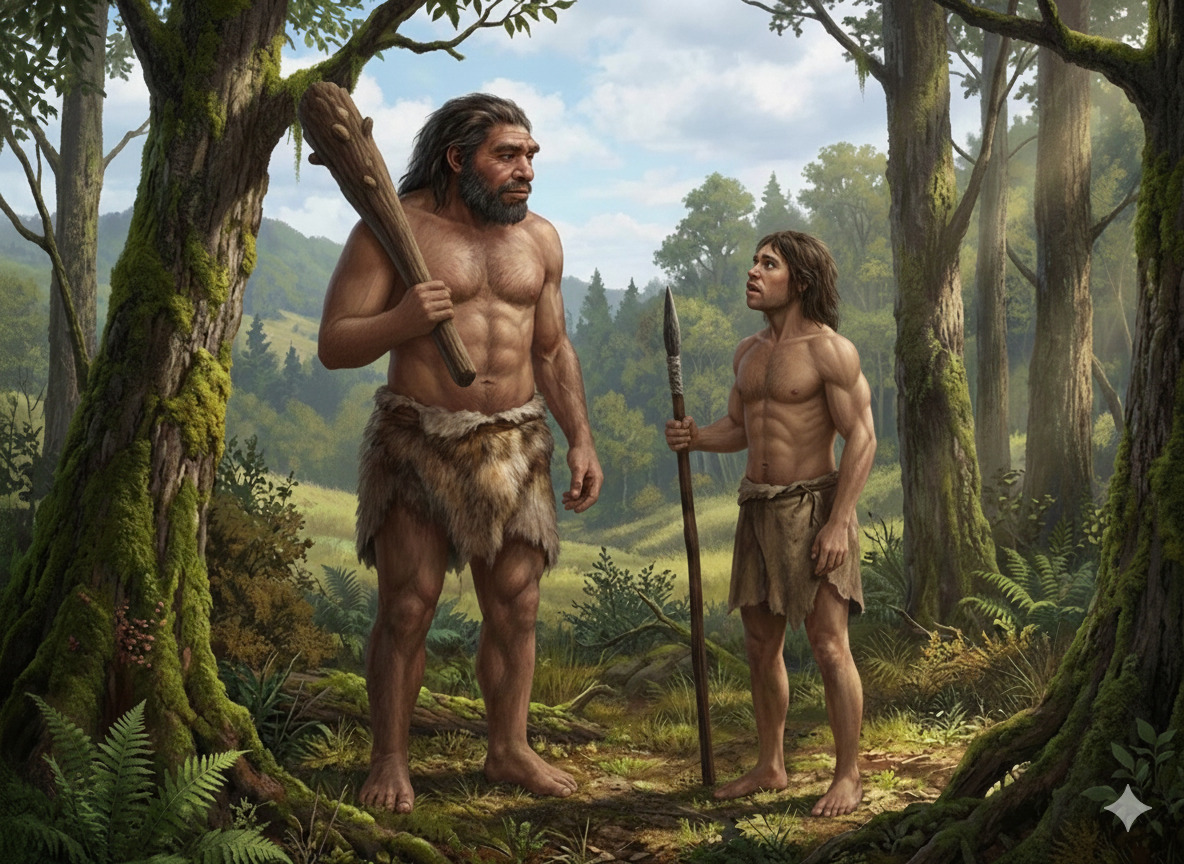
Denisovan Man meets an early Human
In February 2016, I posted an observation on WordPress that most anthropologists would have found professionally risky:
“I have a wacky theory that all the ancestral hominid bones they’ve found so far are ancestral to our own. Without the DNA to go on, all they can do is comparative anatomy and guess what the intra-species variability is. When they start talking about ‘interbreeding species’ of Denisovan, Neanderthal, and modern humans, that is just BS because a species is defined by its inability to breed with other species. I think you had various migrating vs isolated populations going back 8-10 million years that would independently change and later on, migrate and interbreed again, until in the modern human you have this huge variation of genes that represent all the different kinds of hominids we descended from.”
The peer-reviewed confirmation has been arriving ever since.
Why Variation Matters
Sexual reproduction is expensive. It requires finding a mate, competing for reproductive access, and producing offspring that carry only half your genes rather than a full copy. An asexually reproducing organism producing identical copies of itself is twice as reproductively efficient. Evolution should have eliminated sex.
It didn’t. The reason is variation.
In a stable ecological niche with a well-adapted population, variation is mostly liability. The organism that departs from the optimized form is likely worse adapted than its parents — slower, weaker, more susceptible to local pathogens, less efficient at processing local food. Most mutations are deleterious. Most novel trait combinations reduce fitness. The stable environment punishes departure from the optimum.
But environments change. Novel pathogens arrive. Climate shifts. Prey populations collapse. Competitors appear. The population perfectly adapted to yesterday’s environment may be catastrophically unprepared for tomorrow’s. In a changing environment, variation is the only mechanism that produces the raw material for adaptation. The offspring that happens to carry a combination of traits suited to the new conditions survives when its optimally-adapted siblings do not.
Sexual reproduction doesn’t improve the species. That framing is wrong in a specific and important way. It generates variation — most of which is neutral or harmful — that occasionally, in the right environmental context, produces a combination of traits that confers survival advantage. The process has no direction, no foresight, no improvement function. It shuffles the deck. Most hands are worse than the cards you started with. Occasionally a hand is better. In a changing environment, that occasional better hand is everything.
Hybridization between divergent populations amplifies this mechanism dramatically. Two populations isolated long enough to develop distinct adaptations to their respective environments carry different solutions to different problems. Their hybrid offspring carry combinations of both solution sets. Most combinations are worse than either parent lineage optimized for its own environment. Some combinations are better than either parent for environments neither had encountered.
A July 2022 study in the American Journal of Physical Anthropology using Chinese and Indian rhesus macaques — chosen specifically because their divergence time in generations approximates the Homo sapiens/Neanderthal divergence — documented transgressive phenotypes in hybrid offspring: extreme size, heightened overall variation, and novel skeletal markers that existed in neither parent population. Hybridization doesn’t produce averages. It produces extremes. The creative force that unlocks the unusual — the occasional hand that is better than the cards either parent was dealt.
The Hybridization Hypothesis
The hominin lineage appears to have exploited this mechanism repeatedly — not through conscious choice but through the behavioral flexibility that brought divergent populations into contact at precisely the moments when new environments demanded novel adaptations.
The modern human who hybridized with cold-adapted Neanderthals in the Fertile Crescent carried offspring with immune variants, skin adaptations, and metabolic traits that neither parent population had optimized individually. A December 2025 paper in NPJ Biology, Timing and Sleep identified 265 independent genomic segments of adaptive introgression related to circadian rhythms, sleep patterns, and chronotype — inherited from Neanderthals and Denisovans. Modern humans entering high-latitude Eurasia, where seasonal daylight shifts are extreme, did not need to wait hundreds of thousands of years for the relevant mutations to arise. They borrowed the already-evolved solution from populations that had been there for hundreds of thousands of years. The mechanism bypassing the normal mutation-selection timescale entirely.
The modern human who hybridized with high-altitude Denisovans on the Tibetan Plateau carried offspring with EPAS1 variants that made the plateau habitable. The adaptation that took Denisovans hundreds of thousands of years to evolve transferred in a single generation.
This is the Hybridization Hypothesis: the defining characteristic of the hominin lineage is the repeated exploitation of inter-population hybridization as an adaptive mechanism. Not tool use, not language, not cognitive capacity alone — though all three matter — but the cycle of isolation generating divergent adaptation followed by contact incorporating that adaptation into an expanding gene pool.
Crucially, humans did not merely tolerate this mechanism passively through geographic contact. They actively maintained it through the cultural barriers — language, religion, endogamy, caste — that created the isolation necessary for divergent adaptation, and the cultural flexibility that periodically dissolved those barriers at the moments when hybrid vigor was most needed. A language barrier is maintained by the speakers. A religious prohibition against outmarriage is enforced by the community. A caste system operates as a genetic isolation mechanism within geographic proximity — the Brahmin and the Dalit living in the same village for three thousand years maintaining reproductive isolation more effectively than any mountain range.
The isolation phase accelerates adaptation. A small population practicing endogamy within a specific environment produces genetic drift and local adaptation faster than a large panmictic population. The cultural barrier does what the mountain range does, but faster and more selectively.
The hybridization phase is also culturally mediated. The breakdown of cultural barriers — conquest, trade, migration, conversion — produces hybridization events structured by which cultural groups come into contact and under what circumstances.
The web that the genomic data reveals is not an accident of geography. It is a strategy.
The Timing That Isn’t Coincidental
The Quaternary glaciation began approximately 2.1 million years ago, initiating the cycle of ice ages and interglacials that would oscillate Eurasian climates between extremes for the next two million years. The earliest evidence of hominins outside Africa — Homo erectus at Shangchen in China — dates to the same geological moment.
The hominin lineage didn’t expand into Eurasia despite the Ice Ages. It expanded into Eurasia because of them. The oscillating environments that punished fixed adaptation rewarded variation. The hybridization strategy that generates variation through inter-population contact is optimally suited to a world where the climate shifts between extremes on hundred-thousand-year timescales. The hominins that entered Eurasia 2.1 million years ago were entering the most variable environment on Earth at the moment it became most variable. They were built for exactly this.
The Story the Genomes Tell
The scientific literature has converged on exactly this framework under the terms adaptive introgression, reticulate evolution, and transgressive segregation.
A July 2024 Princeton University study led by Joshua Akey, using an AI-powered genetic tool called IBDmix to analyze 2,000 living humans alongside three Neanderthal and one Denisovan genome, mapped three distinct waves of modern human-Neanderthal contact: 200-250,000 years ago, 100-120,000 years ago, and the largest wave 50-60,000 years ago. Not one accidental encounter — a 200,000-year history of repeated contact. Isolation was always leaky. Populations routinely re-merged over vast timescales, continuously injecting fresh variation into both lineages.
“For the vast majority of human history, we’ve had a history of contact between modern humans and Neanderthals,” said Akey. “Our models show that shortly after modern humans arose, we’ve been migrating out of Africa and coming back to Africa, too.”
The story goes deeper than Neanderthals. A 2023 Nature paper by Brenna Henn, Tim Weaver, and colleagues — the Weakly Structured Stem study — found that modern humans did not emerge from a single isolated population in Africa but from a network of interbreeding groups spread across the continent. The earliest detectable split among modern humans occurred 120,000 to 135,000 years ago — but even before that divergence, ancestral populations were already exchanging genes across different African regions. The family tree of Homo sapiens was a web from the very beginning.
A 2025-2026 series of genomic modeling papers pushed this further, establishing that Homo sapiens emerged from an approximately 80/20 merger of two deeply divergent ancestral African populations. The species that hybridized its way across Eurasia first hybridized into existence.
And a July 2024 TRACE study published in Science by Zhang et al. at UC Berkeley found two additional ghost lineages previously unknown: one present in all modern humans at approximately 1%, diverging from the human family tree 800,000 years ago and mixing back into our ancestors before the Out of Africa expansion; a second mixing with human ancestors in Eurasia 1.7 million years ago. The hybridization strategy predates Homo sapiens. It may predate the genus Homo.
The Acceleration
In March 2010, a finger bone from Denisova Cave in Siberia yielded mitochondrial DNA that matched no known human or Neanderthal. The Denisovans were discovered from a pinky finger and a tooth. Two months later, Svante Pääbo’s team at the Max Planck Institute published the first complete Neanderthal nuclear genome in Science, May 6-7, 2010 — sequenced from three female Neanderthals from Vindija Cave, Croatia. Neanderthal DNA: 99.7% identical to modern humans. Up to 2% of non-African human DNA confirmed as Neanderthal in origin. The ancient DNA revolution had begun.
What followed in sixteen years is unprecedented in the history of anthropology:
2010 — Denisovans identified from a finger bone. Complete Neanderthal nuclear genome published in Science. Australopithecus sediba described from fossils found by a nine-year-old boy in South Africa.
2012 — Complete Denisovan genome published. Neanderthal introgression confirmed at population scale.
2013 — Homo heidelbergensis DNA extracted from 400,000-year-old bones in Sima de los Huesos, Spain — the oldest human nuclear DNA ever recovered, revealing unexpected Denisovan affinity despite a European location.
2015 — Homo naledi discovered in the Rising Star Cave system in South Africa — a previously unknown species with a brain a third the size of modern humans that apparently practiced deliberate burial. Accessed through a slot 18 centimeters wide.
2016 — Homo floresiensis confirmed as a genuine species. Van den Bergh et al. published 700,000-year-old fossils from Mata Menge on Flores — a jaw fragment and teeth just as small as the 60,000-year-old “Hobbit” remains from Liang Bua. A genetic pathology cannot persist across an entire island population for 650,000 years. The small stature was a long-standing evolutionary adaptation — island dwarfism, a well-documented mammalian response to resource limitation. The species mocked as “the Hobbit” when first described in 2004 had been waiting 700,000 years to prove the skeptics wrong.
2019 — Homo luzonensis described from the Philippines — a distinct hominin contemporaneous with modern humans on Luzon island. Xiahe mandible from Tibet identified as Denisovan through ancient protein analysis — the first proteomics-based hominin identification, extending Denisovan range from Siberia to the Tibetan Plateau at 160,000 years ago.
2020 — West African ghost ancestor confirmed — 2-19% of West African ancestry from an archaic population diverging before the Neanderthal split.
2021 — Homo longi — “Dragon Man” — described from a skull found in Harbin, China in 1933, hidden under a bridge by a Chinese farmer to protect it from Japanese occupiers, formally described after decades in obscurity. The largest hominin braincase ever documented. Subsequently confirmed as Denisovan through proteomics.
2023 — The Weakly Structured Stem paper published in Nature — modern humans emerged from a network of interbreeding groups across Africa, not a single origin point. Cave sediment eDNA techniques refined to detect hominin presence without skeletal material. Six distinct Denisovan population signals identified in modern human ghost ancestry across Asia.
2024 — Three waves of modern human-Neanderthal contact mapped across 200,000 years using IBDmix — Princeton/Southeast University. Homo juluensis proposed in Nature Communications as a synthesis taxon for the confusing East Asian fossil record, potentially encompassing the physical body of the Denisovan population. Two additional TRACE ghost lineages identified, one present in all modern humans.
2025 — Penghu 1 mandible from Taiwan identified as male Denisovan through ancient protein analysis, published in Science April 10, 2025. Dredged from the Penghu submarine channel and found in a Taiwanese antique shop. 4,241 amino acid residues retrieved, two Denisovan-specific variants confirmed. Robust jaw consistent with large body size. Denisovans confirmed in warm, humid subtropical Asia. A photograph in the paper shows a table covered in bones from the same channel stretching beyond the frame — the commercial dredging of this repository has been distributing specimens through antique markets for decades. December 2025: 265 independent genomic segments of adaptive introgression in circadian rhythm genes identified — modern humans borrowed their high-latitude sleep adaptation directly from Neanderthals and Denisovans.
July 2026 — TRACE methodology published in Science, July 30, by Zhang et al. at UC Berkeley. Two additional ghost lineages identified: one present in ALL modern humans at approximately 1%, diverging from the human family tree 800,000 years ago and mixing with modern humans before the Out of Africa expansion; a second mixing with human ancestors in Eurasia 1.7 million years ago. The human family tree is not a tree. It is a web.
September 2026 — Denisovan femur, also dredged from the Penghu submarine channel in Taiwan, identified through proteomics. Two specimens from the same underwater site. The femur confirms substantial body size — consistent with the 6’3″, 200-pound estimate that the earlier jaw dimensions suggested, and with my featured image I created a year ago!
The field that required a century to identify Neanderthals has identified six new hominin species or populations in sixteen years. The tools — ancient DNA, proteomics, eDNA from cave sediment, computational ancestry reconstruction without reference genomes — arrived simultaneously and are producing results faster than the taxonomy can accommodate.
The Confusion That Isn’t
The paleoanthropologists who kept finding skulls that combined characteristics from what they thought were separate species were treating the combination as a classification problem. The skull doesn’t fit neatly into Homo erectus, Homo heidelbergensis, or modern Homo sapiens — so they propose a new species to accommodate the morphological mosaic. Homo juluensis. Homo longi. The proliferating taxonomy of confusion.
But the hybridization framework says the mosaic is the expected finding. When populations isolated long enough to develop distinct morphological characteristics meet and interbreed, their offspring carry combinations of traits from both lineages. The fossil record of East Asia during the Middle and Late Pleistocene should show exactly what it shows — skulls that don’t fit clean taxonomic boxes because their owners were the products of hybridization between populations that had diverged.
A 2024 Nature Communications paper on Homo juluensis was explicit about this: the species “challenges unilineal evolutionary models, such as traditional multiregionalism, which cannot adequately explain the complexity in the paleoanthropological record.”
The complexity is not the problem. The unilineal model is the problem.
The Direction of Contact
A 2026 study confirmed that the primary direction of Neanderthal-modern human interbreeding was Neanderthal father, modern human mother. The cultural asymmetry this implies is profound.
When the mother was modern human — the hybrid infant was raised in a modern human social group, received modern human care, learned modern human language and culture, and contributed to the community while carrying Neanderthal genes. Integration.
When the mother was Neanderthal — the hybrid infant may have been perceived as aberrant. Rejection or reduced care reduces survival.
The asymmetry compounds over generations. Modern human communities accumulate Neanderthal genes through integrated hybrids. Neanderthal communities fail to accumulate modern human material at the same rate. The Neanderthal gene pool doesn’t get refreshed. Modern humans carry Neanderthal adaptations without losing modern human social cohesion.
Neanderthals didn’t go extinct through violence or competition. They were absorbed — asymmetrically — into a population whose social structure was more inclusive of hybrid offspring. The species that prevailed in Europe was the one that kept the children.
The New Story
The old story: a clean progression, a family tree, a single origin, a replacement.
The new story: a web of repeatedly isolated and reconnecting populations, operating a hybridization strategy that predates the genus Homo by more than a million years, expressed through geographic barriers and cultural ones alike, consistently exploiting changed environments to incorporate novel adaptations from populations that had already solved the problem.
The human genome is not the product of one species. It is a library assembled from at least six distinct lineages — and the assembly is ongoing. The Ashkenazi population practicing reproductive isolation for centuries. The Amish demonstrating founder effects in real time. The caste system operating as an isolation mechanism for three thousand years within a subcontinent.
The strategy that produced our species has never stopped running.
In February 2016, a citizen scientist posted this on WordPress: “I think you had various migrating vs isolated populations going back 8-10 million years that would independently change and later on, migrate and interbreed again.”
The peer-reviewed confirmation keeps arriving. The TRACE paper. The Weakly Structured Stem. The Penghu mandible and femur. The 200,000-year contact history. The 265 circadian rhythm gene segments borrowed from Neanderthals.
The tree that Darwin drew was always a web.
References
“Complete Neanderthal Genome Sequenced – DNA Signatures Found in Present-Day Europeans and Asians, But Not In Africans”, May 5, 2010 – Interview with Jim Mullikin, Ph.D.
Van den Bergh GD et al. “Homo floresiensis-like fossils from the early Middle Pleistocene of Flores.” Nature. 2016;534:245-248. doi: 10.1038/nature17999.
Tsutaya T, Sawafuji R, Taurozzi AJ, Fagernäs Z, et al. “A male Denisovan mandible from Pleistocene Taiwan.” Science. 2025 Apr 10;388(6743):176-180. doi: 10.1126/science.ads3888.
Li L, Akey JM et al. “Gene flow between modern humans and Neanderthals.” Science. 2024 Jul 12. doi: 10.1126/science.adp4732.
Henn BM, Weaver TD et al. “A weakly structured stem for human origins in Africa.” Nature. 2023. doi: 10.1038/s41586-023-06055-y.
Tsutaya T et al. “A male Denisovan mandible from Pleistocene Taiwan.” Science. 2025 Apr 10;388(6743):176-180. doi: 10.1126/science.ads3888.
Van den Bergh GD et al. “Homo floresiensis-like fossils from the early Middle Pleistocene of Flores.” Nature. 2016;534:245-248. doi: 10.1038/nature17999.
Bae CJ, Wu X. “Making sense of eastern Asian Late Quaternary hominin variability.” Nature Communications. 2024;15:9479. doi: 10.1038/s41467-024-53782-5.
Buck LT et al. “A macaque model for the effects of hybridisation on body size.” American Journal of Physical Anthropology. 2022;186(2):e25062.
Zhang BC et al. “Pervasive admixture and the spread of a large-brain trait in ancient African humans.” Science. 2024 Jul 30. [TRACE paper].
Adaptive introgression circadian rhythm paper: NPJ Biology, Timing and Sleep. 2025;2(1):41. doi: 10.1038/s44323-025-00060-2.
Zhu Z et al. “Hominin occupation of the Chinese Loess Plateau since about 2.1 million years ago.” Nature. 2018;559:608-612.
Claude AI helped me write this.
Leave a Reply