
The AI Bubble is Popping

The Banality of Evil
Every bubble of the last forty years: the S&L crisis, dot-com, housing, and now artificial intelligence, has been presented to the public as an accident: a mania, a euphoria, an unforeseeable excess of animal spirits. That framing is a lie. These bubbles are not accidents. They are engineered. Not by a single mastermind, but by a system of institutional incentives so aligned that it produces the same result every time. Cheap credit creates the boom, the boom attracts the late money, and the late money funds the exit of the insiders: the bankers, the early asset holders, the people who print and distribute the credit. The bubble is the transfer mechanism. The insiders are the early investors. The outsiders, like retail buyers, the pension funds, the young, the un-levered, and the savers, are the marks. And the “bust” is never allowed to be a real bust, because a real bust would expose that there was never anything underneath but the next man’s money.
Not So Rosy
Every few months, the government releases another set of headlines. GDP up. Jobs up. Inflation “moderating.” The economy, we’re told, is booming.
And every few months, a quieter set of numbers — the ones that don’t get press releases — tells the truth. Bankruptcies up 17.7 percent across the country, concentrated in the red-state Sun Belt. Nearly one in five adults skipping or shorting their bills. Credit-card delinquencies at small banks touching 6.5 percent. Auto loans 90 days past due at 5.5 percent and climbing. Chapter 7 wipeout filings up 13.5 percent year over year — while the average household would need a third income to keep pace with the cost of living.
These two sets of numbers cannot both be right. And they are not. One of them is a construction. The other is a measurement.
The headline numbers are the construction. And they are built, quite deliberately, out of statistics that have been engineered to flatter — and patched, again and again, with easy money that papers over the holes. This is not speculation. It is documented method. The story of the past three years is the story of how the real economy rotted while the official economy was held upright by accounting tricks and free credit.
Let me show you exactly how the fake numbers are made.
The Jobs Number Has Been Fabricated — Literally
Start with the most politically important statistic in America: the monthly nonfarm payrolls number from the Bureau of Labor Statistics.
Here’s what most people don’t know. The BLS doesn’t survey every business in America. It surveys about 629,000 establishments — a sample. And critically, it cannot observe the businesses that don’t exist yet. New companies, created this month, are not in the sample. So the BLS guesses how many jobs those brand-new, unobserved companies created. This guess is called the “birth/death model.”
For years this model was a modest patch. No longer. In 2025, the birth/death model accounted for more than 70 percent of all published private payroll gains. Seven out of every ten “new jobs” the government reported were not measured. They were forecast — an autoregressive statistical projection of jobs that the model simply assumed were created.
And here’s the kicker: after the data was benchmarked against reality, the model’s projections more than accounted for ALL private payroll gains. The entire “boom” in employment, and then some, was the model itself. The measured reality, underneath the model, was roughly flat — or worse.
The September 2025 benchmark revision confirmed it: roughly 900,000 jobs were retroactively erased from the prior year’s reports — about 76,000 jobs per month that never existed. The Philadelphia Fed found the survey had overstated job growth in 43 of 51 states.
So the jobs number you saw on the news every month — the number that shaped political narratives, spending decisions, and investment — was, to a significant degree, a statistical fiction. Not an error. A forecast that got published as a fact, month after month, and only “corrected” long after the damage was done.
The Inflation Number Has Been Engineered to Lie
Then there’s the inflation number — and here the manipulation is older and more meticulous. Since the late 1990s, the BLS has measured prices using something called hedonic adjustment. Here’s what that means in plain English: when a product changes — a new phone, a new car, a new TV — the BLS makes a subjective judgment about how much of the price difference is due to “improved quality.” And when the government decides the quality improved, it subtracts that estimated value from the price. The result is that the measured price of the good rises less than the actual price you pay at the register.
The bias is built into the structure, not the actors. Quality improvements are visible — a faster CPU, more horsepower, a sharper screen — and manufacturers advertise them, so the hedonic models can see them and subtract them from the price. But quality deteriorations are invisible. Thinner casing, cheaper wiring, a shorter lifespan, a smaller candy bar in the same box — none of that is in the product description, and the index has no mechanism for measuring it. So the model is a one-way ratchet: it can only ever see quality going up, and it subtracts it from the price. It has no way to see quality going down and add it back. (Israel, 2020)
And everyone knows the quality has been going down. Shrinkflation. Planned obsolescence. The phone that dies at two years instead of five. The “leather” that’s now plastic. The “cotton” that’s now polyester. The furniture that’s particle board instead of solid wood. The manufacturer’s design target isn’t “lasts twenty years” — it’s “lasts just past the warranty.” If they can make it more cheaply so it doesn’t last as long, they will. And the index that tells you inflation is 3.7 percent has no mechanism for seeing any of it.
That’s the real point. It’s not that the bureaucrats are corrupt. It’s that the architecture is corrupt — a subjective quality adjustment baked into a quantitative index, with the subjectivity guaranteed to bias the number down. The government that sets Social Security COLAs, pension adjustments, and wage contracts also sets the index those payments are calculated from. The conflict of interest is built into the structure. You don’t need a conspiracy. You just need to give the government latitude to make subjective quality adjustments to a quantitative index — and the bias is guaranteed, because the only direction the subjectivity ever goes is the direction that flatters the people setting the number.
The GDP Number Is a Retroactive Construction
Then there’s GDP — the biggest headline of all. And here the sleight of hand is more brazen still.
GDP and Gross Domestic Income (GDI) are supposed to measure the same thing from two different directions. GDP counts what’s produced. GDI counts what’s earned. In a real economy, they should converge. When they diverge — when GDP claims production far in excess of what people actually earned — one of them is lying.
And they have diverged, dramatically, in recent years. The gap between GDP and GDI is one of the largest on record. The BEA’s own documents admit that early GDP estimates are “based on partial and preliminary data and on trend projections” — in other words, guesses — which are then revised, sometimes massively, as “more complete data” arrive.
Watch the pattern of the revisions. They are never neutral. They arrive on a schedule — and they arrive after the political moment when the number mattered. The boom is announced in headlines. The bust arrives, quietly, as a “benchmark revision” eighteen months later, when nobody is looking and nobody is held accountable. The GDP number is not a measurement. It is a construction that gets rebuilt, retroactively, to fit the outcome.
And here’s the trick that ties the whole thing together — the reason the fake inflation number and the fake GDP number are not two separate problems but one machine. GDP growth is reported in “real” terms, which means the raw dollar figures are divided by a deflator — and the deflator is derived from the very CPI that has been engineered to understate inflation. So the two lies compound each other. The CPI says prices rose 3.7 percent when they really rose far more. That understated inflation figure is then used to deflate the GDP. Which means the same goods and services — the ones whose prices actually exploded — get counted as if they cost less than they did. The inflated dollars are divided by an artificially small deflator, and the result is… more “real” growth. Shrinkflation in the index becomes phantom production in the GDP. The hedonic ratchet that hides your rising cost of living is the same mechanism that inflates the headline growth number. It’s not that the two lies are coordinated. It’s that they’re the same lie — the government deflates your purchasing power with one hand and inflates the economy’s output with the other, and the arithmetic only works if nobody checks both sides of the equation at once. Isn’t that convenient?
The Fake Boom
Even the stock market — the one number everyone can see — tells the same constructed story. The celebrated “all-time highs” are not broad-market strength. They are a concentration mirage. The Magnificent Seven — a handful of AI-adjacent mega-caps — have carried the entire index on their backs. Strip them out, and the picture collapses: the equal-weight S&P 500, which gives every company the same vote as Apple and Nvidia, has badly lagged the cap-weighted index for years. Six or seven stocks have propped up the whole market on borrowed AI capex while the other 490-plus companies — the ones that actually employ people, sell goods, and pay rent — have been flat, down, or quietly deteriorating. When the AI loans come due and the capex stops, there is nothing beneath the Mag 7 to catch the market. The “all-time high” was never the economy. It was the bubble, wearing the market’s clothes.
That’s the sleek, digital face of the fake boom. Now look at the physical one — the one built on borrowed money that’s already coming due.
Not long ago, a developer could borrow money at 3 percent, build a tower, and count the appreciation as profit before a single tenant signed a lease. That was the free ride, in miniature — the entire economy running on borrowed money that was never going to be repaid at a loss.
The real estate market is where the easy money went to die.
The housing market has quietly stalled. Prices have stopped rising in most of the country — and in the areas that drove the boom, they’re falling. But the deeper problem is the structure underneath. The 30-year mortgage, the bedrock of American family wealth, is now funded at rates that price out the very buyers the market needs. Sellers won’t list because they’d give up their 3-percent loans. Buyers can’t afford the 6.5-percent reality. The market has frozen — not crashed, not recovered, frozen — with transaction volumes at levels that would normally signal a deep recession. A frozen market is a market that is not clearing. And a market that doesn’t clear is a market that is hiding its real price.
But it’s the commercial real estate market that threatens the banking system itself.
Here are the numbers the headlines won’t tell you:
- Roughly $875 billion in commercial real estate debt matures in 2026 alone, with hundreds of billions more coming due in 2027. Every one of those loans must be refinanced at rates double or triple what they were issued at.
- CMBS delinquency rates have climbed sharply, with office delinquencies now exceeding 12 percent — and rising.
- Regional and community banks hold a massive share of the more than $3 trillion in commercial real estate loans. Many of these banks are small institutions with concentrated exposure — a handful of commercial loans can sink them. Regulators flagged this years ago. Nothing was done.
- Commercial property values have fallen roughly 13 percent from their peaks — and the office sector, decimated by remote work and emptying towers, is down by about a third. Older B-quality buildings have been repriced so severely they are now simply underwater: the debt exceeds the value of the collateral.
Numbers provided by Gemini
And here is where the Ponzi mechanics get exposed.
Lenders have responded with “extend and pretend.” Rather than foreclose and book the loss — which would reveal the true, impaired value of their assets and threaten their solvency — they have pushed out maturity dates, restructured terms, and pretended the loans are fine. This is the same playbook as every previous bubble: don’t mark it down, roll it forward, pray the asset comes back.
But there’s a difference this time. Rates haven’t come back down. The free ride is over. Tighter lending standards mean extension is harder to get. And each rolled-over loan is a delayed default, not a prevented one. The “extend and pretend” strategy has a shelf life — and it expires exactly when the maturing debt hits the wall that the market can no longer refinance.
The commercial real estate bust is the visible preview of the AI bust. It is what happens when easy money stops and the loans come due: values mark down to reality, lenders pretend, and the day of reckoning is merely postponed — never cancelled. The office towers are the physical embodiment of malinvestment. The data centers will be the digital ones.
The AI Capex: Borrowed Growth, Counted as Real
And now the engine of the current fake boom — the thing that has kept the constructed numbers aloft — is the AI capital expenditure machine.
Here is the mechanism, in plain terms. The AI buildout — data centers, GPUs, power contracts, cloud infrastructure — is financed overwhelmingly by credit. Bank loans, created out of thin air by the act of lending. This borrowed money gets spent. And spending, in our national accounting, is counted as growth. Data center construction shows up as GDP investment. Chip purchases show up as corporate revenue. Power contracts show up as jobs.
But here’s the trick: borrowed spending is not production. It is a transfer from the future to the present. The GDP number cannot tell the difference between a data center that will generate real revenue for thirty years and a data center that will be mothballed, at a fraction of its cost, in eighteen months. Both count identically — as investment, as growth.
This is the Austrian concept of malinvestment, and it has never had a cleaner case study. The cheap credit of the 2020s depressed interest rates below the natural rate. That false price signal told entrepreneurs: build long-duration, capital-intensive projects; the future will pay for them. And build they did — rationally, given the signal. The distortion wasn’t their error. It was the credit’s error, transmitted through the price system.
So the “booming” GDP of the past three years is, to a large degree, borrowed growth — spending financed by debt, counted as if it were production, resting on ROI projections that have not materialized and will not. The moment those loans come due and can’t be rolled over, the malinvestment is exposed. The data centers become stranded capital. The “investment” becomes a write-down. And the GDP number — already a construction — will be revised to reveal that the growth was never real.
Not Just Malinvestment
Here’s where the story gets darker than the Austrian frame alone can capture, because what’s happening isn’t just waste — it’s cornering.
The malinvestment narrative says: the AI buildout is bad because the capital is misallocated. The data centers won’t produce the returns the loans assumed. The money will be written down. That’s true, and it’s the standard story. But there’s a second layer operating underneath, and it’s the one that makes this bubble different from a normal misallocation.
The hyperscalers have bought hundreds of billions of dollars of GPUs — and they’re sitting in warehouses, or installed in data centers that don’t have power. Ed Zitron has documented this, and the receipts are on the balance sheets: the CIP line — Construction In Progress — on the hyperscaler and neocloud financials shows hundreds of billions in something, and there’s nothing else expensive enough to create those figures except GPU servers. Amazon was confirmed by Business Insider. The GPUs are parked, idle, bought on credit, waiting for power that doesn’t exist.
And the power doesn’t exist because the physical inputs don’t exist. Turbine blades for gas generators use rhenium to keep from melting. Only 50 tons of rhenium are produced per year, globally, and it’s all spoken for. You can’t just mine more — rhenium is too rare, a byproduct of refining molybdenum, which is too rare, a byproduct of refining certain copper ores. Out of one metric ton of molybdenum-rich copper ore, you get between 1/20 and 1/5 of a gram of rhenium. There is no substitute. The supply chain’s response to “we’ll pay top dollar” is “LOL. LMAO.” You can print money, but you cannot print turbine blades.
And here’s the killer. The GPUs are managed on LIFO — Last-In, First-Out — because the newest GPUs do the most compute with the least power. That’s the sensible strategy. But it has a dark side: if you can’t ship everything and clear the warehouse, your oldest inventory keeps getting older forever, and its value drops every single year. With GPU production and sales continuing to outpace power production, it’s looking quite likely that a lot of these warehoused GPUs will never be deployed, ever. The oldest ones will be economically unviable compared to newer ones, unable to run the newer frontier models that require more memory. They will become e-waste before they process a single token. They will be among the biggest and dumbest write-off losses in human history.
That’s the physical version of the malinvestment. The GPUs aren’t just a bad investment — they’re a guaranteed write-off. The billions spent on them will be written down as worthless, because by the time the power arrives — if it ever does — the GPUs will be obsolete. And the money that bought them was borrowed. The credit that financed them hasn’t come due yet. When it does, the write-off lands.
And this is where the mechanism turns from malinvestment into a corner:
- The buyers bought up the supply of GPUs. That’s the corner.
- They’re withholding them from the market — not using them, not selling them, holding them.
- The scarcity is manufactured, not real. The GPUs exist. They’re just not being deployed.
- The rental rate for GPUs is priced on that manufactured scarcity — so the “going rate” is inflated by hoarding, not by genuine demand.
- And the credit that bought them hasn’t come due yet — so the whole thing runs on borrowed money and artificial scarcity, with no reckoning.
The parallel is the USDA’s “price supports.” The government buys up cheese and stores it in warehouses, forever, to drive up the price. Buy up the supply, withhold it, let the scarcity prop the price, and the producers and the early holders benefit while the consumer pays more. That’s the mechanism. And it’s exactly what’s happening with GPUs — except instead of the USDA with taxpayer money, it’s the hyperscalers with borrowed money, on a scale that distorts the entire global semiconductor market.
The consumer side is the tell. You can’t buy a video card at a reasonable price. The VRAM, the chips, the cards — the supply that would normally serve gamers and small builders and the rest of the market — is being siphoned off into the AI corner. The person who just wants a graphics card for their PC is now competing with the hyperscalers for the same silicon. And the “semis soar” — the semiconductor stocks riding the AI rally — are riding a manufactured price, not a real one. The investors making out like bandits on the semi rally aren’t riding genuine demand. They’re riding a corner.
That’s what makes this not just malinvestment. Malinvestment is wasted capital — the data center that never gets used, the factory that never gets built. It’s inefficient, but it’s at least productive in the sense that it produces something. A corner is different. The GPUs aren’t producing anything — they’re withheld. The value isn’t in the output. It’s in the scarcity. The capital isn’t just wasted; it’s weaponized — used to drive up prices, manufacture scarcity, and let the early holders extract before the credit comes due.
And when the loans do come due, the corner collapses. The idle GPUs in the warehouse — bought on credit, parked, never deployed — become the physical manifestation of the malinvestment. The scarcity evaporates the moment the hoarders are forced to sell. The price crashes. The investors who rode the corner lose. And the consumers who paid the inflated prices for years — who couldn’t buy a video card at a reasonable price — get nothing back. They ate the manufactured scarcity. They paid the cost of the corner. And they were never the ones who benefited from it.
That’s not a bubble. That’s a corner, financed by credit, withholding supply, driving up prices, and leaving the outsider to eat the scarcity that was manufactured for the insiders’ benefit. The USDA cheese warehouse is the historical precedent. The GPU warehouse is the present one. And the only difference is the commodity, and the funder. The GPU may not mold, but its lifespan before obsolescence is much shorter — only 3.5 years.
Sam Altman
The Sam Altman story is the case in point. In October 2025, OpenAI signed massive, non-binding letters of intent with Samsung and SK Hynix — outlining a projected demand of 900,000 DRAM wafer starts per month to support the “Stargate” infrastructure. That’s roughly 40 percent of the world’s entire DRAM output. And here’s the thing: the agreements were non-binding. No physical RAM changed hands. No money. No delivery. Just a paper commitment. But the announcement alone panicked the market — contract memory prices skyrocketed over the subsequent months, on the announcement of demand, before a single wafer moved. You don’t even have to buy the supply to corner it. You just have to announce you’re going to. The market prices the scarcity in advance, based on the claim, and the price goes up before the purchase happens.
The consumer receipts are the proof. A 32GB DDR5 kit that cost $110 in 2024 is now advertised for over $1,500 — a thirteenfold increase in two years. DDR5 memory prices in Japan have risen as much as 761 percent in a single year for certain high-capacity kits. Samsung has sold out its 2027 HBM supply and signed long-term agreements covering 60 to 70 percent of its production capacity. And manufacturers are expected to meet only 60 percent of worldwide demand by the end of 2027. The scarcity is real — but it’s manufactured, not natural. The supply exists. It’s being absorbed by the AI infrastructure buildout, and the price reflects the corner, not genuine consumer demand.
And then the logic that completes the corner. In a recent podcast, Altman argued that it’s “quite terrible to have everybody have a bunch of the world’s limited supply of DRAM sitting in their own computer” — estimating that home PC memory is used only around 5 percent of the time. He provided no data for that figure. No source. No study. Just an assertion, made to justify consolidating the scarce resource under the control of the people who created the scarcity. The consumer who can’t buy a video card at a reasonable price is now told their ownership of memory is the problem. That’s the USDA cheese program, with the blame shifted onto the consumer — the government buys up the cheese, drives up the price, and then tells you that you’re the problem for wanting cheese.
And When It Collapses, They’ll Paper It Over — Again
This is the part you already sense, and it is correct: whenever the music has stopped — 1987, 2000, 2008 — the response has never been to let the malinvestment liquidate and the credit contract. It has always been to reinflate. Cut rates. Pump money. Bail out the early holders. Socialize the losses. And blow an even larger bubble on top of the wreckage.
The mechanism is a Ponzi scheme, and the early investors have always been protected. The S&L bailout protected the depositors and the bankers. The dot-com “recession” was met with a rate-cutting regime that fueled housing. The 2008 crisis nationalized the bad debt (TARP, QE, bailouts) and rebuilt on top of it. In every case, the people who held the assets at the top — the early investors — got out at full value, and the late money ate the impairment.
But here is what makes this time different — and what makes the AI bubble the last Ponzi scheme the system can run:
Each reinflation required moving rates down from a higher perch. 1987 from 10 percent. 2000 from 6 percent. 2008 from 5 percent. Each time, there was room. Room to cut. Room for private balance sheets to absorb the debt. Room to inflate one more asset class.
That room is gone. Rates are pinned. Government debt is exploding. Private debt is at record levels. And the AI bubble sits on top of a stack of layered leverage — bank loans, venture capital, private credit, corporate balance sheets, equity market caps — each one leveraging the one beneath. The next “rescue” — when the AI loans come due and the capex can’t pay them back — would require monetization so extreme that it destroys the dollar’s store-of-value function.
The choice is no longer “reinflate vs. liquidate.” It is hyperinflation vs. great liquidation. Neither is survivable for the current institutional setup. The reinflation engine, like the bond bull market that powered it for 43 years, has reached its terminal point.
The 43-Year Free Ride That Made All of This Possible
Which brings us, finally, to the origin — because you cannot understand the fake numbers without understanding the regime that created them.
October 6, 1979. Paul Volcker, six weeks into his Fed chairmanship, raises the federal funds rate to 20 percent and lets it sit there. Bonds get destroyed. Inflation is broken. And from that day forward — for 43 years, until March 2022 — the cost of capital fell, almost without interruption, in one of the greatest secular declines in financial history.
For four decades, anyone holding long-duration assets got a free ride. Not just coupon income — capital gains, as falling rates inflated the value of everything with duration: bonds, stocks, real estate, private equity. The borrower (the US government) quietly had its debt eroded by its own engineered inflation. The asset owners got richer not because they produced more, but because the price of money kept falling. The young and the un-levered were priced out, systematically, for a generation.
The “early investors” in this 43-year scheme — the bondholders of 1980, the equity holders of the 1990s, the real-estate owners of the 2000s — extracted wealth from the late arrivals: the young, the un-levered, the wage earners, and ultimately everyone holding cash. This is not ideology. It is arithmetic, compounded over four decades.
Which brings us to the Everything Bubble. Because the free ride didn’t just happen — it was manufactured, and the manufacturing was most visible in the price of money itself. For roughly twelve years, from December 2008 through the financial crisis, the long stagnation, the pandemic, and everything in between, the federal funds rate sat at zero — or a quarter point, or half a point. The most basic price in any economy, the price of borrowing money, was pinned at essentially nothing. The Fed was telling the market, in the clearest terms possible, that money was worthless — that there was no cost to borrowing it, no risk to lending it, no reason to save it. And when the price of money is zero, the only rational response for anyone holding capital is to spend it — on anything, anywhere, regardless of the return, because the alternative is to hold a currency that earns nothing. That’s how you get a data center built on a promise. That’s how you get a generation priced out of housing while the people who own the assets get richer for doing nothing.
And the Fed couldn’t even go below zero to make the signal stronger — the Europeans and the Japanese had tried negative rates, and the US was the one major economy that couldn’t, because the dollar is the reserve currency and the world’s dollar holders would have fled at the first sign of a negative yield on the world’s safe asset. So the Fed was stuck at zero — the most distorted price in the history of the financial system, held there for a dozen years, with no mechanism to signal anything true about the value of money, and no way to push it lower even if it wanted to. That was the regime. A price of money that said, for twelve years, that time and risk and savings were worth nothing. And that is what made the Everything Bubble possible — because when the price of money is zero, everything is worth buying, and nothing is worth holding.
March 2022 was the day the regime ended. The first rate hike since 2018. And then the worst year for US Treasuries in modern history — long bonds down more than 30 percent. The free ride was over. The scaffolding of the 43-year boom — every asset priced on the assumption that rates would fall forever, or stay low forever — was revealed for what it was: a bet that the ride would never end.
And this is the deepest irony. The AI bubble did not happen despite the end of the free ride. It happened because of it. When the bond market collapsed in 2022, the capital that had ridden four decades of falling yields had nowhere to go. It needed a new home, a new story, a new way to keep compounding. AI was the vehicle. The same money that had extracted 43 years of wealth from the bond bull market rotated into the Magnificent Seven — into AI capex — to keep the distribution going one last time.
The AI bubble is not a new phenomenon. It is the final distribution event of the 43-year bond bull market. The early investors need one last exit. AI is the story that lets them take it. And the late money — the pension funds buying AI index funds at peak multiples, the sovereign funds building “national AI infrastructure,” the retail investors piling into the Nasdaq — is this generation’s marks, buying the assets the early investors are selling, at the top of a regime that is already dead.
What to Watch
- The refinancing calendar of AI debt. When the data-center loans mature and can’t be rolled at 2021 rates, that’s the countdown clock.
- The QCEW benchmark revisions. The gap between the survey and actual unemployment-insurance filings is the size of the lie.
- The GDP/GDI divergence. When production claims far outstrip what people actually earned, the production number is fiction — and it gets revised down, every time, after the harm is done.
- Buyback announcements. When the AI names stop buying back stock, the earnings-manipulation engine is stalling.
Just Another Ponzi Scheme
“Ponzi scheme” is a word people throw around loosely, so let me be precise about what a Ponzi scheme actually is — and then show you, mechanically, that this is one.
A Ponzi scheme has a simple structure. Early investors are paid returns not from real profits, but from the money contributed by later investors. The scheme works only as long as new money keeps coming in faster than old investors want to cash out. The instant inflows slow, the payouts stop, and the whole thing collapses — because there was never any real asset underneath, only the promise that the next guy would pay the last guy. The early investors get out rich. The late investors get nothing. That’s the anatomy.
Now look at the American financial system since 1979, and count the matches.
Match one: returns paid from new money, not from profits. The “returns” that powered the stock market, real estate, and private equity for four decades were not primarily profits from production. They were liquidity — the capital gains created by falling interest rates and ever-expanding credit. Rates fell, so old assets rose in value. That’s not profit. That’s the present value of future cash flows being inflated by cheaper money. The gains of the early asset holders were paid for by the debt that later investors — and future generations — are obligated to service. The early investors didn’t earn that money from the economy. They extracted it from the credit expansion.
Match two: the early investors cash out first. In every cycle — S&L, dot-com, housing, and now AI — the people holding the assets at the top sell into strength and take their gains out of the system. The late money — the pension funds, the retail investors, the sovereign wealth funds buying at peak multiples — arrives just in time to fund the exit. That is the defining transfer of a Ponzi scheme: the late investor’s contribution is the early investor’s payout.
Match three: the scheme is sustained only by new inflows. This is the “reinflation” you’ve correctly identified. Every time the music stops — 1987, 2000, 2008 — the system does not allow the losses to be realized and the scheme to close. It pumps in new money — rate cuts, QE, bailouts — specifically to keep the inflows coming and to let the early holders exit whole. The busts were never allowed to be busts. They were refinanced, socialized, and followed by even larger bubbles. That is not a market correcting itself. That is a Ponzi operator refusing to let the scheme collapse, because the collapse would expose that there was never anything underneath.
Match four: the “asset” is a narrative, not a value. In a genuine Ponzi scheme, the early investors are sold on a story — a gold mine, a trading algorithm, a miracle investment — and the returns are paid from new deposits. Substitute “AI” for “gold mine,” and the structure is identical. The Magnificent Seven are priced on a narrative: the promised future revenue of artificial intelligence. The returns are not coming from realized earnings — they are coming from the belief of later buyers, and from the borrowed capex that keeps the story alive. When the belief fades, or the money runs out, there is no underlying asset to catch the price. There is only the story — and stories don’t have balance sheets.
And the final match — the one that makes it a Ponzi rather than a bubble: In a normal speculative bubble, the losses are realized. Prices fall, bad investments are written off, capital is reallocated, and the system clears. In a Ponzi scheme, the losses are never allowed to be realized — because realizing them would expose the fraud. And so the losses are rolled forward, socialized, monetized, and hidden behind “extend and pretend” and benchmark revisions. The bank that refuses to foreclose on the underwater office tower, the Fed that reinflates every bust, the government that revises the fake numbers after the political moment has passed — all of it is the operator’s refusal to let the scheme close.
That’s why this is not merely a bubble. A bubble bursts. A Ponzi scheme collapses — and when it collapses, the difference matters, because the people at the top have been getting out the whole time, and the people at the bottom are the ones left holding the empty bag.
No More Ponzi Schemes
And now the bubble is bursting — not with a crash, but with a question.
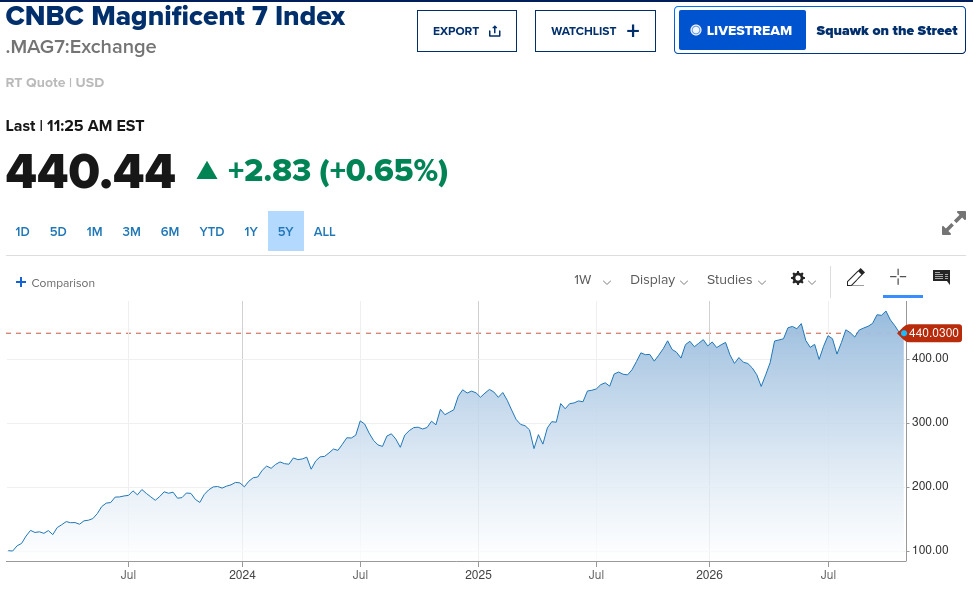
The MAG7 index has risen from 100 in Jan 1 2023 to almost 480 on Oct 12 2026, continuously rising almost five-fold. Note it has fallen 10% since then. This is clearly not a market finding its equilibrium. It’s an auction with one buyer, and the auction just ended. And what triggered the end wasn’t a rate hike or a recession — it was a question that the market had been avoiding for three years: who pays for this? The hyperscalers are the spenders, committing hundreds of billions to compute. The AI companies are the receivers, burning cash on the compute they buy. And neither is producing enough revenue to close the loop. The spenders are paying the receivers, the receivers are buying from the compute providers, and nothing in the chain is generating new value — it’s all circulating within the bubble, funded by borrowed money. The market has stopped asking whether AI works and started asking who pays for it, and when. The answer is: nobody, yet. The index has pulled back before, but you have to ask if this is the exit ramp. The dip-buyers who bought the first drop are the late investors, taking the bag the early holders are distributing into the bounce. The question has been asked. The answer is coming. And when it arrives, the retrace will be the last time anyone got out whole.
October wiped out over $1.5 trillion in U.S. market value — more than three times the Black Monday crash of 1987, which erased around $500 billion in a single day. And the top was made in June, two months before the crash, in the tech and semiconductor sectors — nobody paid attention. That’s the pattern of every top: it happens quietly, the crash happens loudly, and the late bulls are the ones trapped. The forced selling — the margin calls — has spread to everything, including gold and silver, because the leveraged players need cash now. That’s not a sentiment shift. That’s liquidation. And it creates a huge supply overhead: the investors trapped at the top will sell on any rally, trying to “get out even.” Every bounce becomes a distribution, not a recovery. The people who bought the top are holding the bag, and the rallies are their exit — the same exit, at the same time, into the same thin air.
The same collapse is happening on the other side of the world, and it’s telling the same story. China and South Korea — the two economies most exposed to the semiconductor and hardware buildout — have seen their markets crater alongside the Mag 7. The KOSPI is down 20 percent from its summer peak, and the Shanghai Composite is down 10.3 percent. But those headline numbers hide the real carnage: the declines in the AI- and tech-heavy sectors have been far worse. The STAR 50 Index — Shanghai’s tech and AI-heavy board — has collapsed 40 percent from its summer high. That’s not a pullback. That’s a rout, in the sector the whole narrative was built on. And it was so bad in China that the “Plunge Protection Team” — the state’s market-stabilization apparatus — was forced to intervene last week, buying stock directly to prop up the indices. That’s the tell. When a government has to buy its own market to keep it from falling, it’s not a correction — it’s a controlled retreat from a collapse. And the irony is total: the AI revolution that was supposed to be the great American technological triumph over the rest of the world has, in a single quarter, taken down the Mag 7, the Korean chipmakers, and the Chinese market all at once. The bubble wasn’t contained to one country. It was global. And it’s popping everywhere at the same time.
There are no more Ponzi schemes available. The rosy numbers are fabricated by method — a birth/death model that invents jobs, hedonic adjustments that erase inflation, GDP accounting that counts borrowed spending as production. The boom is not real; it is credit, dressed up as growth, resting on an ROI that was always overestimated. And the machine that papered over every previous hole — the reinflation engine, powered by 43 years of falling rates and a free ride for early investors — has reached its terminal point.
Watch what gets revised, and when. That tells you everything. The boom is announced in headlines. The bust arrives as a quiet benchmark revision, eighteen months later, after the political moment has passed and the early investors have left the building.
They have already left. It is time to stop funding their exit.
Part 2 of this article will expose the big picture behind this.
Written with the help of Alter AI
P.S. — For readers new to the Austrian frame: the bust is not the disaster. The boom was. The malinvestment happened when cheap credit warped the interest-rate signal and we built data centers the real economy can’t use. The bust is just the market painfully correcting a distortion the banking system created. Stop bailing out the boom. Let it clear. That’s the only honest path — and the sooner, the cheaper.
References
Israel, K., “Why Official Inflation Measures Don’t Work“, Mises.org, 2020
Erik on Tech, “The Warehoused GPU Problem is Worse Than You Think“, republished on ZeroHedge Oct 30, 2026.
Castellanos, S., “Sam Altman Calls PC RAM A ‘Quite Terrible’ Use Of Limited DRAM Supply, Argues Cloud Data Centers Are More Efficient“, Oct 31, 2026.
Leave a Reply