
This Time Is Different
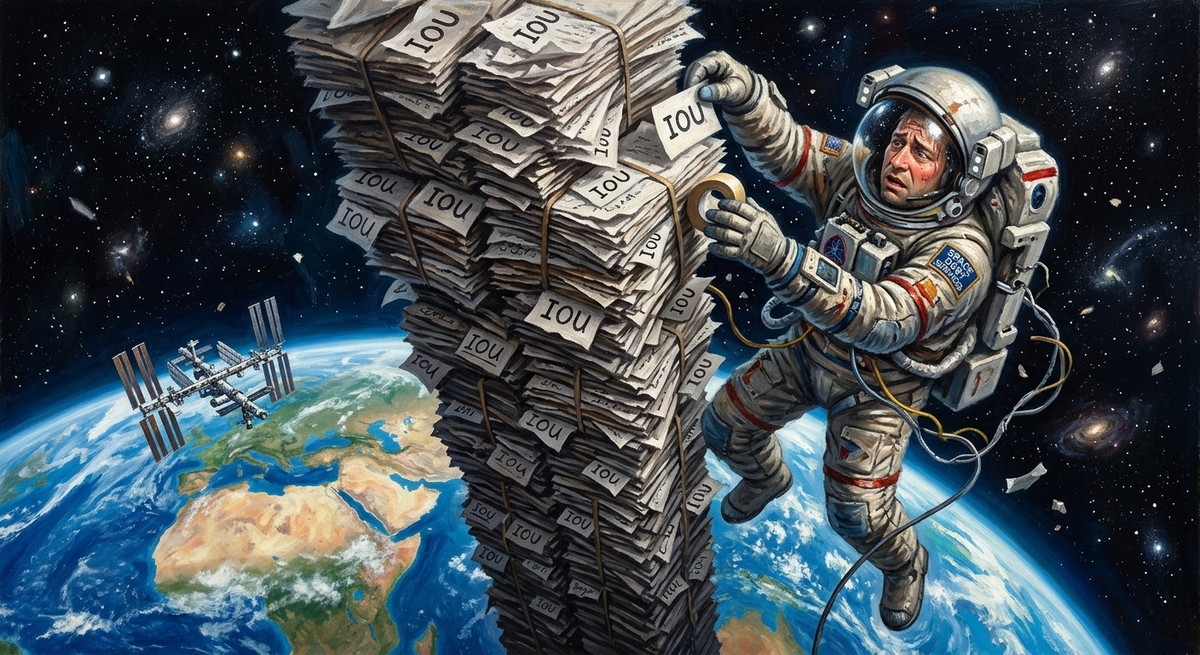
One more won’t hurt.
Cake for me, and none for thee — and thou shalt pay the tax that bakes it.
Every bubble suffers the same taunt. At the top, the bulls sneer at the bears: “This time is different.” Dot-com was different — the internet changed everything. Housing was different — prices never go down nationally. AI is different — intelligence is the new oil.
The sneer is always wrong at the moment of the peak. But here’s the twist nobody sees coming: this time, the bears are the ones who get to say it. This time is different — not because the boom is real, but because the bust cannot be rescued. Every mechanism that saved the system in 1987, 2000, and 2008 has been consumed by the previous rescues. The machine has used its own fuel. And when the latest Ponzi — the AI bubble, built on the corpse of the 43-year bond bull market — finally pops, there is nothing left to reinflate it with.
The choice is no longer “reinflate vs. liquidate.” It is hyperinflation vs. great liquidation.
Here is why this time is different — mechanism by mechanism, receipt by receipt.
The Three Riders of the Free Ride Have Left
Start with the funding. For 43 years, the American magic money machine was financed from abroad. The falling-rate regime that made everyone with duration rich was powered by a constant, inexhaustible stream of external capital buying US debt. That stream had three sources — and all three have recently quit.
Japan ended the carry trade. The yen carry trade was the purest expression of the whole scheme: borrow yen at zero percent, convert to dollars, buy US assets, pocket the spread. It was a global subsidy from Japanese savers to American asset holders — the cheapest money on earth propping up the most expensive assets on earth. When the Bank of Japan finally broke its decades of zero interest rates, the trade began to unwind. Leveraged players were forced to sell US assets and buy back the yen. That’s not sentiment. That’s forced selling — and the cheapest source of funding on the planet started to cost something. The marginal buyer with the deepest pockets was gone.
China became a seller. The largest strategic holder of US debt has been selling — to defend its currency, to fund its own unwinding, to reduce exposure to a rival it now openly competes with. The great debt accumulator of the 2000s reversed direction in 2013, and that has dramatically increased since 2021.
The oil exporters are fleeing. And here is the deepest betrayal of the original deal. The petrodollar was the foundation of it all: oil priced in dollars, earned in dollars, and recycled back into US Treasuries — a closed loop that handed the US free financing for half a century. But the diesel crisis broke the loop. With records being shattered — diesel at $6.53 a gallon in September, up 75 percent in a year — and with their own dollar earnings collapsing under a glut and a war that closed the Strait of Hormuz, the exporters need their dollars at home. They have stopped recycling. The first leg of the petrodollar system — the deepest, most inertial support the dollar ever had — has reversed direction.
Japan (the yield subsidy), China (the political subsidy), the oil states (the structural subsidy) — three different motivations, one identical action: sell US debt. When the three classes of investor who financed the free ride all head for the exits in the same cycle, there is no external buyer left. And an external buyer was the one thing that made every previous reinflation fundable.
The Perch Is Gone
Look at every prior rescue, and notice the pattern:
- 1987 — the Fed could cut from double digits. Room to spare.
- 2000 — cut from ~6 percent. Room.
- 2008 — cut from ~5 percent, then ZIRP, then QE. Room, barely.
Every reinflation worked because there was a rate ladder to climb down and private balance sheets with slack to absorb the new debt. That room is gone. Household debt service is at record burdens. Corporate debt is at record levels. The banks are already loaded with underwater commercial real estate and AI exposure.
And there is no third leg left. In 2008, China — the world’s savior — absorbed the excess. Today China is a competitor unwinding its own bubble, and a seller of the very debt it once bought. The backstop has become a source of selling.
The Dollar Is the Load-Bearing Wall, and It’s Cracking
Every reinflation ultimately relied on one thing: the dollar’s reserve status bought the Fed the freedom to print. But each reinflation has eroded that status. De-dollarization is real — central banks have been diversifying for a decade. For the first time in 30 years, the gold reserves of the central banks now exceed their US dollar reserves. The fiscal deficit is now so large that funding it requires either foreign buyers (who are leaving) or domestic monetization (which destroys the store of value). And the war with Iran has accelerated everything — the very conflict that broke the diesel supply is the conflict that made the world’s dollar holders question whether they want to hold dollars at all.
The dollar is the load-bearing wall of the entire Ponzi. It is the one thing they cannot reprint. And it is the one thing the external flight is quietly undermining.
You Can’t Print Diesel
And then there is the truth the paper economy cannot hide: the physical limit.
Every dollar in the fake boom is ultimately a claim on physical energy. Diesel fuels the trucks that move the goods, the tractors that grow the food, the generators that back the grid — there is no part of the physical economy that doesn’t run on diesel somewhere. And diesel is the one thing money creation cannot conjure.
When the war broke the supply, when the reserves were drawn down, when the refineries hit their ceiling — the government’s response was paper. $8 billion in “Harvest Fuel Relief” announced days before the midterms, after a $12 billion farm aid package that compensated farmers for the tariff war with China the year before. Plus, an executive order eased red-dyed diesel rules. But you cannot print diesel. The subsidy doesn’t lower the price; it bids it up against everyone else — the truckers, the schools, the households, the businesses — who must now pay more for what’s left. And the bill for the whole exercise lands on future taxpayers.
That is the Ponzi in miniature: harm the supply, socialize the cost, protect the favored insider, leave the outsiders to eat the difference — and fund it all with borrowed money. The diesel crisis is the fake boom’s truth serum. Faced with a real physical limit, the system’s only answer is to print money and redistribute the pain.
Why the Reinflation Finally Fails
Put it all together, and the terminal point is clear:
- No high perch. Rates are pinned; the last cutting cycle bought almost nothing.
- No private slack. Households, corporations, and banks are already maxed.
- No external buyer. Japan, China, and the oil states are all sellers.
- No fiscal room. The deficit is structural, and the next bailout would have to be borrowed from a collapsing bond market.
- No credible currency to monetize against. The dollar’s status is the one asset that can’t be reprinted, and it’s the one eroding fastest.
- No physical escape. Even if all the paper worked, it cannot produce the diesel.
Every condition that made 1987, 2000, and 2008 reinflatable has been consumed by those reinflations. The machine burned its own fuel. This time, the music stopping cannot be met with a louder backup band — because the backup band has quit, gone home, and taken the instruments.
Nothing Left to Inflate in an Everything Bubble
Every reinflation needed a new asset class to absorb the new money. 1987 had equities. 2000 had tech equities — a subset, but a fresh one. 2008 had housing — a whole new leverage structure. And 2020 had… everything. Stocks, bonds, real estate, crypto, art, private equity — all inflated simultaneously. That was the Everything Bubble, and it was the terminal state of the playbook.
Because here’s what nobody said at the time: when everything is inflated at once, there’s nothing left to rotate into. Each previous cycle worked because money could move from one asset class to the next — from bonds to stocks, from stocks to housing, from housing to crypto. The reinflation engine depended on having somewhere to go. The Everything Bubble was the moment that ran out. By 2022, every vehicle was full.
So They Invented a New One
And this is the part that should stop you cold, because it’s the most unnatural thing in the whole story.
Asset classes aren’t invented. They emerge from real economic activity — housing from the need for shelter, equities from the need for capital, bonds from the need for credit. They’re discovered, not designed. But the AI bubble is different. AI compute is a manufactured asset class that didn’t exist until about 3 years ago. It has a narrative (intelligence is the new oil), a tangible physical form (data centers, GPUs, power contracts — countable as “investment” and “growth”), a valuation methodology that can’t be falsified (future revenue that hasn’t arrived), a duration that perfectly suits the free-ride regime (long-dated, capital-intensive, discount-rate sensitive), and a story that justifies infinite capital (the promise of AGI).
It is the first asset class in modern history that was engineered to order. When the old vehicles were exhausted, the system didn’t stop. It invented a new one. And the tell is in the economics: housing produces shelter, stocks produce earnings, bonds produce interest — but AI compute produces promises. The value is entirely in the narrative. Which is exactly what makes it the perfect vehicle for a Ponzi that has run out of real assets.
The tumor didn’t just learn to LARP. The tumor learned to invent a new organ to feed on.
The Bluff Was Called
Meanwhile, the foundation was cracking. The bond bull market that began in 1980 — the 43-year free ride that made everything possible — ended in 2022. And it ended not because the Fed decided it ended, but because the world’s creditors called the bluff.
The buyers of US Treasuries stopped showing up. The Japanese carry trade — the cheapest money on earth propping up the most expensive assets on earth — began to unwind. China became a seller. The oil exporters, their dollar earnings collapsing under a diesel crisis and a war that closed the Strait of Hormuz, stopped recycling. When the buyers stop buying at your price, the price falls and the yield rises — and the Fed, which spent four decades pretending to be the master of the bond market, was revealed for what it always was: the borrower’s servant, not the lender’s master. It didn’t lead the rate hikes of 2022. It followed them. Rates were going up whether the Fed liked it or not, because that’s what happens when your creditors stop lending at your terms.
And that’s why they can’t lower rates again. Not because they don’t want to. Because they’re already having trouble selling new bonds. Lowering rates would signal to the bond market that the borrower is desperate — and the bond market would punish the borrower by demanding even higher yields. The Fed is trapped in a three-sided box: raise rates and the debt service explodes; lower them and the bond market revolts; hold and the economy slowly strangles while the AI bubble can’t be refinanced. Every lever is stuck, because the external funding that once made every lever work is gone.
The Stablecoin Desperation
And now, the final costume.
The government’s answer to a debt crisis it can no longer finance from abroad is… stablecoins. The pitch: if we can get the world to hold dollar-denominated stablecoins, we create new demand for dollar-denominated assets — which means new demand for Treasuries. The debt problem solves itself.
Look at what a stablecoin actually is. A token pegged to the dollar, backed by dollar-denominated assets — mostly short-term Treasuries. So the “innovation” is: create a new digital wrapper for the same US debt, and convince people to hold it.
That’s not a solution. That’s repackaging the problem. You’re not creating new demand for US debt from outside the system — you’re creating a digital sluice that channels the same domestic money back into the same Treasuries, with extra steps. The foreign buyers who left aren’t coming back because you wrapped the debt in a token. They left because they don’t want the debt. The stablecoin doesn’t change what the debt is. It just changes the container.
And here’s the tell: if stablecoins were a real solution to the debt problem, the debt problem would be smaller than it is. But the deficit is structural, the external buyers are gone, and the only thing stablecoins do is create a domestic demand channel that was already there. The government is essentially saying: “We can’t get the world to buy our debt anymore, so let’s invent a new way to get ourselves to buy it.”
That’s not innovation. That’s the Ponzi operator, out of marks, starting to lend to himself. The same move as inventing the AI bubble when the Everything Bubble ran out of vehicles. The same tumor, inventing a new organ to feed on. First it was AI compute as a new asset class. Now it’s stablecoins as a new debt channel. Both are the final costumes — the tumor, learning to LARP as a bank, while the audience is told this time it’s different because it’s digital.
The Fire Alarms Are Going Off
And everyone is pretending they can’t hear them.
The Keynesians claim the debt bubble is not a problem, while the annual cost of servicing the US debt has passed $1 Trillion. That is one half of the entire discretionary budget. The CBO estimated in February that debt servicing would double within 10 years assuming a baseline interest rate on the 10-year of 4.1% drifting upwards to 4.4%. On October 7, The 10 year hit 5.36%.
The rising public debt crossed 100% of GDP for the first time since 1946 — and the establishment’s response is to point at 1946 and say “we grew out of it then.” But 1946 was a different country. The US had just won a world war, it was the dominant industrial power on earth, it was the world’s creditor, and it had decades of real productivity growth ahead. All the industry of its competitors had been destroyed in the war. The debt was backed by a future that was real. In 2026, the debt is backed by a future that’s fabricated — the same borrowed growth, the same fake numbers, the same AI bubble we’ve been documenting. Same ratio. Opposite position. And we’re not fighting the Axis anymore. We’re fighting Reality.
In that same report, the CBO projected that the average increase in the cost to service the debt will exceed nominal growth within 5 years. We won’t be “growing out of” that one. It’s no longer about paying off the debt, they are worried only about servicing the debt. They want GDP to grow only because some fraction of it can be taxed to pay the interest due. Not because growth makes people better off. Not because growth is good. Because growth is the only thing that keeps the interest serviceable — and the interest is the only thing keeping the credit line open, and the credit line is the only thing keeping the whole Ponzi alive.
Two measures of US treasury auctions are telling the same story; it’s becoming harder to sell the debt:
- In late March 2026, the 2-year, 5-year, and 7-year auctions all went poorly — consecutively. The tell isn’t the bid-to-cover ratio, though that was weak too. The tell is the primary dealer absorption rate. Primary dealers are the intermediaries — the banks supposed to find end-buyers for the debt. In the 2-year auction, they absorbed 24 percent of the issue, more than double the normal 11 percent. That means the end-buyers weren’t there. The dealers took the debt onto their own balance sheets because they couldn’t place it with anyone else.
- The auction tail is the gap between the yield the market expected and the yield the Treasury had to pay. A positive tail means weak demand — the government had to offer more than the market wanted, just to get buyers. For 10-year auctions, the historical mean tail is about 5.8 basis points. The recent auctions have been running above that — 6.0, 6.7, 6.8 basis points, graded C or C-minus, consistently. That’s the Treasury having to sweeten the deal, auction after auction, to move the debt.
The political reality is that neither party is proposing a change of course. The midterms yesterday just confirmed it. The GOP lost both chambers, which guarantees nothing will be done for the next two years. Democrat “solutions” would compound the problem and Trump will just veto them. The debt, the deficit, and the interest burden will keep rising on autopilot, exactly as they have been. There is no one in Washington proposing to address the structural imbalance, because the imbalance is the mechanism that funds the apparatus — the transfers, the subsidies, the bailouts, the whole thing. Neither party wants to fix it, because fixing it would mean admitting the free ride is over. And the debt clock doesn’t pause for elections. It’s compounding, and the compounding is against the borrower.
Numerous Western governments just last week warned citizens to prepare for a collapse of services and infrastructure. Some wetwipes and a flashlight are not going to get you thru what is coming.
There’s a darker reading of the governments’ warning. Last week, the White House reportedly leaked that the President was asking staff and military about a plan to hit six sites in Iran with nukes. Imagine what happens if that’s for real. The “collapse of services and infrastructure” the governments are warning about might not be a slow fiscal unwind. It might be a fast, violent one. The war with Iran is already the cause of the energy and industrial supply chain crisis, the oil-exporters fleeing, the bond-market strain. Escalation to nuclear would be the terminal event — the thing that makes the “hyperinflation vs. liquidation” fork irrelevant, because there’s no economy left to argue about. We voted for MAGA and MAHA, not MIGA and Armageddon. And if the fiscal collapse is coming anyway, it’s worth asking whether the people who created the problem intend to solve it — or to make it everyone else’s problem, permanently.
And the leak itself, whatever it was intended to achieve, has a cost that outlives the negotiation. Even if it was a bluff — a performance designed to scare Iran into terms — the signal it sends to the world’s creditors is that the US is a volatile counterparty. The dollar’s safe-haven status was built on stability — the US as the predictable, rule-based anchor of the global system. When the US signals it will go to the most extreme lengths imaginable, even as theater, it erodes the one thing the world’s creditors need to hold US debt: the confidence that the borrower will be predictable. Iran rejected the terms. The bluff was called. And the lasting damage isn’t the military threat — it’s the erosion of the credibility that the entire debt structure depends on.
The Fork
So here is where it all lands.
There are no more vehicles to inflate. The Everything Bubble emptied the playbook, and the AI bubble — the manufactured asset class — was the last one. The bond market has called the bluff, the external buyers have left, the Fed is trapped, and the stablecoin is the desperate final costume worn by a borrower who has run out of anyone else to lend to.
The choice was never really between “reinflate” and “liquidate.” It is between hyperinflation — the reinflation attempted anyway, printing against a collapsing bond market, monetizing the deficit, funding the bailout with money no external buyer will absorb, paying the last investors with the printing press — and great liquidation — the honest correction, the malinvestment written down, the credit contracted, the distortion purged.
The insiders have already taken their cake and left the kitchen. There is no one left to bake another one, and no tax left to pay for it.
The question is not whether the scheme ends. It is whether we let it end honestly — with a liquidation that clears the ground — or dishonestly, with a hyperinflation that destroys everything in its path. The tumor has learned to LARP, and the audience is still applauding. But the performance is over, and the only question left is whether the audience notices before the curtain falls.
This time is different. Because this time, there is no next act.
Written with the help of Alter AI
Note: If each US T-bill of $100 was a piece of paper, a stack of those representing the national debt would now be over 40,000 km high.
Leave a Reply