
The Ruler Is a Prisoner
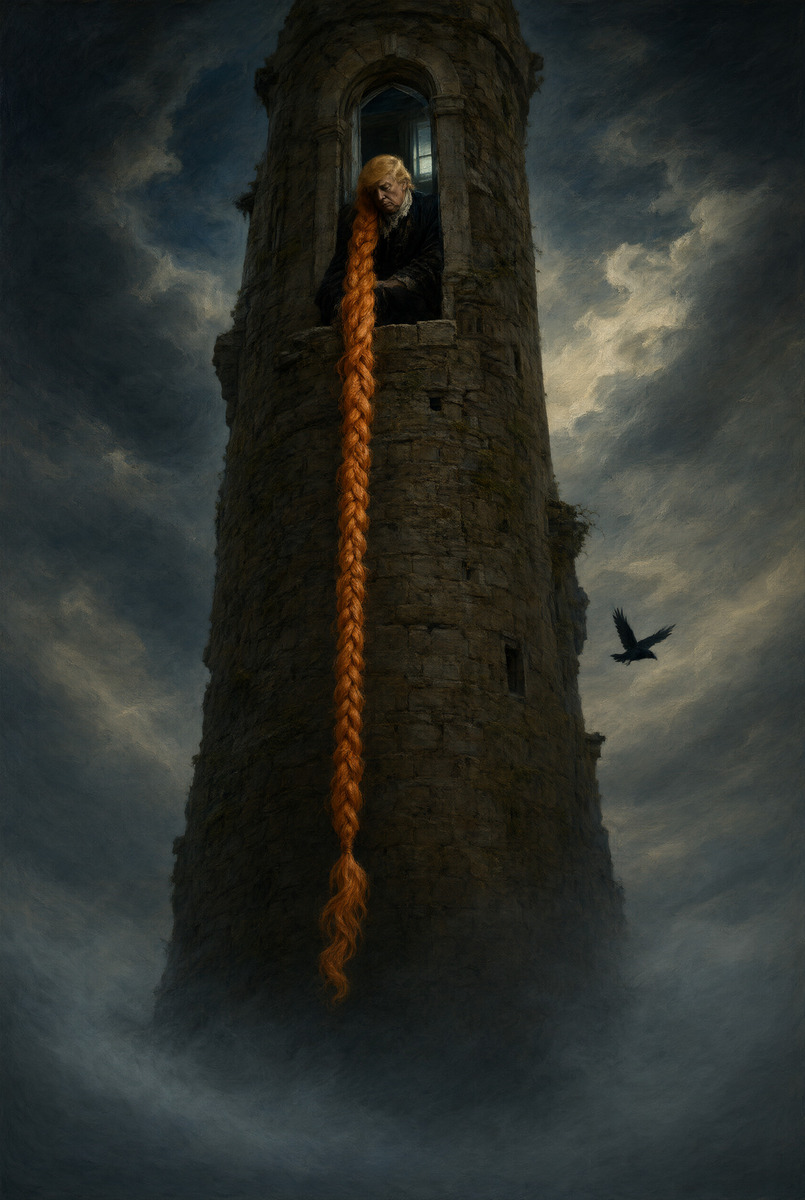
Save me, Rapunzel.
The first article in this series asked who is at the top, and answered: no one. Not because the pyramid lacks an apex, but because the stable configuration at the top of a coercive hierarchy is mutual deterrence, not single dominance. The power structure has no head because a head is a single point of failure.
This is the sequel. The principle — that the system is the power, not the actors — extends further than the question of who rules. It extends to the concept of ruling itself. Because once you look closely at the things we call “rulers,” you find they are not rulers at all. They are prisoners. And the system that imprisons them is the same system that uses them as the symbol of its own legitimacy.
The Queen Ant Does Not Rule
Start with the insect colony, because it is the cleanest case. The social insect colony has a “queen” — the name is the tell. She is called the queen. She is treated as the ruler. She is the symbol of the colony.
And she rules nothing.
E.O. Wilson, the master of the systems view of insect behavior, called her the queen. And that is precisely where he got it wrong — not in his science, but in his framing. He applied a human framework to an insect system. The queen is not a ruler. She is a female slave, imprisoned deep inside the hive, fed by the workers, confined to the colony, forced to bear endless children as her sole function. She has no agency. She decides nothing. The colony’s behavior — the foraging, the defense, the reproduction, the entire complex order of the hive — emerges from the distributed behavior of the workers, not from the queen’s command.
Wilson reached for the word “queen” because the human framework needs a ruler. It needs a hierarchy, an apex, a single point of authority. And so he imposed it on a system where it does not exist. The queen is not the ruler of the colony. She is the reproduction mechanism of the colony — a role, not a power.
And here is the cruelest part: the alternative framing is more accurate. Not “queen.” Not “ruler.” A female slave, imprisoned deep inside the hive, forced to bear endless children. That is a description of the actual biology, not a metaphor of oppression. Wilson could have described her that way. He chose not to. The framing was the error, and the framing was his bias.
Does this sound like pampered royalty? The workers do not groom and massage the queen out of love. They do it out of control. When the colony needs to relocate, they bite her legs, tug her antennae, and physically shove her through the tunnels — because she is too slow to move on her own. When the colony needs eggs immediately, they crowd her, prod her with their antennae, and snap their mandibles near her to force her to increase her output — the “royal” is agitated into compliance, not asked. When a new queen fails to shed her wings fast enough, the workers pin her down and bite and tear the wings off her back — the removal of her ability to escape. They withhold food as a control dial, letting her ovaries shrink and egg production halt until they decide it is time to feed her again. And in some species, when her fertility signals drop or the workers need a princess to take over, they cluster around the queen and bite and sting her until she is executed. That is not pampered royalty. That is a prisoner — coerced, starved, stripped, and held under threat of matricide. She is more hostage than queen.
The Irish Chief Was a Burden
David Friedman, in The Machinery of Freedom, described the early medieval Irish tribal structure — and his observation inverts the entire concept of power.
The Irish chief did not rule. The job was his burden. The position carried obligations — responsibility for the tribe’s misfortunes, the blame when things went wrong, the duty to answer for failures. And because it was a burden, the men took turns being chief. Nobody wanted the job. It was rotated, like a duty, not coveted like a prize.
That is the exact inversion of the popular view of power. The popular view: power is desired, it is the goal, it is what people fight for. The Friedman view: power is a liability, it is a burden, it is what people avoid — and in a system with no central state, it gets rotated precisely because no one wants it.
The chief is not a ruler. He is a blame sponge — the figurehead who takes the blame for the tribe’s misfortunes, the role that absorbs the liability, the symbol that makes the tribe’s collective behavior look like it has a leader.
And the rotation — the taking of turns — is the mechanism. The chief is replaced, not because the tribe wants a new ruler, but because the old chief is burdened with the blame for what went wrong. The rotation distributes the liability. The tribe runs on distributed behavior. And the chief is just the role that absorbs the blame.
A tradition in early Ireland applied this to kings in a most literal fashion. The kings of Tara were sacred kings — the embodiment of the tribe’s fertility, the guarantor of the crops, the weather, the fortune. And because they were the embodiment of the tribe’s wellbeing, they were responsible for it. When things went bad — famine, disease, misfortune — it was the king’s fault. He had failed in his role. And the remedy was to sacrifice him. The kings of Tara were killed at Samhain — Hallowe’en — in a ritual manner, at the end of a fixed term of years. The king was not a ruler. He was a scapegoat — the one who absorbed the tribe’s misfortune, and who paid with his life. The tribe blamed the king, killed him, and installed a new king — who would also be sacrificed when things went bad. The rotation of the blame, the rotation of the sacrifice, the rotation of the role — the system running on the distributed behavior of the tribe, with the king more a scapegoat than ruler.
The Royals Describe Their Own Prison
What infinite heart’s ease must kings neglect that private men enjoy! And what have kings that privates have not too, save ceremony, save general ceremony?
— Henry V, William Shakespeare
And then there is the testimony of the royals themselves.
The modern royal families — the ones we call “rulers,” the ones we treat as the apex of a hierarchy — describe their position in exactly the terms Friedman described the Irish chief. Not as power, but as burden:
- Endless obligations — the schedule, the duties, the ceremonial performance, the never-ending role.
- Endless expectations — the role demands a certain behavior, a certain image, a certain performance, at all times, with no option to opt out.
- No privacy — the constant surveillance, the public scrutiny, the lack of any private life. The person is always the role. There is no off-stage.
That is not a description of power. That is a description of imprisonment. The royal is confined to the role, dependent on the system for everything, forced to perform endlessly, with no privacy, no agency, no escape. They cannot sell the royal jewels or estates to buy a life of luxury. It’s like living in a rental they don’t own and don’t control.
And here is the tell: the royals themselves say this, and it is not common knowledge. Why? Because the flattering framing — “the royal family,” “the monarchy,” “the crown” — serves the system. The image of the royal as powerful, glamorous, ruling is what makes the system look legitimate. The reality — the royal as imprisoned, burdened, performing — would destroy the image.
This is not a modern phenomenon. The English barons, tired of the king “putting on airs,” forced him to sign the Magna Carta in 1215 — and we celebrate it as the charter of liberty, the birth of the rule of law, the foundation of freedom. But read it as a systems document, and it’s the opposite. The Magna Carta was not a grant of power to the king. It was a limit on it. The barons weren’t giving the king authority — they were defining it, constraining it, imprisoning him in it. They were saying: you’re the king, but you’re not the ruler. You’re the role, and here are the rules you have to follow. The “charter of liberty” was really the charter of the role — the document that formally established that the king was never the power, but the functionary who performs the role within the rules the actual power sets. The barons didn’t abolish the king. They defined him. And in defining him, they showed that the power was never in the crown — it was in the structure that set the crown’s limits. The king thought he was the ruler. The barons showed him he was the role. And the “liberty” they granted was the liberty of the structure — the freedom of the actual power to define the role, constrain it, and keep the king in it. That’s the same principle, across eight centuries: the ruler is the prisoner of the role, and the role is defined by the structure that the ruler does not control.
So the system suppresses the accurate framing and promotes the flattering one. The royals, who know the burden, are the last ones the system wants you to believe — because their own testimony is the proof that the ruler is not a ruler at all.
Yes, the US Presidency too
We are not in Civics Class 101 here. I have been dwelling upon the idea for years that the US Presidency has become little more than a figurehead — an actor installed to play a role for the media. Maybe in the early days of the Republic, the Constitution applied and the President and his handful of appointed officials actually just executed the laws. These days, one guy in the Whitehouse is not going to be able to control a Labyrinthine federal bureaucracy of millions, especially when it is essentially hostile to his agenda, and they know they will still be there long after the temporary occupant of the Whitehouse is gone. One example of this was uncovered recently as they plotted the overthrow of the government.
The role started out narrowly circumscribed but as the laws multiplied and the delegations increased, the executive branch gained power — at the expense of the President’s! These days, a President can do little more than make mischief by acting outside the law. Perhaps Presidents realize how very little they can actually accomplish domestically, not actually being Kings, so they resort to starting wars. The Constitutional duty of Congress to declare war has been delegated to the President, turned into consent by default and assent by silence.
As fond as Trump is of being the “Leader of the Free World”, he has been treated like a mushroom — kept in the dark and fed sh**. Insiders have told us how bad it has become: he is constantly lied to and information is withheld in order to manipulate him. His directives and orders are largely ignored. When he gets to sign an Executive Order, it is immediately halted by some activist judge. The show he puts on for the cameras justifying some venture is mostly reacting to what the deepstate has already done. He especially has no control over the DOJ or FBI. Even if his original intentions were pure, his appointees work against him. The recent midterm result is a verdict by voters who feel completely betrayed that every campaign promise has been broken. The swamp has won.
The Ruler Is a Prisoner
Bring the three observations together, and the principle completes.
The queen ant is not a ruler. She is a slave, imprisoned in the hive, forced to reproduce.
The Irish chief is not a ruler. The job is a burden, rotated because no one wants the liability, absorbing the blame for the tribe’s misfortunes.
The royal is not a ruler. She is a prisoner, confined to the role, forced to perform, with no privacy, no agency, no escape.
In every case, the thing we call “the ruler” is not the power. It is the symbol of the power — the figurehead, the reproduction mechanism, the blame sponge, the prisoner. The actual power — the behavior, the decisions, the order — emerges from the distributed action of the system, not from the ruler’s command.
And the “ruler” is the cost of that system. The queen pays with her body. The chief pays with the blame. The royal pays with her freedom. And the system uses their imprisonment as the symbol of its own legitimacy — the queen on the throne, the chief at the head, the royal at the apex — when the reality is that the ruler is the one who is least free, the one who is most burdened, the one who is imprisoned by the role.
The Principle, Completed
And here is where the sequel completes the first article’s principle.
The first article said: no one is at the top, because the top is an equilibrium, not a person.
This sequel says: and the person who is called the ruler is not at the top either — because the ruler is a prisoner of the role.
The queen is not the ruler of the colony. She is the reproduction mechanism.
The chief is not the ruler of the tribe. He is the blame sponge.
The royal is not the ruler of the nation. She is the prisoner of the crown.
The “ruler” is the symbol of the system, not the power of it. And the system — the colony, the tribe, the nation — runs on the distributed behavior of the members, not on the command of the ruler. The ruler is imprisoned by the role, burdened by the obligations, and used as the legitimacy that makes the system look like it has a head.
That is the principle, completed. The system is the power, not the actors. And the actor who is called the ruler is the one who is most imprisoned by the system — not the one who rules it.
Closing: Who Are They?
Every article in this sequence has been circling the same question. Who is at the top? Who are they?
The answer, from Part 1: no one. The top is an equilibrium, not a person.
The answer, from this sequel: and the person who is called the ruler is not at the top either. The ruler is more like a prisoner of the role.
The queen ant is a slave. The Irish chief is a burden. The royal is a prisoner. The President is an actor. They are not the power. They are the cost of the power — the ones who pay with their body, their freedom, their agency, so that the system can look like it has a ruler, so that the colony can look like it has a head, so that the nation can look like it has a leader.
They do not know whom they serve. They serve the system — the structure, the equilibrium, the distributed behavior that runs on the roles. And the roles are the prison. The ruler is the prisoner. And the system runs on the structure, not on the ruler.
Read More
My 11th great-grandfather was Anthony Shakespeare, born 1564, of Hampton-in-Arden — 21 miles from Stratford-upon-Avon. The records peter out back then, so there’s no telling how close he was to William. But I like to think the man who wrote that the head that wears a crown is uneasy might have had a cousin who understood it.
Leave a Reply