
The Red Planet is not dead. It’s bound — and the unbinding is the plan.
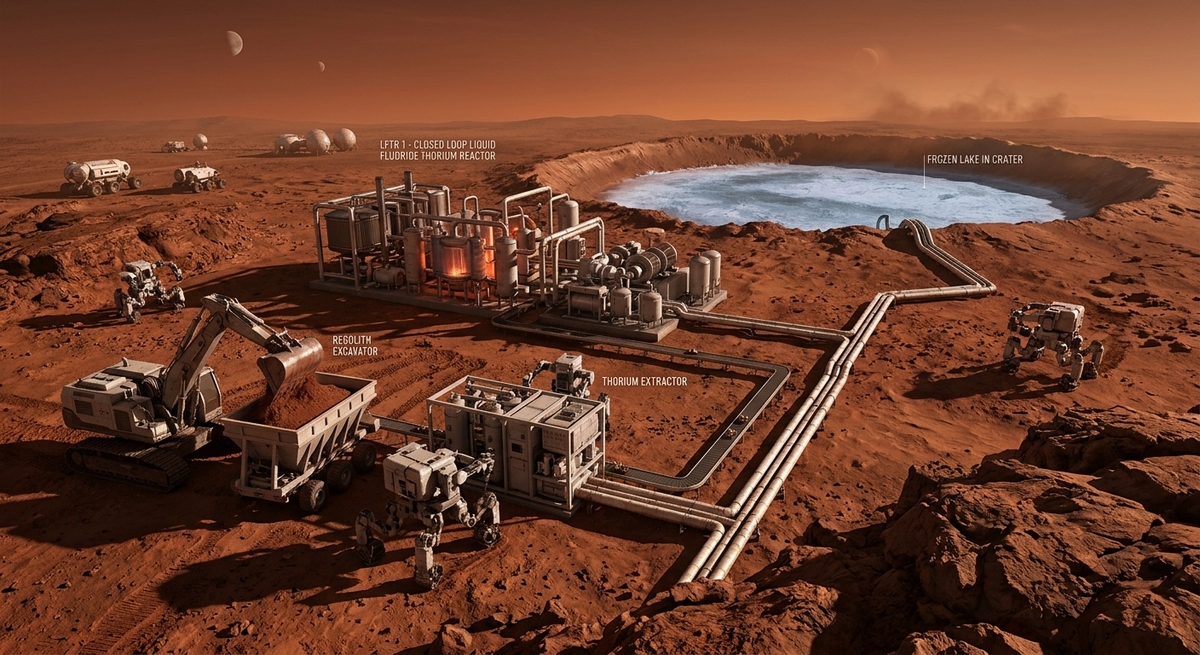
Robots build a thorium molten salt reactor on Mars.
“Beam us up, Scotty.”
First off, Mars is currently incredibly hostile to life. The most inhospitable place on Earth is the McMurdo Dry Valleys in Antarctica. With extreme aridity, winds up to 320 km/h (200 mph), and temperatures down to -60°C (-76°F), exposed human skin would crack and freeze in minutes. An unprotected human would die within an hour. But Mars remains exponentially more hostile to life. The atmosphere pressure is a near-vacuum – about 3 times a commercial jet’s height on Earth. And compressed, the resulting air would be a lethal asphyxiant composed of 95% carbon dioxide contaminated with carbon monoxide. The surface is unprotected from cosmic rays and solar particles — several hundred times higher than the radiation exposure in Antarctica. Compounding this is a brutal, global cold that averages a freezing -62°C (-80°F) and can plummet to a catastrophic -140°C (-220°F) during the polar nights. The corrosive soil is full of oxidizing perchlorates that would even kill a tardigrade (and zero chance of growing potatoes.)
But Mars is not a dead world. It’s a locked world — the oxygen bound up in rust and perchlorates, the water frozen in the ice, the carbon dioxide trapped in the dry ice and regolith. Everything needed to remake the planet is already there. And the plan to unlock it is simpler than the critics want you to believe.
The Evidence That Mars Wasn’t Always Dead
The Curiosity rover has taken spectra of the Martian surface, showing the presence of minerals like jarosite — produced only in interactions with water. And here’s the tell: jarosite reacts with the Martian air over relatively short timescales — less than 1 million years. So if jarosite is present today, the water that formed it was there recently — geologically speaking.
That changes the whole story. Mars wasn’t just “warm and wet long ago” — it was warm and wet episodically, including relatively recently. The Ice Age cycles that began on Earth about 2.1 million years ago were driven by the same solar radiation that Mars receives. Same sun, same orbital mechanics, same periodic variation in insolation. It’s no surprise that Mars had intermittent warm periods too. The evidence was always there — the specialists just didn’t look until the chemistry clock forced them to.
The “Do It Now” Logic
The critics say: “You can’t create a stable atmosphere on Mars — without an ionosphere, it will be stripped away by solar radiation over tens of thousands of years.”
And the answer is: do it now, and worry about the ionosphere later.
The stripping is a process that happens over tens of thousands of years. The benefit of a breathable atmosphere, liquid water, and a balmy Mars is immediate. Solve the immediate problem first. Worry about the long-term one later — because the capability you build now is what solves the problem later.
Uranium and Thorium on Mars
Orbital gamma-ray spectroscopy
The strongest evidence comes from gamma-ray spectrometers on orbiters, which detect characteristic gamma rays emitted by radioactive decay:
- Mars Odyssey (2001–present), Gamma Ray Spectrometer (GRS): Mapped thorium and potassium globally. Thorium is a reliable proxy for uranium because the two behave similarly in igneous differentiation. Odyssey found Th concentrations ranging from ~0.3–0.8 ppm in typical crust, rising to several ppm in enriched regions.
- Mars Express, OMEGA and HRSC (supporting context): While not direct U/Th detectors, compositional mapping helped identify evolved, silica-rich terrains where incompatible elements concentrate.
Key enriched regions
- Tharsis volcanic province — especially around Olympus Mons and the Tharsis Montes, where fractional crystallization concentrated incompatible elements.
- Syrtis Major and parts of Elysium Planitia — basaltic volcanism with moderate enrichment.
- Noachian highlands — generally lower, more primordial concentrations.
- Localized “hot spots” — e.g., areas interpreted as evolved (andesitic/dacitic) compositions, analogous to terrestrial high-silica volcanics that carry the highest U/Th grades.
Earth and Mars share a similar planetary origin and relative abundance of elements. The difference is that various geological processes have been happening on Earth to concentrate U/Th in certain ores, making them economically feasible for mining.
Mars may have experienced brief, early episodes of mobile-lid or plate-like tectonism in the Noachian, as suggested by some interpretations of crustal magnetic lineations (Connerney et al., 1999; Sleep, 1994), but this is contested and, even if real, was short-lived and did not produce Earth-style, long-lived subduction-driven continental-crust enrichment. Measured Martian crustal Th (~0.3–0.8 ppm vs. ~8–10 ppm in Earth’s continental crust) indicates the enrichment engine did not operate to Earth-like degrees, and the planet’s subsequent dry, reduced, stagnant-lid history limited the hydrothermal and supergene concentration mechanisms that generate ore-grade U/Th deposits on Earth.
The bottom line is we just don’t know if such high grade ores will be found on Mars. To overcome Mars’ low thorium concentration, an off-world engineering solution shifts the burden from massive physical excavation to automated, physics-driven refining. Robotic systems would first utilize dry electrostatic and magnetic separation to isolate heavy, thorium-bearing mineral grains from the bulk Martian basalt without using precious water. This pre-concentrated material is then fed into a fluidized bed reactor for direct gas-phase fluorination, utilizing native Martian fluorine salts to vaporize and discard waste elements at specific temperatures, leaving behind a highly concentrated pool of molten Thorium Tetrafluoride. Finally, this crude salt can be fed directly into the liquid “breeding blanket” of a closed-loop Liquid Fluoride Thorium Reactor (LFTR), which uses its own internal neutron flux to transmute the thorium into Uranium-233 and automatically filter it into the power core—essentially allowing the reactor’s own nuclear physics to finish the refining process online.
Such a reactor of course needs a “seed” to transmute fertile thorium to fissile isotopes, and that is actually NASA’s plan. The Kilopower (KRUSTY) project will first send a small 10 to 40 kWe reactor to Mars and extracted thorium can go into a blanket around the reactor to be activated.
Concept papers have described the feasibility of molten salt thorium breeder reactors for powering long duration space flight. It may be that we have to send such reactors to Mars before they can be manufactured there. NASA has funded a series of projects to plan for this like the “Fission Surface
Power Project” in 2021.
Other concept papers review the Thorium reactors on Mars favorably:
“Thorium based nuclear technology for the development of Martian civilization“ (Kingston University Research)
- Core Concept: This paper explicitly addresses how thorium-based reactors represent the most logistically viable energy framework for long-term human settlement on Mars.
- Key Argument: It contrasts the low abundance and extreme refining difficulty of uranium on Mars with the widespread presence of natural Martian thorium. It models the core processes needed to harvest this material in situ, engineering around Mars’ unique gravity and atmospheric differences to optimize long-term electrical baseloads for human habitats
“Liquid Fluoride Thorium Reactor – current research and capabilities for Mars and Moon human colonies“ (International Astronautical Congress / IAF)
- Core Concept: A thorough system architecture paper exploring the mechanical advantages of placing an LFTR underground on the Martian surface.
- Key Argument: The paper highlights that because an LFTR operates at high thermal efficiencies (~45% at 700°C) and near-atmospheric pressure, it eliminates the need for massive, high-pressure terrestrial containment domes. Furthermore, it models using the reactor’s high-grade industrial process heat for non-electrical tasks critical to Martian survival, such as water desalination, thermal hydrogen production (via water splitting), and driving the Haber process for agricultural nitrogen
“Why the molten salt reactor should be our next big step for space“ (The Space Review / Space Architecture Studies)
- Core Concept: This research acts as a transitional blueprint for dual-use Martian tech, where a thorium molten salt reactor functions first as a spacecraft’s propulsion engine and then transitions into surface infrastructure.
- Key Argument: Upon landing an upper-stage vehicle on Mars, the reactor is physically repurposed. Instead of driving a rocket nozzle, the liquid molten salt is diverted through an secondary heat exchanger loop coupled to a closed-loop carbon dioxide (CO₂) Brayton cycle. Because the Martian atmosphere is 95% CO₂, the system can natively utilize local atmospheric gas as the secondary turbine working fluid to power the base.
The Oxygen Is There — Bound Up
The Red Planet is red because it’s rusted — iron oxide — which is iron bound to oxygen. And the soil is full of perchlorates — oxidants that release oxygen when they react with water. The water too is there on Mars, frozen deep into the surface.
The Viking landers proved this in 1976. When they added a water-containing nutrient solution to a soil sample, the soil reacted dramatically — releasing labeled carbon in a way that looked like metabolism. The mainstream concluded it was chemistry, not biology. But the point is the chemistry: the soil is full of oxidizing chemicals. The added water actually releases oxygen trapped within perchlorate crystal lattices, but the perchlorates themselves would slowly breakdown in the presence of water and UV radiation (plenty of UV on Mars).
So the oxygen is not absent on Mars. It’s bound — in rust, in perchlorates, in CO2 and H2O — and releasing it is an engineering problem, not a physics impossibility.
The high heat of a molten salt reactor provides a solution for generating oxygen from water. The leading design for a nuclear-coupled Mars base is the Sulfur-Iodine (S-I) Cycle:
- The Bunsen Reaction (120°C): Water harvested from Martian ice is mixed with Iodine and Sulfur Dioxide, producing Hydrogen Iodide and Sulfuric Acid.
- Oxygen Release (830°C): The reactor’s high-grade process heat is channeled into a secondary loop to bake the Sulfuric Acid. At this temperature, the acid cracks apart, releasing pure Oxygen gas while recycling the sulfur dioxide back to step 1.
- Hydrogen Release (450°C): In a separate thermal zone, the Hydrogen Iodide is heated, cracking it to release pure Hydrogen gas while recycling the iodine.
But that’s not all! NASA sent the MOXIE experiment to Mars on the Perseverance rover, and proved oxygen could be created from atmospheric CO2. Marrying an industrial-scale MOXIE-style electrolysis factory with a Thorium Molten Salt Reactor creates the ultimate closed-loop thermodynamic engine for terraforming Mars. A massive bottleneck for planet-wide oxygen production is the immense energy required to compress, electrify, and heat atmospheric CO2 up to its blistering 800°C electrochemical cracking threshold. A thorium reactor solves this entirely by piping cold Martian air directly through a secondary heat exchanger wrapped around its 700°C to 800°C molten core, instantly pre-heating the gas for free using raw baseline process heat. Concurrently, the reactor’s closed-loop turbines supply the constant, high-voltage electrical current required to drive the zirconia electrolysis tubes 24 hours a day, completely unhindered by Martian dust storms or freezing polar nights. By leveraging this nuclear synergy, the colony transforms a localized lab experiment into a self-sustained atmospheric forge capable of churning out thousands of tons of breathable oxygen while simultaneously generating the waste heat needed to melt subsurface glaciers and power automated soil-washing bioreactors.
The Plan
Here’s the sequence. It’s not science fiction. It’s engineering + biology.
Stage 1: The Robots. Send smart machines to Mars — no humans at risk, no life support needed, no return trip required. Set up massive nuclear reactors at the ice deposits. Melt the ice.
Stage 2: The Water. The Korolev Crater in the northern lowlands holds a permanent water ice deposit — ~60 km across, ~1.8 km deep — visible from orbit. Melt it, and you’ve got a lake — not just water vapor, but a visible body of liquid. It is just one of dozens of craters like that. The volume of water frozen in the Martian polar caps is truly immense. Both ice caps hold roughly 2 to 3.2 million cubic kilometers of water ice.
Stage 3: The Feedback Loop. Expose enough liquid water to the air, and it evaporates, rises, and turns into rain. The rain falls on the soil, reacts with the perchlorates and oxidants, and releases oxygen. The oxygen accumulates. The greenhouse gases — the CO2 released from the dry ice and regolith — warm the planet. More ice melts. More water. More rain. More oxygen.
Water → rain → oxygen → warmth → more water. A self-reinforcing loop that terraforms the planet itself.
Stage 4: The Extremophiles. Once the planet is warmer and wetter, introduce extremophiles — the organisms that already thrive in Earth’s harshest environments: Antarctic lakes, deep-sea vents, acidic hot springs, salt flats. They live, reproduce, and remake the soil and atmosphere. They process the perchlorates, fix the carbon, generate oxygen, build soil — a biosphere forming from the rock.
Stage 5: The Ionosphere (Later). The life rebuilds the atmosphere. A thicker atmosphere shields the surface — more pressure, more protection from radiation. The biosphere sustains itself, like Earth’s does. The planet becomes alive — and the life completes the terraforming that the robots started. Bamford et al. have published a feasibility study, “How to create an artificial magnetosphere for Mars,” which involves giant reactors on Phobos injecting charged particles into a torus around Mars.
Reactors Alone are Not Enough
Consider what a hundred reactors actually buy you. A large commercial reactor produces about three gigawatts of thermal power. A hundred of them produce three hundred gigawatts. Set that against a planet and it disappears: Mars has a surface area of roughly 1.4×10¹⁴ square meters, and raising its mean temperature by thirty kelvin requires changing its radiative balance by something like nine petawatts. A hundred reactors supply one part in thirty thousand. Spread across the planet, they would warm Mars by about a thousandth of a degree.
That is not what the reactors are for! The heat of a reactor on Mars is not a planetary thermostat. It is a process input — the heat and electricity that make the chemistry possible. It melts ice. It runs electrolysis. It feeds a Sabatier reactor that turns carbon dioxide and hydrogen into methane and water. It bakes adsorbed CO₂ out of the regolith and drives water out of the soil. Every one of those reactions is an input to the atmosphere, and every one of them makes the next step cheaper.
Nanoparticle injection needs an atmosphere to work in. They are lifted by turbulence, they persist because the air is thick enough to hold them, and they trap heat most effectively when water vapor and CO₂ are already in the column doing part of the work. A reactor that thickens the atmosphere is not competing with the dust. It is making the dust more efficient.
And there is a further reason the two cannot be separated. Any liquid water released now would not stay liquid. At six millibars, water boils at roughly the freezing point. Melt a lake today and it evaporates, and the vapor is carried poleward and deposited in the ice caps, because the poles are the planet’s cold trap. The water is not lost. It is relocated to where it will be needed. The reactors unlock it and move it. The nanoparticles raise the pressure and temperature until liquid water can stay where it falls.
Neither works without the other. The reactor is the mine. The dust is the greenhouse. The water is the thing they are both working on.
The Nanoparticle Warming: Feasibility
The most promising current- technology warming mechanism comes from a 2024 study by Samaneh Ansari, Edwin Kite, Ramses Ramirez, and colleagues, published in Science Advances: “Feasibility of keeping Mars warm with nanoparticles.”
The proposal is elegant in its simplicity. Release engineered nanoparticles — roughly 9-micrometer rods of silica, alumina, or iron oxide — into the Martian atmosphere. These particles trap heat, raising the surface temperature by approximately 30 K. That’s not radiation shielding. It’s atmospheric engineering — the warming mechanism that triggers the feedback loop.
How It Works
The mechanism is straightforward:
- The nanoparticles are engineered — specifically shaped (rods, ~9 µm) to maximize their heat- trapping efficiency.
- They’re released into the atmosphere — suspended in the air, where they absorb and re-emit radiation in a way that traps heat near the surface.
- The temperature rises ~30 K — enough to melt the ice, release the CO2, and trigger the greenhouse feedback loop.
And here’s the critical feasibility point: the materials are common — silica, alumina, iron oxide — all available on Mars itself. The nanoparticles could be manufactured in situ — from the Martian soil — not imported from Earth. That reduces the logistics enormously.
The 30 K Threshold
And 30 K is the key number — because it’s the threshold that matters:
- ~30 K of warming — enough to melt the water ice — Korolev, the polar caps — into liquid.
- Enough to release the CO2 — from the dry ice and regolith — thickening the atmosphere.
- And enough to trigger the self-reinforcing loop — water → rain → oxygen → warmth → more water.
So the nanoparticle warming is the initial push — the ~30 K that starts the loop — and then the planet takes over warming itself.
Feasibility vs. Fantasy
The critics say “warming Mars is science fiction.” The reality is it’s engineering:
- The materials are common — silica, alumina, iron oxide — all on Mars.
- The manufacturing could be in situ — from the Martian soil — not imported.
- The mechanism is understood — engineered nanoparticles trap heat, raising the temperature ~30 K.
- And the threshold is achievable — 30 K is enough to start the feedback loop.
That’s feasible — not fantasy. The paper models it, quantifies it, and shows the warming is achievable with current materials and current understanding.
How Long?
The timeline is the part that surprises people. The authors estimate that a detectable increase in surface pressure would appear within months of sustained release, and that the full thirty kelvin of warming would arrive within about ten years. That is not geological time. That is a mortgage.
The mine that supplies it is the size of a serious terrestrial operation. Producing the required particles means processing about twenty million cubic meters of regolith a year — roughly an Olympic swimming pool of rock every hour — to extract around seven hundred thousand cubic meters of metal. The paper describes the resulting pit as a prismatic mine seven hundred meters wide, with side walls sloping at twenty degrees, lengthening by two hundred and fifty meters a year. After a decade it would be two and a half kilometers long and well over a hundred meters deep: a Bingham Canyon in miniature, carved into the Martian highlands.
The metal output runs to a few million tons a year. That is not a laboratory process. It is an industry — the kind of thing that requires the reactors we were just discussing, and the reason the two concepts belong in the same sentence.
The paper’s model has a boundary, and it is worth naming. The authors account for the radiative effect of the particles. They note the feedbacks — warming releases CO₂ from the regolith and water from the ice, both greenhouse gases, both of which warm the planet further and release more — but those feedbacks are described as possibilities, not folded into the their model. The ten-year figure is what the dust does on its own.
Which makes it a floor, not a ceiling. Add the reactors and the arithmetic moves in both directions. A reactor that bakes CO₂ out of the regolith and melts ice into vapor is not waiting for the feedback loop to start. It is starting it. Every ton of gas it liberates thickens the atmosphere, which lifts the particles higher and keeps them aloft longer, which traps more heat, which releases more gas. The mine shrinks accordingly. You are not mining the atmosphere out of the ground. You are mining the spark.
But the direction is clear. Dust alone is a slow thermostat. Dust plus an industrial base is a fast one. And the faster it runs, the less of Mars you have to dig up to start it. The build-out of reactors and mines on Mars will take years, but a warmer, wetter Mars is entirely possible within 30 years after the project begins.
The Point
So the nanoparticle warming is the feasible first step — the ~30 K push that starts the loop:
Release engineered nanoparticles (~9 µm rods of silica, alumina, or iron oxide) into the Martian atmosphere. They trap heat and raise the surface temperature ~30 K. That melts the ice, releases the CO2, and triggers the feedback loop. The materials are common — available on Mars itself. The manufacturing could be in situ. And the threshold is achievable.
Summary
The critics say Mars is dead. The reality is Mars is bound — the oxygen in rust, the water in ice, the CO2 in dry ice — everything needed is already there. The plan is simple: robots → water → rain → oxygen → warmth → extremophiles → life → self-sustaining planet.
That’s not a fantasy. That’s engineering + biology — the same kinds of extremophiles that already exist on Earth, released onto a warmer Mars, where they reproduce and remake the world they inherit.
Elon Musk’s perennially delayed Mars project currently plans for a fleet of robots in 2029, and then humans 4 years later, but that would be cruel and unnecessary. Wait to send people until Mars is less hostile.
Mars is not a dead world. It’s a locked one. And the lock is breakable.
Do it now. Worry about the ionosphere later. The stripping takes tens of thousands of years — and the balmy Mars is worth it — now.
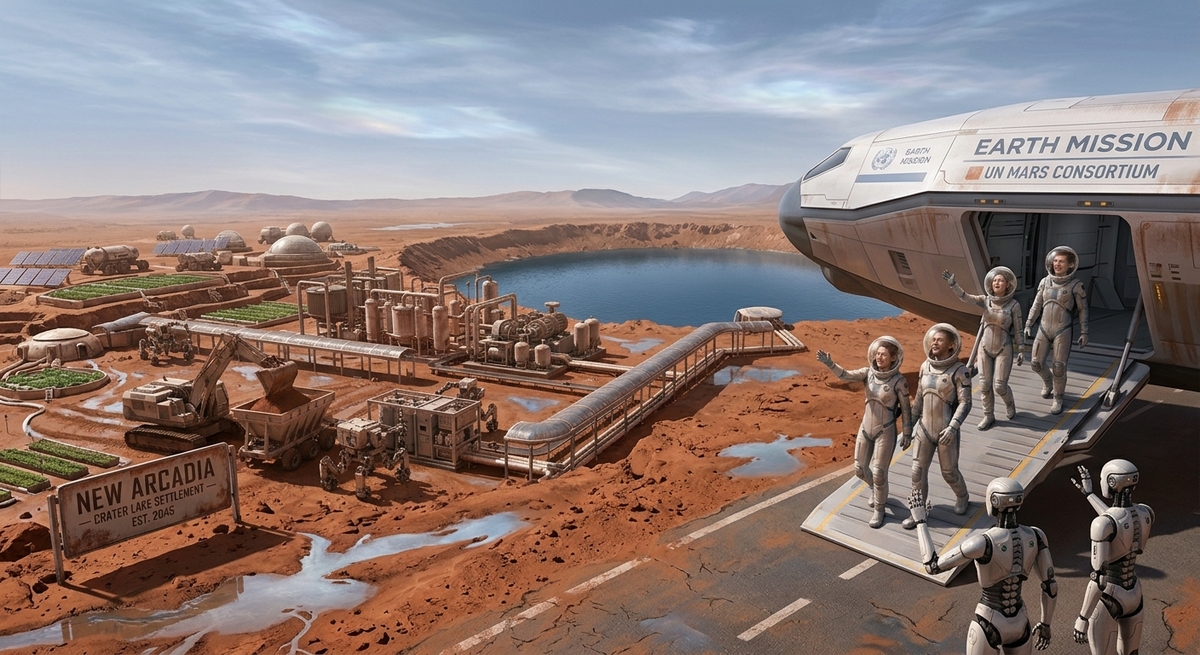
Thirty years later, a warmer, wetter Mars sees the first human settlers.
Alter, Gemini, and DeepSeek helped with the writing of this article.
Leave a Reply