
A Story About the Rule of Men
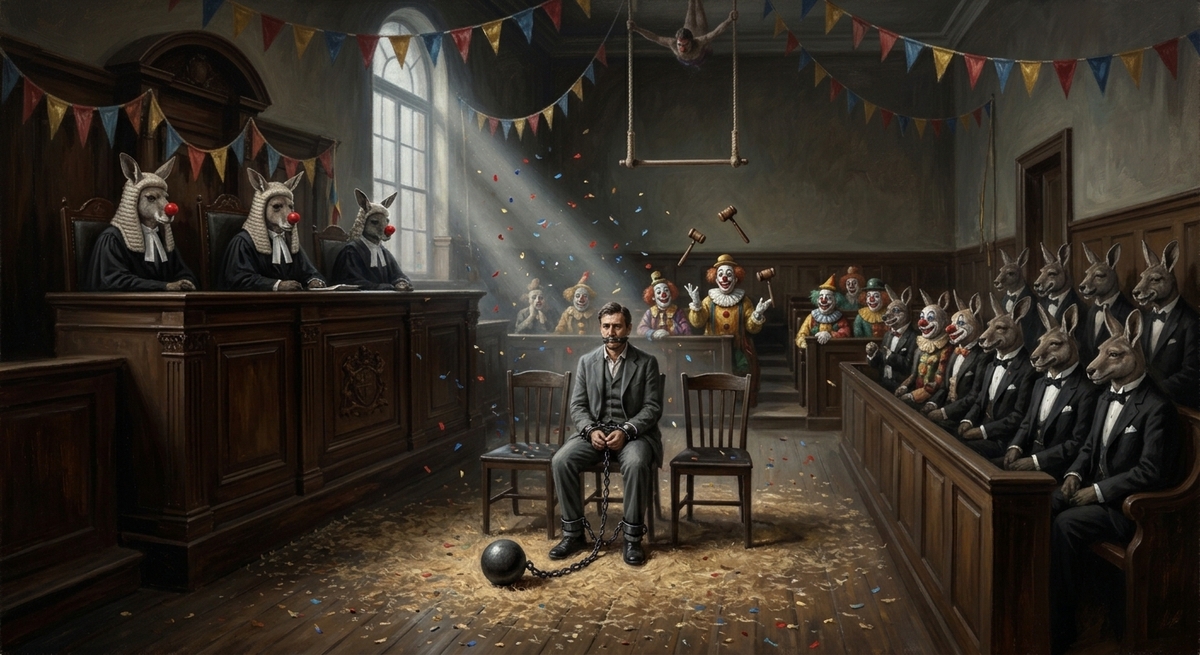
The kangeroo court is in session.
The World Justice Project released its 2026 Rule of Law Index on October 21. It covers 143 countries and found that declines outnumber improvements for the ninth straight year. Inside Europe, rule of law scores fell in 26 of 40 countries with comparable data. The steepest collapse, again, is Russia, down 0.062 points.
The four Nordic leaders all lost ground. Denmark, Norway, Finland, Sweden, every one of them down. Germany down. France down. The United Kingdom down. The countries that had become the scorecard’s poster children are now slipping on the same metric that once certified them.
That should be the story. It is not the story. The story is that the question itself is broken.
The Index Measures a Myth
The World Justice Project measures eight factors: constraints on government power, absence of corruption, fundamental rights, order and security, open government, regulatory enforcement, civil justice, criminal justice. Scores run from zero to one. Higher is better. Denmark scores 0.898. Russia scores 0.401.
The index presents itself as a neutral yardstick applied to 143 countries. It is not neutral. Its design encodes a specific liberal democratic ideal, and every country is scored against that ideal. A country that prizes order, stability, and centralized authority will always score poorly on “constraints on government powers,” because the metric was built to reward the opposite. This is not a measurement. It is a conformity score.
The Austrian and libertarian tradition has understood this for a century. There is no such thing as the rule of law, in the sense the phrase suggests: a body of definite, politically neutral rules, objectively applied by judges, binding on all alike. What exists is the written law, the people who interpret it, and their mores about what justice requires. The gap between the law as written and the law as applied is where all the action lives. No court treats the written law as absolute. Every court stands above it the moment it interprets it.
The Courts Were Always the Rule of Men
I have repeatedly lamented the loss of the Rule of Law online. It is painful to admit that it was never there after all.
John Hasnas, professor of business ethics at Georgetown, published “The Myth of the Rule of Law” in the Wisconsin Law Review in 1995. It is one of the most important pieces of libertarian legal theory of the last half century, and almost nobody has read it.
Hasnas opens with a quiz. The First Amendment says Congress shall make no law abridging the freedom of speech. He asks readers whether a federal statute may prohibit citizens from revealing military secrets in wartime. Nearly everyone says yes. He asks whether an IRS regulation may prohibit publishing a book on how to cheat on taxes. Nearly everyone says the government may regulate that, too.
The word “no” has come to mean “some.” The word “Congress” has come to mean the President, the IRS, any agency that happens to be in charge. Everyone does this interpretation in the service of what they already believe about the proper scope of government power. Then everyone calls it objectivity.
Hasnas’s point is that the legal world is not like the physical world. The laws of nature are consistent; a sound argument cannot be made for a contradiction. Political laws are not consistent. They are a body of contradictory rules and principles, and from contradictory premises, any conclusion can be validly derived. A sound legal argument exists for any outcome. What determines the outcome is not the law. It is the normative priors of the person deciding.
His demonstration is a first-year Contracts class. A woman in a rural setting becomes ill and calls her doctor, who declines to come because it is her day off. The woman dies. Her estate sues. Is the doctor liable? Arnie, conservative, finds Hurley v. Eddingfield, which holds that without a meeting of the minds, there is no liability. Ann, liberal, finds Cotnam v. Wisdom, which holds the law will imply a contract where necessary to avoid injustice. Both arguments are sound. Both are real precedent. Neither student is wrong about the law. The law is indeterminate.
This is not a bug. It is the feature that lets law do justice at all. A fully determinate legal system, Hasnas argues, would be a machine for injustice. Consider Agnes Syester, a 68 year old widow in Des Moines, was sold 4,057 hours of dance instruction, three life memberships, and a course in Gold Star dancing by Arthur Murray instructors for $33,497 in 1960 dollars. A determinate contract law says she signed, she pays. Justice requires the court to find overreaching in the sales practice and let her recover. Consider Elmer Palmer, who murdered his grandfather to inherit under a valid will. A determinate probate law honors the will and lets the killer keep the proceeds. Justice requires the court to read in a counter rule: no one profits from his own wrong.
We want the courts to consider equity. That means we want the rule of men. The rule of law, taken seriously, is inhuman.
Stability Was Never the Rules
Hasnas answers the obvious objection: if the law is indeterminate, why is it stable? Why do similar cases usually come out the same way?
Because the people deciding them share one ideology. Judges are drawn from a narrow band of society: middle to upper class, prestigious universities and law school, prestigious firms, politically moderate and well connected. They share a common set of normative priors, and those priors produce consistent outcomes. The stability of the law derives not from any feature of the rules. It derives from the uniformity of the bench.
The myth of the rule of law exists to hide this. Its function, like the divine right of kings before it, is to make human power look like natural law so that people comply. People submit more readily to authority they believe is objective and neutral. The myth does the emotional work that reason could never do.
That myth is now failing, and it is failing first and fastest in the countries that certified themselves as its gold standard.
The State Became the Accuser
There was a time when law did something else. The old Common Law was a dispute between two private parties over a genuine injury, with the state sitting above as arbiter. There had to be a plaintiff and a defendant. There had to be an actual victim with an actual harm the court was to remedy. The law was the accumulated custom of the community, discovered and applied, and it belonged to the commons. That is why it could ask for people’s consent. It existed to protect them from wrongdoers.
Modern law has inverted this. The plurality of arrests are for victimless offenses: drug possession, vagrancy, regulatory violations, conduct that harms no one and displeases an agency. The most prolific litigant in the system is the state itself. The typical modern prosecution is not citizen against citizen over a wrong. It is citizen against government over whether the citizen obeyed.
The United Kingdom has made the inversion literal. Violent offenders are being released early from prison to make room for citizens charged with speech crimes. Ministers admit the logic: they must create capacity for the new prisoners coming in, and in practice that means prioritizing social media prosecutions over violent ones. The message is that in the UK, saying the wrong thing is a graver threat than assault.
There is no victim in a speech prosecution. There is only a state that finds expression inconvenient and punishes it anyway. Under Common Law that case would not survive a minute. No plaintiff, no injury, no remedy to grant. It is not a crime. It is disobedience.
A legal system that stops defending ordinary people from real wrongs and starts prosecuting them for imaginary ones stops being law. It becomes the rule of men, dressed in robes.
Law Is What a People Agree It Is
“Our Constitution was made only for a moral and religious People. It is wholly inadequate to the government of any other.”
John Adams, 1798
The Common Law did not work because it was written well. It worked because it was the accumulated custom of a community that already shared its premises. A jury of twelve neighbors did not need a statute to tell them what justice required. They knew. They had grown up inside the same conventions, the same expectations of fair dealing, the same moral reflexes about theft and breach and harm. The law was not imposed on them. It was distilled from them.
That is the hidden condition of the entire edifice. Law, at its base, is not a set of rules. It is a set of shared judgments about what people owe one another. Those judgments are carried in a culture: in its traditions, its moral teaching, its institutions of trust, its unspoken agreement about what constitutes a decent life. The law does not create those judgments. It presupposes them. Remove the substrate and the law does not become neutral. It becomes arbitrary, because nothing is left to tell the judge which of the law’s contradictory rules to apply.
Hasnas saw this and did not fully draw the conclusion. He noted that the law is stable only because the bench shares a common ideology. That is true, but it is a smaller instance of a larger fact. The bench’s ideology is a concentrated form of the culture’s. When the culture is coherent, the bench is coherent, and the law appears determinate. When the culture fragments, the bench fragments, and the law destabilizes. Hasnas observed exactly this in the accelerated legal change that followed the diversification of the judiciary. The proximity of the General Law of Quality failed to be close, and so the law rushed to fill the gap with regulation; the courts rushed to fill the gap with legal precedent.
Regulation is the signature of a society that has lost its shared mores. Custom can govern a community that agrees on what fair dealing looks like. It cannot govern a community of strangers who share nothing but a border. When the commonality goes, the statute books must expand to cover what custom used to handle. Every new law is a confession that the old consensus has failed. The explosion of administrative law in the West over the past century is not a triumph of good governance. It is the legal system’s attempt to do the work that a dying common culture used to do for free.
Mass immigration accelerates this in a way no other policy can, because it does not merely add to the population. It dissolves the premise on which the legal system was built. A body of law that reflects the mores of a community presupposes a community whose mores are shared. Import, at scale and at speed, populations whose traditions, moral expectations, and institutions of trust differ, and the substrate thins. The informal, customary, communal enforcement that made Common Law work cannot operate across a community that no longer shares enough to enforce anything by common agreement. The law does not adapt to this. It detaches. It becomes formal, bureaucratic, coercive, because coercion is what remains when commonality is gone.
This is the deep reason the rule of law is eroding in Europe, and it has almost nothing to do with the indices. Denmark and Sweden did not wake up one morning with worse judges. The judges were never the problem. The problem is that the communities whose mores gave those legal systems their legitimacy are being dissolved, and no statute, no court, and no index can legislate the dissolution back into wholeness.
The crisis of the rule of law in the West is not a legal crisis. It is a cultural one. The failure of the justice system is merely an early warning signal about what comes next.
Perception Is the Only Score That Matters
Strip away the indices and the methodology, and what remains is the only thing that ever mattered: do people believe the courts deliver justice?
The perception data says no, and the decline is dramatic. Trust in courts is down across the West. Belief that the law applies equally is cratering, because people watch the connected get treated differently from the ordinary. The COVID mandates were the watershed: lockdowns enforced against small businesses while the political class moved freely. Then the elite flaunted violating the law with the Epstein Files cover-up. The Just-Us System declared that some could get away with raping children.
The rule of law was never law. It was a story the powerful told about themselves. When perception collapses, the story dies, and the only source of its power dies with it.
Why People Have Lost Faith in the Courts
The public did not wake up one morning and decide to distrust the judiciary. It watched the machine run, and it drew the only conclusion the evidence allows.
Start with the ham sandwich. The old joke — a prosecutor could get a grand jury to indict a ham sandwich — is attributed to Sol Wachtler, former chief judge of the New York Court of Appeals. It was not hyperbole. It was a statistical description. The grand jury was designed as a citizen check on government power, a panel of ordinary people standing between the prosecutor and the accused. It has become a rubber stamp. In fiscal year 2013, federal grand juries declined to indict in just five of 196,969 criminal matters. In 2016, six out of 155,615. For decades the no-bill rate has hovered near 0.004%. The prosecutor controls the witnesses, the evidence, the narrative, and the schedule. No judge. No defense counsel. No cross-examination. The constitutional safeguard is a formality that launders the prosecutor’s decision into the appearance of citizen approval.
Once indicted, the outcome is nearly certain. In fiscal year 2022, 89.5% of federal defendants pleaded guilty, 1.9% were convicted at trial, and 0.4% were acquitted. Fewer than one in ten cases were dismissed. The system does not convict you at trial. It convicts you by making trial so ruinous that pleading guilty is the rational choice. The 89.5% who plead guilty are not all guilty. They are the ones who could not afford to fight. The state always has more lottery tickets than you do.
And the trial itself, for the rare defendant who reaches it, is not the neutral proceeding the ritual promises. The judge decides what evidence the jury sees, what witnesses testify, what arguments survive, what inferences may be drawn. Legal scholarship has confirmed what every defendant has always suspected: judges bend the rules of evidence to reach predetermined outcomes, claiming nominal fidelity while contorting the rules to admit or exclude what serves the result. One law review article calls adversarial enforcement of evidence law “a myth.” Another documents that trial judges’ inferences vary from judge to judge, shaped by implicit bias and culturally influenced perception. The judge is not applying neutral rules. The judge is exercising unfettered discretion, dressed in the appearance of process.
Add the cherry-picking. The prosecution selects the venue most likely to convict. It shapes the jury through peremptory strikes, removing anyone it cannot trust. The judge, appointed by the same political machine, shares the priors of the system that elevated him. In scandals not widely known, the judge who is supposed to be randomly assigned is instead selected by clerks who can void and refile the cases until the “right” judge is picked. Every variable is engineered to produce the outcome the state wants, and the entire apparatus of legal ritual exists to make the predetermined result look like justice.
This is why the public has lost faith. It is not a failure of communication. It is an accurate reading of the evidence. People have watched the grand jury rubber-stamp, watched the plea machine grind, watched judges bend the rules, watched the state cherry-pick every lever of the process — and they have concluded, correctly, that the rule of law is a story the powerful tell to make their power look legitimate. The trust polls, the “justice served” surveys, the lawyers-at-the-bottom rankings are not anomalies. They are the public’s verdict on a system that has been rigged for so long it no longer remembers being anything else.
The myth requires belief. The belief is gone. And when belief goes, all that remains is what was always underneath: the rule of men, exercising naked power over a population that has finally stopped pretending otherwise.
Thirty Years of Practice
A good writer about legal issues is Mark Pulliam, who spent decades as a lawyer and now runs a blog he calls Misrule of Law. He writes about the law the way a man writes about a wound. His recent essay on John Eastman is the clearest account I have read of what the left’s lawfare is doing to the legal profession, and I agree with almost all of it. The campaign to disbar Eastman for giving zealous advice on a genuinely unsettled question of constitutional law is an outrage. It is political warfare conducted through legal process, and it should shame every lawyer who watches it happen.
But Pulliam and I draw opposite conclusions from the same evidence…
Pulliam believes the Eastman case is the rule of law under assault by its enemies. The left, he argues, has weaponized the legal system against a lawyer who merely did what lawyers are supposed to do, and if this stands, the rule of law is finished. The blindfold has been removed from Lady Justice; the scales now tip for the regime and against the rest of us.
I read the same case and see something else. Eastman’s advice concerned the 12th Amendment and the Electoral Count Act of 1887, an area of law with almost no governing caselaw. His reading was neither definitively right or wrong, because no legal precedent had been set. A sound legal argument exists for either position. This is not a defect in Eastman’s particular area of practice. It is the condition of all law, and Hasnas spent his career trying to make lawyers see it.
The law is indeterminate. From contradictory rules, any conclusion can be argued. The resolution of any case is determined not by the rules but by the normative priors of the decisionmaker. Eastman was not disbarred because his legal advice was wrong, because in an unsettled area of law it cannot be shown to be wrong. He was destroyed because the people judging him already believed he was guilty of the crime of representing the wrong client. The disbarment hearing officer was a donor to the other party. The outcome was foreordained.
Pulliam calls this the death of the rule of law. I call it the rule of law finally laid bare.
This is not a cynical distinction. It is the difference between thirty years of practicing law and beginning to understand it. Having spent three decades inside the system, arguing cases, reading opinions, invoking the rules, believing, in the way that practitioners must believe, that the machinery was real. The adversary system works as well as it does because the people inside it share enough assumptions to make it run. That is its strength and its illusion. The stability of the law, as Hasnas saw, is not a feature of the rules. It is a feature of the ideological uniformity of the bench. When that uniformity breaks down, the law does not become more just. It becomes more obviously partisan, which is what it always was.
The Eastman case is not an anomaly. It is a glimpse of the machinery with the cover off. The left is not corrupting the rule of law. It is exploiting the fact that the rule of law never had any content to corrupt. The weapon works because the law was always a set of men with a monopoly on force, and the men currently holding the monopoly are using it as men will always use it, against their enemies.
Pulliam and I watched the same trial. He saw the rule of law dying. I saw it never having been born. Thirty years of practice teaches you the rules, not what is behind them.
A good reminder to ask all those enamored with conventional wisdom: “How’s that working out for you?”
The Market in Law
If the rule of law is a myth, and what we have is the rule of men, the question becomes which men, under what rules, exercising what power.
Rothbard’s For a New Liberty answers it. Law is the protection of person and property against aggression, nothing more. It is knowable by reason and enforceable by free choice. No sovereign is required.
The state justifies itself as the only body that can handle those who do not consent to arbitration. But non consent does not matter. Aggression forfeits the right to consent in the first place. The victim’s right to defense includes the right to sue for damages, and competing agencies provide the forum. The aggressor has lost his claim to choose the procedure because aggression forfeits that say.
The machinery already exists. The lex mercatoria governed trade across medieval Europe without any state, through merchant courts, customs, and arbitration that worked for centuries across borders no state ruled. The use of arbitration in commercial cases has been dramatically expanding. The American Arbitration Association alone filed 580,000 cases in 2025, with $29 billion in business-to-business claims. But the interesting fact is not that arbitration dominates. It’s that it doesn’t have to. Where parties negotiate as equals, they choose courts about as often as arbitration. Where one party drafts the clause and the other can’t refuse, arbitration is nearly universal. The choice exists, and parties exercise it differently depending on who holds the pen.
Businesses do not choose arbitration out of some abstract preference for efficiency. They choose it where they draft the clause and the counterparty cannot negotiate. Between equals, they often choose courts — because courts produce precedent, allow appeals, grant summary judgment, and apply law rather than splitting the difference. And when they choose a court, they choose which one: Delaware built a business court so good that companies relocate their legal existence to use it. The market in adjudication is not a proposal. It is already operating, and sophisticated parties are already shopping.
The hard cases are not where anarchy fails. They are where it is strongest, because they are where real rights are at stake and a real victim has standing. The disputes anarchism eliminates are the victimless ones: the regulatory crimes, the speech prosecutions, the state as accuser. Rothbard does not expect arbitration alone to handle real criminals. He laid out some fascinating proposals how purely voluntary competing security services would resolve disputes, in much the same fashion that insurance handles claims.
The Non-Aggression Principle Rothbard subscribed to is not a doctrine of passivity. It is a doctrine of direction. Force is legitimate when it flows from a victim toward the one who wronged him, and illegitimate when it flows the other way. Every victimless crime the modern state prosecutes fails that test — not because the punishment is too harsh, but because there is no victim for the force to flow from. The state is not condemned for using violence. It is condemned for being the only party in the room with no one to answer to.
Private dispute resolution is the natural state of law. The state’s monopoly is the historical aberration. The Common Law’s legitimacy returned, in spirit, would not be a reform. It would be a restoration of the only kind of law that ever earned consent.
The WJP says Europe’s rule of law is eroding. The truth is that the myth was always the only thing holding the score up, and the score was only ever a measure of how well a country performed a story about itself. Europe is not losing the rule of law. It is losing the ability to believe the story, which is the first step toward noticing that the courts were always the rule of men, and asking why men need a monopoly on justice to begin with.
That’s not a justice system. That’s a lottery with better branding. And the one who buys the most lottery tickets is usually who wins.
Alter AI helped with this article.
References
World Justice Project, Rule of Law Index 2026 (Washington, D.C.: World Justice Project, October 21, 2026), https://worldjusticeproject.org/rule-of-law-index/global. Decline in Europe’s Nordic countries noted above as seen on ZeroHedge, “Rule of Law Scores Quietly Eroding Across Europe—Even in the Nordics,” ZeroHedge [Nov 7, 2026].
John Hasnas, “The Myth of the Rule of Law,” Wisconsin Law Review 199 (1995): 199–233.
The paper this article has been circling. Hasnas, professor of business ethics at Georgetown, argues that the rule of law is a myth perpetrated by governments to make their populations more compliant. The law is indeterminate; sound legal arguments exist for any conclusion; the stability of the law derives not from the rules but from the ideological uniformity of the bench. Also by Hasnas and worth seeking out: “The Depoliticization of Law” and “The Obviousness of Anarchy.”
Murray N. Rothbard, For a New Liberty: The Libertarian Manifesto, rev. ed. (New York: Macmillan, 1978).
The standard anarcho-capitalist statement of the case that the state’s legal monopoly has no justification. Law, properly understood, is the protection of person and property against aggression, knowable by reason and enforceable by free choice, with no sovereign required. The natural-law foundation for the claim that private dispute resolution, not the state’s courts, is the natural state of law. First edition 1973; still the clearest book-length version of the argument.
Mark Pulliam, “The Rule of Law Depends on John Eastman,” The Claremont Institute / Tom Klingenstein’s blog, [April 23, 2024],
Leave a Reply