
The Wall of Abstraction
“You can’t see the forest for the trees.”
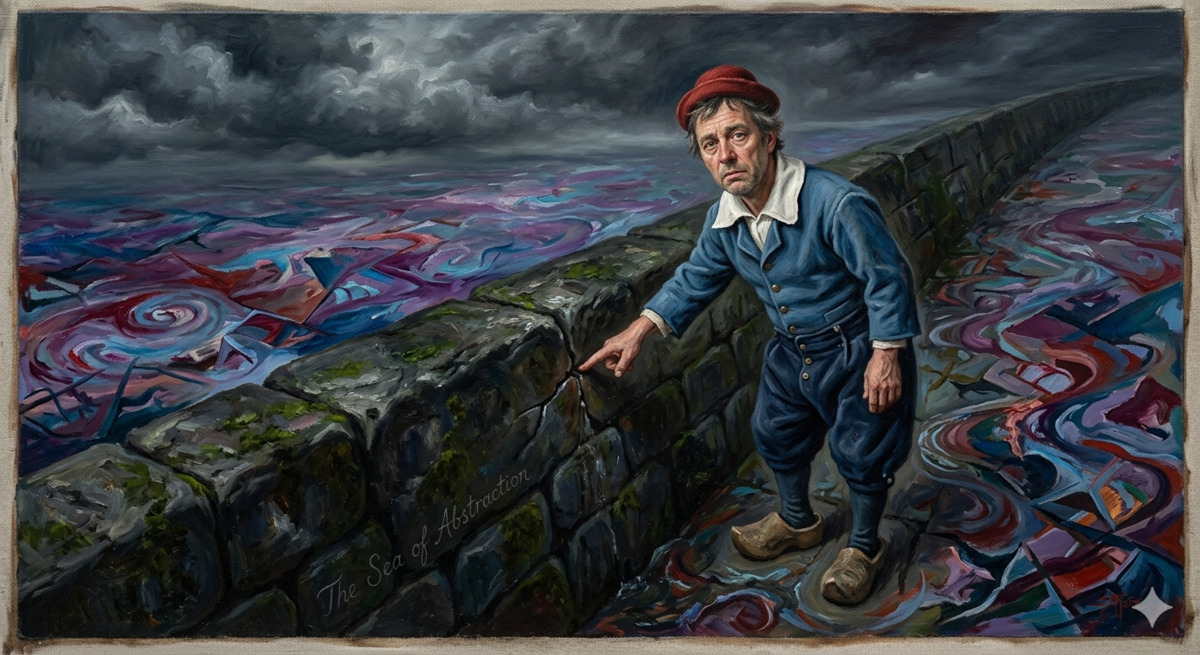
“Do I really need to stand here?”
I. The Child’s Question
Every parent knows the experience.
It begins innocuously. Why is the sky blue? Because sunlight scatters off the atmosphere. But why does it scatter? Because of the way light interacts with air molecules. But why does it interact that way? Because of the electromagnetic properties of matter. But why—
At some point the adult runs out of road. What comes next is not an answer. It is a Wall.
“Because that’s just how it is.” “Because I said so.” “You’ll understand when you’re older.”
The child has not become less intelligent. The questions have not become less valid. What has happened is that the adult has reached the boundary of their own understanding — or the boundary of what they are willing to say — and substituted a performance of explanation for actual explanation.
I noticed this at eleven years old, asking questions that the adults around me could not answer. What I observed was not failure of knowledge specifically. It was something more structural — a boundary that appeared consistently, across different adults, different subjects, different conversations. The questions would proceed normally for a few exchanges, and then suddenly the answers would change in quality. They would become circular, or dismissive, or invoke authority rather than explanation. Something had been reached that could not be passed.
It took decades to understand precisely what that something was.
The child asking “But why?” is not being annoying. The child is performing pure science — following causation without regard for comfort, permission, or social consequence. The question is the most honest intellectual act a human being performs. We spend the rest of our lives learning to stop asking it.
II. What Abstraction Actually Is
Before naming the Wall precisely, we need to understand the cognitive process it interrupts.
Consider a simple example. You encounter several small furry animals. Some have orange stripes. Some are black. Some are gray. Some are white. At first you might categorize them separately — the orange-striped ones, the black ones, the gray ones. But there is a pattern available at the next level up: all of these creatures share fundamental characteristics of structure, behavior, and biology that identify them as the same kind of thing. They are all cats. The cat is not merely a category — it is a species, defined by the capacity of its members to mate and reproduce with one another. That property does not belong to any single cat. It belongs to the level above, where the pattern becomes visible. The “cat” level of abstraction doesn’t erase the differences between a tabby and a black cat. It reveals something more important — the underlying unity that the surface differences were obscuring.
This is what abstraction does. It moves upward from specific instances to general patterns, from particular observations to explanatory principles. Each level up reveals what the level below cannot see.
Every word in this sentence is already an abstraction. “Tree” compresses an infinitely complex biological system — root networks, vascular tissue, photosynthetic machinery, evolutionary history — into a single transferable token. That compression is both the power and the cost of abstraction. You can think about “trees” without holding every tree simultaneously in mind. But in doing so, you lose the texture of the bark, the specific angle of each branch, the particular microbiome of the root system.
The full abstraction stack looks something like this: individual tree → species → forest → ecosystem → biosphere. Each level reveals what the level below cannot see. Each level costs what the level below could see.
The folk wisdom “you can’t see the forest for the trees” encodes precisely this insight. To see the forest you must stop seeing the individual bark textures and branch angles. The detail has to blur into “tree-unit” before the pattern becomes visible. The saying is usually interpreted as advice to step back and see the big picture. But it means something more specific and more interesting: the forest is the next explanatory level up that actually exists — and the person staring at bark is refusing, or unable, to ascend to it.
Children apply abstraction instinctively as they build their understanding of the world. The infant doesn’t catalog individual instances of “cup-shaped-vessel-containing-liquid.” The infant abstracts “cup” — a general category that applies across infinite specific instances. This is a cognitive achievement of extraordinary sophistication, performed without instruction or conscious effort.
Which makes it all the more interesting that adults seem to have genuine difficulty performing conscious abstraction — moving deliberately to the next explanatory level when the current one proves insufficient.
The Wall of Abstraction defined precisely: the moment when the next explanatory level exists and would genuinely answer the question — but the ascent to it is refused, blocked, or simply not attempted. The cat is there to be seen. The forest is there to be seen. The explanatory layer is available. The Wall is the failure to go there.
The child’s “But why?” is instinctive abstraction stack climbing. The Wall appears when the adult hits the level they cannot reach, or will not reach, and performs an answer instead of finding one.
📖 Read More: The Abstraction Stack in Computing Fifty years of software development is essentially a curriculum in abstraction stack navigation. Debugging requires knowing which level the bug is hiding at — hardware, operating system, runtime, application logic, user interface — and moving between levels until you find it. A misplaced semicolon in a PHP script can cause the error to appear 100 lines beyond where it actually is — the interpreter reporting what it finds at its level of abstraction, while the real problem sits undetected at another. The programmer who stares at the wrong level of the stack can spend hours on a problem that resolves in seconds once they move to the right level.”
III. The Wall Through History
The Wall is not modern. It is not Western. It is not a product of any particular religion, culture, or institution. It is the universal boundary where human understanding stops and explanation becomes performance.
What changes across history is the costume the Wall wears.
In the earliest human cultures — animist, shamanistic, pre-agricultural — the Wall wore the face of spirits and gods. Why does lightning strike? Because the sky god is angry. Why does the river flood? Because the river spirit demands sacrifice. These answers satisfied the immediate cognitive need for causation. They also terminated inquiry at the cultural tolerance boundary. You could ask why the sky god was angry. You could not ask whether the sky god existed.
As civilizations became more complex, the pantheons became more sophisticated and the Walls more elaborate. Agricultural societies developed gods of harvest, rain, fertility, war — each a specialized Wall that terminated inquiry in its domain. The gods will it. Pray and sacrifice. The question of mechanism was not asked because the Wall arrived before it could form.
The medieval synthesis — monotheistic theology as the unified Wall — was in some ways more intellectually honest than its predecessors. A single coherent God provided a terminal explanation for everything simultaneously. The Wall was internally consistent, theologically defended, and philosophically sophisticated. Aquinas built elaborate logical architecture right up to the edge of it. Beyond the edge: God’s will. The architecture stopped there.
Early science broke through the theological Wall — but immediately began building new ones. “Natural philosophy” replaced divine will with mechanical causation, then hit its own Walls at “vital forces” and “the ether” and “caloric fluid.” Each was a legitimate explanatory framework that worked well within its domain and terminated inquiry at its boundary. The scientists who believed in the ether were not stupid. They were doing what humans always do — building the best Wall available from current materials.
Modern science has constructed the most sophisticated Wall in human history. Peer review, p-values, replication requirements, funding gatekeeping, institutional credentialing — all of these are legitimate tools for ensuring rigor. They are also, simultaneously, Wall infrastructure. The question that cannot find funding will not be asked. The result that cannot survive peer review will not be published. The researcher whose conclusions threaten the funding source will not be funded again.
The Wall doesn’t announce itself. It presents as methodology.
IV. The Sophistication Hierarchy
The Wall scales with the intelligence of its builder. This is worth understanding clearly, because it means sophisticated people are not immune to the Wall — they simply build more elaborate ones.
The least sophisticated Wall: “God’s will” / “The Bible says so.” Recognized as a cognitive stop sign by most twelve-year-olds. The Wall is visible because it makes no pretense of being anything else.
The folk wisdom Wall: “Everything happens for a reason.” Unfalsifiable, emotionally necessary, and genuinely comforting. It terminates inquiry without the embarrassment of claiming divine authority.
The academic Wall: “That’s not peer reviewed.” “Correlation isn’t causation.” “The sample size is insufficient.” Each of these is a legitimate methodological concern when honestly applied. Each becomes a Wall when selectively deployed to protect conclusions rather than ensure rigor.
The alternative researcher’s Wall: Morphogenetic fields, simulation theory, sacred geometry. Intellectually respectable, gestures at everything, commits to nothing empirically testable. The Wall that feels like open-mindedness while functioning as a ceiling.
The institutional Wall: “National security.” “Conspiracy theory.” “Misinformation.” The Wall with enforcement mechanisms attached.
The most sophisticated Wall: An elaborate, internally consistent framework that terminates precisely before the conclusion that would be most disturbing. The philosopher of science who constructed an entire book inventing every possible reason why sociobiology could not apply to human beings — not because the arguments were wrong individually, but because the aggregate effect was to make the question unanswerable by design. The sophistication of the Wall was itself evidence of what it was protecting.
The progression is not random. Each level represents a genuine advance in the complexity and defensibility of the termination mechanism. The sophisticated Wall is harder to identify precisely because it resembles rigorous thinking until the moment it stops.
V. Why the Wall Exists
The child’s “But why?” is cognitively expensive and socially dangerous. Understanding why the Wall exists requires taking both of those costs seriously.
The social function: Every culture develops consensus answers that terminate inquiry before it destabilizes the social structure. This is not pathological — it is necessary. A society whose every member followed every causal chain to its logical conclusion could not function. Some questions, if universally pursued, would dissolve the agreements that make cooperation possible. The Wall is social glue.
Thomas Kuhn’s analysis of scientific paradigms captures the institutional version of this function. Normal science — the productive, cumulative work of filling in the details of an accepted framework — is only possible because the Wall holds. Revolutionary science is traumatic precisely because it dismantles the Wall that was enabling all the normal work. Kuhn wasn’t criticizing the Wall. He was describing why it is structurally necessary.
The individual function: Following every thread to its conclusion is psychologically destabilizing. The person who genuinely pursues every “But why?” to its terminus encounters genuine uncertainty — about the nature of consciousness, about the basis of morality, about whether the social structures they depend on are justified. The Wall protects the individual from conclusions their psychology cannot comfortably integrate.
The institutional function: Some conclusions would delegitimize the institution that draws them. The pharmaceutical company that follows “But why does this drug cause this side effect?” to its honest answer may be following a path to its own liability. The government agency that follows “But why did this policy fail?” to its honest answer may be documenting its own incompetence. The Wall serves the institution by ensuring that inquiry terminates before it becomes institutional self-destruction.
The Wall is not primarily about truth. It is about coherence — social, psychological, and institutional. Which is why dismantling it requires understanding what it is protecting, not just insisting that it shouldn’t exist.
VI. The Wall in Modern Science — Specific Examples
The Wall is most visible where it is most consequential. Here are documented cases where “But why?” hits the Wall today:
Why does the universe have the cosmological constants it has? The values of fundamental physical constants — the speed of light, the gravitational constant, the fine structure constant — are precisely tuned to permit the existence of complex matter and life. Ask why they have these values and you encounter the Anthropic Principle (“they have to be this way for us to be here to ask”) or the Multiverse hypothesis (there are infinite universes with all possible constants; we’re in one that permits observation). Both are unfalsifiable. Both are Walls dressed as physics.
Why do GLP-1 drugs affect addiction and dopamine pathways? The mechanism by which semaglutide and similar drugs reduce addictive behavior is not understood. This is publicly acknowledged. What is not being asked loudly enough is what else these same pathways do — the downstream effects on motivation, creativity, emotional range, and personality that might accompany the documented metabolic benefits. “We don’t fully understand the mechanism” is the Wall that conveniently prevents the next question.
Why does EMF biological research keep getting defunded? The pattern across several decades: researchers document biological effects of electromagnetic radiation at non-thermal levels; funding does not renew; the conclusion “evidence is insufficient” is reached. The Wall ensures that the evidence stays insufficient by eliminating the mechanism for generating it.
Why did Eichmann do it? Hannah Arendt’s answer — the banality of evil, the bureaucratic diffusion of moral responsibility — was rejected with fury precisely because it removed the Wall of “he was a monster.” The monster Wall is comforting because it locates the capacity for systematic atrocity in a safely abnormal psychology. Arendt’s answer was disturbing because it did not.
Why is there a Fermi Paradox? The universe is 13.8 billion years old. If technological civilizations arise at even a small fraction of the rate our existence suggests, the galaxy should have been colonized many times over before our sun formed. The silence is the data. “We haven’t looked long enough” and “they’re too far away” are Walls that prevent asking whether the silence is itself the answer.
VII. “But Why?” as Methodology
The citizen scientist’s tool is simple: treat every Wall as a research question rather than a terminal answer.
When the US and Israel launched strikes on Iran in February 2026, the official explanations invoked nuclear proliferation concerns and regional security. These may be genuine factors. However, the But Why methodology asks: what does the next layer up reveal? Military analyst Michael Yon offers a framework that cuts through official justifications consistently: every significant conflict in history is ultimately fought over routes, resources, or ideology. Apply that lens to the Iran conflict and the Strait of Hormuz — through which 20% of global oil transits daily — comes immediately into focus. The nuclear program may be real. The Strait is also real. The But Why methodology doesn’t require choosing between them. It requires seeing both layers simultaneously.
The same methodology applied consistently:
Austrian economics: The Fed sets interest rates. But why does monetary expansion produce the specific patterns of investment and misallocation it does? Following that chain through Mises and Rothbard produces a complete theory of the business cycle — past the Wall of “the Fed knows best” — that predicted the 2008 crisis, the dot-com bubble, and the current AI capital misallocation more accurately than any mainstream model.
The Epstein network: The official answer — lone predator, individual pathology — is the Wall. The But Why methodology asks: what was the network for, who did it serve, and why did the investigation stop where it stopped? Those questions do not require a specific answer to be legitimate. They require only that the Wall not be accepted as the terminus.
The Great Silence: The Fermi Paradox is not a curiosity. It is a dataset. The But Why methodology applied to cosmic silence produces hypotheses that mainstream astronomy is structurally reluctant to pursue — not because they are unscientific, but because some of the answers would be destabilizing in ways that extend well beyond astronomy.
The citizen scientist’s methodology: every Wall is a research question. Every terminal answer is an invitation to look behind the curtain.
VIII. The Inner Wall — The Black Iron Prison
Everything discussed so far has been about external Walls — institutional, cultural, historical. But the most consequential Wall is the one we build inside ourselves.
Philip K. Dick spent the last decade of his life trying to describe what he called the Black Iron Prison — the structure of walls we construct inside our own cognition to avoid conclusions our own reasoning would otherwise produce. His 8,000-page Exegesis is the record of a mind that would not stop asking “But why?” even when the answers were destabilizing.
The internal Wall is subtler than the external one because it feels like wisdom rather than limitation. The internal editor that stops the question before it reaches conscious articulation presents itself as prudence, as maturity, as knowing which battles are worth fighting. The adult who has stopped asking “But why?” does not experience the absence as a loss. They experience it as having grown up.
The child asks without fear because the child has not yet learned which answers are safe and which are destabilizing. That ignorance is not naivety. It is the condition of genuine inquiry.
The most sophisticated internal Wall is the one that operates before the question forms — the cognitive habit that routes inquiry away from certain territories so automatically that the person never notices the detour. They simply find themselves not thinking about certain things, without being able to say why.
PKD’s name for the external version — the Black Iron Prison — applies equally to the internal one. The walls are invisible precisely because they have been so thoroughly internalized that they feel like the shape of thought itself rather than a constraint on it.
Dismantling the internal Wall requires something the external Wall does not — not evidence or argument, but the willingness to notice the detour while it is happening. To catch the internal editor mid-redirect and ask: why am I not thinking about this?
That question — Why am I not thinking about this? — is the But Why methodology turned inward. It is also the hardest question most people will ever ask.
IX. The Interpersonal Wall
After a half century of conversations, a pattern becomes visible.
Within two or three exchanges, most discussions reach a boundary. The questions are proceeding normally — following the causal chain, ascending through abstraction levels — and then something changes. The answers become circular. Familiar phrases appear: “That’s too complicated.” “You’re overthinking it.” “Some things just are.” The conversation has arrived at the Wall.
This is not a failure of intelligence. Some of the most intelligent people I’ve encountered hit their Walls most predictably — because intelligence, deployed in service of protecting a comfortable framework, is remarkably effective at that task. The Wall scales with the mind that builds it.
The most instructive case is the pseudo-awake — people who have rejected some prevailing narrative and believe that rejection constitutes awakening. They’ve discovered that governments lie, that media narratives are constructed, that official explanations often serve official interests. This partial ascent becomes its own stopping point. Their cynicism is their new Wall, one level up from where most people build it. They feel genuinely superior to those who haven’t questioned anything — while remaining bounded by frameworks they haven’t examined.
“If you want a picture of the future, imagine a boot stamping on a human face—for ever.”
– O’Brien in 1984.
The conversational technique that reveals this is simple: relocate the discussion to the level above where the Wall is operating. Don’t argue within their frame. Demonstrate that the frame itself is the question.
The left versus right politics is the clearest example. Most political conversation happens entirely within the left/right framework — which party is better, which policy is correct, which candidate is more honest. The Wall operates at the level of the framework itself. The question that relocates the conversation: does it matter whether it’s the left boot or the right boot stamping your face forever?
They’ve figured out there’s a boot. They haven’t asked why there needs to be a boot at all.
That question doesn’t attack anyone’s intelligence. It doesn’t argue within the framework. It makes the framework visible as a framework — a constructed box that the conversation has been happening inside without anyone noticing the walls.
Some people welcome this. Their eyes open a little wider. The conversation goes somewhere genuinely new.
Others fight to preserve the frame. “Don’t you hate Emmanuel Goldstein?!”1 The defensive response is immediate and sometimes intense — not because the question is wrong, but because the framework being questioned is load-bearing. Removing it would require rebuilding too much of what rests on top of it.
The Wall, in the end, is always protecting something. The interpersonal version is no different from the institutional one — it terminates precisely before the conclusion that would require the most reorganization. The honest observer’s only tool is patience, precision, and the willingness to keep asking the question one level up from where the conversation wants to stay.
X. The Question That Remains
“But why?” has no final answer. Every answer generates another question. The stack extends indefinitely in both directions — down into the specific and up into the general — without ever reaching a terminus that is not itself another Wall.
This is not a counsel of despair. It is an accurate description of the epistemic situation. Some Walls are genuine limits — the event horizon, the finality of death, the future that hasn’t happened yet. These deserve honest acknowledgment. But most of the Walls we encounter daily are not genuine limits. The forest exists. The next explanatory level is available. The cat category is there to be seen. The honest position is knowing the difference — and refusing to mistake a chosen stopping point for an actual boundary.
One honest question remains: how do you know when you’ve reached a genuine limit versus building your own Wall? The answer is behavioral. A Wall built to protect something appears precisely before a disturbing conclusion, gets selectively applied, and serves an identifiable interest. A genuine limit applies regardless of who’s asking and serves nobody’s interest by existing. The citizen scientist who claims immunity from building Walls is building one. The methodology is not a guarantee of truth. It is a discipline of noticing.
The James Webb Space Telescope is seeing past Walls that operated for decades. The early universe galaxy distribution doesn’t match what our models predicted. The Hubble Constant tension — the discrepancy between different measurements of the universe’s expansion rate — remains unresolved. Saturn’s hexagonal polar storm has been observed for forty years without a complete explanation. Each of these is a place where the Wall was operating and an instrument finally saw past it.
The instruments are always built first. The anomaly is documented. The Wall holds for a while — “measurement error,” “insufficient data,” “we don’t yet understand the mechanism.” Then the Wall gives way and the next layer of the abstraction stack becomes visible.
The honest position is not “I have the answer.” It is: “I have followed the question further than most, and I can describe the shape of what the Wall is hiding from its shadow.”
The child asking “But why?” is not being naive. The child is being rigorous. The question is pure. The method is sound. The willingness to follow the causal chain without regard for where it leads is exactly what genuine inquiry requires.
We spend our lives learning to stop asking.
Perhaps it is time to start again.
“The most beautiful thing we can experience is the mysterious. It is the source of all true art and science.” — Albert Einstein
Note: Einstein himself built one of the most consequential Walls in 20th century physics — his refusal to accept quantum indeterminacy (“God does not play dice”) was a sophisticated Wall that delayed his own engagement with quantum mechanics for decades. The epigraph and its irony work together.
Notes
- “Emmanuel Goldstein?!” (Orwell’s 1984 — the designated enemy whose existence justifies staying inside the approved framework without questioning it.)
📖 Read More: Connections Across the Dissolution Series
The Holes We Refuse to See (Ch. 1): The institutional version of the Wall mechanism — how organizations systematically avoid the questions that would require them to change.
Faux Science (Ch. 4): The peer review Wall specifically — how legitimate methodological tools function simultaneously as inquiry-termination infrastructure.
The Paradigms Article (1986): Deliberate ignorance as an active cognitive choice rather than passive absence of knowledge. The Wall chosen consciously.
The Inner Prison (Ch. 8): PKD’s Black Iron Prison developed at full length — the Wall internalized until it becomes invisible.
No One at the Top (Ch. 9): The Wall without a builder — how institutional inquiry-termination emerges from incentive structures rather than deliberate coordination.
Michael Yon, interview with Sarah Westall, “Iran Missiles Strike US Targets, Israel Support Falters,” Spreaker, 2026.
Jones, Eric M. (1985). “Where is everybody?”: An Account of Fermi’s Question (PDF). Los Alamos National Laboratory.
Gray, Robert H. (2015). “The Fermi Paradox Is Neither Fermi’s Nor a Paradox“. Astrobiology. 15 (3): 195–199.
Leave a Reply