
How Modern Pharaoh Built His Granaries Without Storing Any Grain
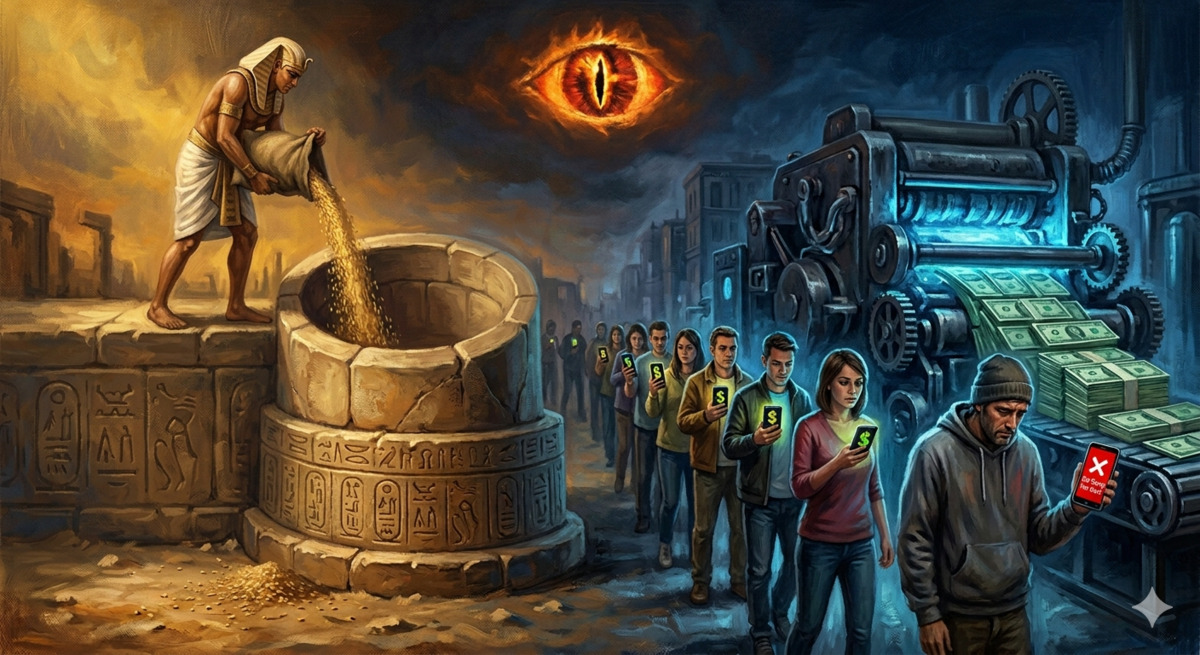
No soup for you!
And when money failed in the land of Egypt, and in the land of Canaan, all the Egyptians came unto Joseph, and said, Give us bread: for why should we die in thy presence? for the money faileth.
Genesis 47:15 (KJV)
I. Genesis 47, the Original Playbook
The story begins with an information advantage.
Joseph, son of Jacob, possessed something Pharaoh did not: foreknowledge. Through the interpretation of dreams — seven fat cows consumed by seven lean cows, seven full ears of grain consumed by seven thin ears — Joseph knew what was coming seven years before it arrived. He advised Pharaoh to appoint a single administrator over all of Egypt with authority to collect one fifth of all grain production during the seven years of plenty, storing it against the seven years of famine to follow.¹
Pharaoh, recognizing that no one else possessed this intelligence, made Joseph that administrator.
What followed is one of the most candid accounts of state power in any ancient text. During the seven years of abundance, Joseph moved through the land collecting. He built granaries in every city. He stored grain in such quantities that Scripture says he stopped counting — “like the sand of the sea, very much, until he ceased to measure it, for it was immeasurable.”²
Then the famine came. And it came everywhere — not just Egypt but across the known world. Egypt alone had food.
The transaction sequence that followed has no parallel in ancient literature for its honesty about how wealth transfers work under crisis conditions. In the first phase, all the people of Egypt and surrounding lands brought their money to Pharaoh in exchange for grain. “And Joseph collected all the money that was to be found in the land of Egypt and in the land of Canaan in exchange for the grain that they were buying, and Joseph brought the money into Pharaoh’s house.”³ When the money ran out, people came back. Joseph said: give me your livestock. They gave their horses, their donkeys, their flocks and herds. The second year they came again. The money was gone. The livestock were gone. Joseph said: give me your land and your labor. I will give you seed and you will work the land for Pharaoh, and Pharaoh will receive one fifth of the harvest every year, forever.
“So Joseph bought all the land of Egypt for Pharaoh, for every Egyptian sold his field, because the famine was severe upon them. So the land became Pharaoh’s.”⁴
The people said: You have saved our lives. Let us find favor in your eyes, and we will be Pharaoh’s servants.
There is one detail that textual commentators rarely emphasize, though it is structurally essential: the priests were exempt. Their land Pharaoh did not buy, for the priests had a fixed allowance from Pharaoh and lived on that allowance. They did not need to sell.⁵
This is the original model. Information advantage generates foreknowledge. Foreknowledge enables collection before the crisis. The crisis enables the fire sale — money, then assets, then labor. The permanent tithe follows. The priestly class — the administrative apparatus of the state — is exempted from its own rules. And the population, at every stage, experiences extraction as rescue.
The tithe was honest. Twenty percent, stated plainly, written into law, known to every farmer before the harvest. Joseph told the people exactly what he was taking.
That honesty, as we will see, is the one feature of the original model that did not survive modernization.
There is one other thing worth noting before we leave the ancient world. Joseph’s power had a physical constraint. The granaries had to hold real grain. Grain is bulky, heavy, subject to rot and vermin and the logistics of transport. The collection was limited by the physics of surplus. You can only store what you can physically carry and contain. The scale of the extraction was bounded by the scale of what actually existed.
Modern Pharaoh has solved that problem. But we are getting ahead of ourselves.
II. Modern Pharaoh’s Innovation — The Central Bank Removes the Physical Constraint
For most of human history, the Pharaoh model was constrained by physics.
A medieval king could tax his subjects, but the tax had to be paid in something real — grain, cattle, silver, labor. He could debase the currency by mixing lead with silver, but there were limits to how much he could debase before the deception became obvious and the currency was refused. He could borrow against future tax revenues, but lenders required interest and eventually demanded repayment, or stopped lending. The physical world imposed a ceiling on extraction that even the most ambitious ruler could not breach without visible, immediate consequences.
The invention of the central bank — specifically, the invention of fiat currency unconstrained by any commodity reserve — removed that ceiling.
The Federal Reserve was established in 1913. The last formal link between the dollar and gold was severed by Richard Nixon in 1971, when the United States unilaterally closed the gold window that had anchored the Bretton Woods system. Since that date, the dollar has been backed by nothing except the legal compulsion to use it and the credibility of the institution that issues it.
What this means in practice: Pharaoh no longer needs to store grain. When the crisis comes, he can create the currency to buy what he needs. The claims he distributes during the famine are not drawn from a surplus accumulated during the years of plenty — they are manufactured at the moment of need. The silos are full of IOUs. $38.9 trillion of them at last count, a figure that grows by roughly $1 trillion every hundred days and is now accruing interest at $970 billion annually.⁶
This is a profound transformation in the structure of power, and it has two faces that appear contradictory until you understand their relationship.
Face one: Modern Pharaoh appears weaker than the ancient version in one respect. He has no stored surplus. He has made no provision against the famine except the ability to manufacture claims against future production. If the credibility of the institution that issues those claims is destroyed — through hyperinflation, through loss of reserve currency status, through debt default — the power evaporates.
Face two: Modern Pharaoh is stronger than the ancient version in every other respect. The ancient tithe was bounded by physics. The modern tithe — inflation — is bounded only by the population’s tolerance for it, and that tolerance is nearly unlimited because the mechanism is nearly invisible. The price of eggs goes up. The landlord raises the rent. The employer doesn’t give the raise. At no point does anyone knock on your door and say: we are taking 8% of your stored wealth this year. The extraction happens through millions of individual market transactions, each one experienced as a personal inconvenience caused by “the economy,” not as tribute demanded by the collector.
Joseph told the farmers exactly what he was taking. Modern Pharaoh tells you exactly what he’s giving. The net transfer is the same. The psychological experience is opposite.
But the fiat monetary system, for all its flexibility, still faces a version of Joseph’s original problem. Joseph needed to know where the grain was — which farms had produced how much, which cities had stored what, which households had reserves and which were depleted. His information network was the foundation of his power. Without it, the collection was impossible.
Modern Pharaoh has the currency. What he needed was the database.
He built it. And he built it through a company most people still do not fully understand.
III. 1991 – A Pivotal Year
Palantir was founded in 2003. But it did not start in 2003.
1991 was a year of dissolution. Everyone knows about the breakup of the Soviet Union — the defining geopolitical event of that year. Less discussed is what else dissolved in 1991: the financial infrastructure of a decades-long covert apparatus. In July, regulators in seven countries simultaneously seized BCCI — the Bank of Credit and Commerce International — the CIA-linked institution that had served as the off-books financial backbone for arms trafficking, drug money laundering, and intelligence operations across 73 countries. $23 billion was never accounted for. In August, investigative journalist Danny Casolaro was found dead in a West Virginia hotel room, his notes missing, having told friends he was close to completing his investigation of what he called “The Octopus” — the intersecting networks of BCCI, Iran-Contra, and a stolen software program called PROMIS. In November, Robert Maxwell fell from his yacht near the Canary Islands. These were not unrelated events.
PROMIS — Prosecutor’s Management Information System — was developed in the early 1980s by Inslaw, Inc., a Washington DC software firm, under contract to the Department of Justice. Its capability was genuinely revolutionary for its time: it could integrate previously siloed databases into a single queryable layer, tracking individuals across multiple systems simultaneously. A 1992 House Judiciary Committee investigation found that senior DOJ officials had “acted willfully and fraudulently” and “took, converted and stole” Inslaw’s software “by trickery, fraud and deceit.” ²⁴ What the DOJ wanted PROMIS for was not case management. A May 14, 1985 letter from Assistant Attorney General William Bradford Reynolds to US Attorney William Weld — a primary document obtained by investigative historian Jack Colhoun — outlines a covert plan to distribute PROMIS databases equipped with “a special retrieval unit” throughout the Middle East, brokered through arms dealers Manucher Ghorbanifar and Adnan Khashoggi, Saudi financier Khalid bin Mahfouz, and Assistant Secretary of Defense Richard Armitage, with financial flows routed through Credit Suisse into the National Commerce Bank. The “special retrieval unit” was a backdoor — a covert mechanism allowing the CIA to download whatever was stored on any system running the software.²³
The Israeli intelligence operation ran in parallel. Rafi Eitan, head of LEKEM — Israel’s scientific intelligence service — obtained a copy of PROMIS through Reagan administration contacts and commissioned Silicon Valley engineer Yehuda Ben-Hanan, working through former Mossad operative Ari Ben-Menashe, to construct a separate backdoor exclusively for Israeli intelligence.²⁶ Robert Maxwell — British media magnate, member of Parliament, and documented Mossad asset — distributed this Israeli version through his Pergamon Press technology network to intelligence agencies across more than 80 countries. Christine Maxwell, Robert’s daughter, led the US-based front company through which her father sold compromised PROMIS versions that, according to Inslaw’s founder Bill Hamilton, seriously compromised US national security.²⁸
Robert Maxwell died in November 1991. The PROMIS litigation continued. Hamilton documented that efforts were subsequently made to modify PROMIS sufficiently to avoid further litigation — to create analogous software with ostensibly different origins while preserving the essential capability. In the late 1990s, Christine Maxwell co-founded a data analytics company called Chiliad. According to Bloomberg, the unnamed third co-founder was Alan Wade — who was simultaneously serving as CIA Chief Information Officer. Chiliad’s software was, per Whitney Webb’s documented research, remarkably similar to PROMIS and to early versions of Palantir.²⁵ The company was conveniently positioned well in advance of September 11, 2001, allowing it to score key FBI and intelligence community contracts in the immediate aftermath — aided by a glowing recommendation from the 9/11 Commission. Same network. Same function. Same architecture. Different name.
In 2003, Peter Thiel and Alex Karp founded Palantir Technologies with $2 million in seed funding from In-Q-Tel — the CIA’s venture capital arm, disclosed in Palantir’s own S-1 filing.²⁷ Alan Wade, having served as CIA Chief Information Officer and co-founded Chiliad with Christine Maxwell, subsequently guided Palantir’s early development. The architecture that PROMIS established — a single software layer integrating previously siloed databases, deployed through trusted relationships with government agencies, with capabilities exceeding the stated purpose — did not disappear when PROMIS was exposed. It was refined, renamed, and relaunched. Each iteration structured to survive the accountability mechanism that threatened its predecessor.
IV. The United States of Palantir — A Vertical Integration
In the words of Whitney Webb, “Palantir was created to be the privatized panopticon of the national-security state, the newest rebranding of the big data approach of intelligence agencies to surveilling both foreign and domestic populations.” Its seed funding came from In-Q-Tel, the CIA’s venture capital arm, and the CIA was in fact its only client until 2008. The company’s founding mission, per its own description, was “defending the West” — specifically, applying the fraud-detection algorithms Thiel had developed at PayPal to the problem of identifying terrorist networks in the aftermath of 9/11. It became the secret panopticon that Poindexter’s infamous Total Information Awareness program, also begun in 2003, had hoped to become until that was shut down following public outcry.²⁹
The name is from Tolkien: a Palantír is a seeing stone — a sphere of perfect transparency through which the user can observe distant events in real time. The stones were forged by the Elves and used by kings to coordinate strategy across vast distances. In the books, they become instruments of domination when Sauron captures one and uses it to surveil and manipulate anyone who looks into the others.
What Tolkien’s story makes clear — and what the PROMIS lineage behind Palantir confirms — is that the Palantír seeing stone sees both ways. The agencies using Palantir to observe their targets are simultaneously observed by Palantir. A private company with CIA origins sits at the center of federal law enforcement, military targeting, tax enforcement, and immigration data — reading everything that flows through it.
Palantir’s co-founder Alex Karp served as CEO from founding until 2023, when Shyam Sankar — long-serving Chief Technology Officer — became CEO. Sankar has been characteristically candid about what the company has built, and the platform names reflect that candor. Gotham, Palantir’s government intelligence platform, is named after the city-wide surveillance system Batman deploys in Christopher Nolan’s The Dark Knight — which maps an entire city from cell phone data to track criminals. Palantir’s Gotham does the same thing at national scale.³¹ Foundry, the commercial/civil data integration platform, takes its name from industrial metallurgy — raw data as ore, Palantir as the forge recasting how institutions operate, per Palantir’s own S-1 filing. Apollo, the deployment infrastructure underlying both, is named after the Greek god of precision — “the god who keeps the arrows flying,” per Sankar’s Q4 2022 earnings call, delivering software relentlessly to every environment from classified networks to the back of a humvee.³³ Surveillance and targeting. Industrial transformation. Continuous precision delivery to the battlefield edge. The names were chosen carefully. Sankar said in a 2023 Stratechery interview, “Apollo is at the very bottom of the stack, it’s the production infrastructure, Foundry is next and it’s kind of full stack, Gotham will sit on top.”
Traditional government contractors serve a single agency or a narrow function. Palantir’s architecture is different in kind, not degree. Through three integrated platforms — Gotham for intelligence and military targeting, Foundry for civilian data integration, and Apollo for deployment infrastructure across both classified and unclassified environments simultaneously — Palantir has achieved something no previous contractor accomplished: vertical integration of the entire American state. Not tentacles in multiple agencies, but a single architecture owning every significant layer of state function, from battlefield kill decisions at the top to the farmer’s subsidy records at the bottom. The contracts that follow are not a list of clients. They are a map of a nervous system.
The War Machine. The Pentagon relationship with Palantir is the oldest and largest. Seventy-five separate contracts have been consolidated into a single $10 billion vehicle.⁸ Palantir’s Gotham platform — named for Batman’s city, itself a city of pervasive surveillance (and crime) — runs targeting, logistics, intelligence fusion, and battlefield decision support for the United States military. Alex Karp publicly boasted that their software is “used, on occasion, to kill people.“³⁰ This is not a criticism they resist. It is, in their framing, the point.
The Food Supply. The USDA contract, valued at approximately $300 million, created what amounts to a single file on every American farmer — production data, acreage, financial records, subsidy history, crop insurance claims, loan status.⁹ James Scott, in Seeing Like a State, traced the entire arc of state power through the concept of legibility: the state’s ability to make its subjects visible, measurable, and therefore taxable and controllable. Grain agriculture, Scott argues, was the original legibility technology — the reason early states formed where they did, around sedentary farming populations that couldn’t easily hide. The USDA contract is the completion of that five-thousand-year project. The farmer is now fully legible.
The Tax System. The IRS has used Palantir’s Lead and Case Analytics platform since 2018, a relationship revealed only in 2026 through documents obtained by the nonprofit watchdog American Oversight and reported by The Intercept.¹⁰ The platform integrates individual tax returns, bank statements and transactions, Affordable Care Act data, and all available data from the Treasury Department’s Financial Crimes Enforcement Network (FinCEN). It tracks cryptocurrency wallets against a repository of identified addresses from seized servers. The system can visualize “connections from millions of records with thousands of links” across all of these datasets simultaneously.
In 2025, DOGE engineers and Palantir worked together at the IRS to build a “mega API” — a unified application programming interface connecting all IRS databases to a single queryable layer, with the stated intention of extending that layer to DHS and the Social Security Administration.¹¹ Members of Congress wrote formally to Palantir CEO Alex Karp alleging that the project likely violates the Privacy Act, Internal Revenue Code sections 6103 and 7213A, and post-Watergate laws specifically enacted to prevent the weaponization of taxpayer data. Palantir published a rebuttal on social media. The project continued.
Immigration and Movement. DHS operates a unified Palantir platform integrating travel data, facial scans, immigration records, and biometric identifiers. ICE’s relationship with Palantir — through the Investigative Case Management platform and, more recently, the $30 million ImmigrationOS contract — gives enforcement agents access to over 4 billion records through a single application, cross-referencing Medicaid enrollment, ACA data, tax records, and law enforcement databases to identify, locate, and deport individuals.¹² The Electronic Frontier Foundation documented how Palantir’s ELITE tool enabled ICE to cross-reference Medicaid enrollment data with immigration enforcement databases — giving agents a tool to identify and locate illegal aliens receiving benefits they were not legally entitled to receive.
Medicine and Public Health. The Department of Health and Human Services relationship encompasses millions of medical records now residing in the infrastructure of a defense contractor. The CDC’s Center for Forecasting and Outbreak Analytics partnered with Palantir in 2025, cementing what Unlimited Hangout described as the “public-private model of invasive surveillance in public health.”¹³ The FDA’s relationship began through a crisis — the baby formula shortage — and has since expanded to cover comprehensive data on American food consumption, production, and supply chains.
The Complete Picture. Pentagon. USDA. IRS. DHS. ICE. HHS. CDC. FDA. Additional relationships with the Air Force, Marine Corps, Army, Naval Criminal Investigative Service, Homeland Security Investigations, and — in active development or negotiation — the FBI, DOJ, CIA, CBP, and NASA.
This is not a company with government clients. This is the information architecture of the American state, contracted out to a private company with intelligence-community origins, CIA seed funding, a Tolkien name, and no meaningful external oversight of what it does with what it knows.
Just like Spectre, Palantir now operates across multiple western countries, but not Switzerland! A 2024 Swiss Armed Forces audit confirmed Palantir’s high technical capabilities but identified a significant likelihood that sensitive data could be accessible to the US government and American intelligence agencies.³⁴
A personal note: fifty years of computing experience makes the sole source justification for Palantir contracts difficult to take seriously on technical grounds. Database integration — connecting heterogeneous data sources into a unified queryable layer — has been standard enterprise computing practice for decades. Dozens of established IT contractors already hold federal security clearances and have deep government experience: Booz Allen Hamilton, SAIC, Leidos, Raytheon Technologies, General Dynamics IT, IBM Federal. Any of these could build equivalent capability. AI-assisted integration tools make it faster and cheaper still. What Palantir provides is not technical capability unavailable elsewhere. It is political access, intelligence community relationships, and institutional lock-in — none of which justify sole source procurement on technical grounds. Plus, where privacy is important, one might expect the government to hire appropriate personnel who could do it. It’s really not that difficult!
Joseph built his granaries in every city. The modern granaries are built but they hold no grain. They hold everything else.
V. The Rothbard Inversion — Why Efficiency in Coercive Apparatus Is Categorically Different
At this point the conventional analysis makes a mistake so fundamental that it forecloses the entire problem.
The conventional critique of Palantir — when it exists at all — proceeds along efficiency and privacy lines. Palantir’s data integration is useful, the argument goes, but it creates risks of abuse, concerns about civil liberties, questions about oversight. The framing accepts as given that making government more efficient is, like making FedEx more efficient, generally a good thing with edge cases requiring management.
Murray Rothbard identified the error in this reasoning in Power and Market (1970), and it is the most important analytical distinction in this entire discussion.
Market efficiency and coercive efficiency are not the same kind of thing. They are opposite kinds of things.
When FedEx becomes more efficient, it delivers packages faster at lower cost. It does this by competing for customers who have the alternative of using UPS, or USPS, or driving to the recipient themselves, or not sending the package at all. FedEx’s efficiency improvement is subject to the test of voluntary exchange at every step. If it becomes less useful to customers, they leave. The efficiency improvement creates value — it produces more of something people want for the same or fewer resources.
When the coercive apparatus of the state becomes more efficient, something categorically different happens. The state does not compete for customers. It extracts from subjects. The subject’s alternative — exit, evasion, resistance — is precisely what state efficiency is designed to eliminate. Every improvement in the state’s ability to identify, track, and process its subjects reduces the subject’s capacity to preserve some portion of their production from extraction. The efficiency improvement does not create value. It transfers value — from the subject to the collector — by eliminating the friction through which subjects previously retained something.
This is not a small distinction. It is the entire distinction.
When the Birkarlar acquired better horses and learned the Sámi’s seasonal migration routes more precisely, they did not create value for the Sámi. They extracted more efficiently from the Sámi. The improved efficiency of the extraction apparatus directly corresponded to a reduced capacity of the Sámi to keep something back. No number of productivity improvements in the logistics of collection changes the fundamental character of what is being collected.
Palantir’s technology is genuinely impressive. Its ability to integrate heterogeneous databases, visualize relationship networks across millions of records, and generate actionable intelligence from data that would otherwise remain siloed is real and substantial. None of this changes what that technology is being applied to. It is being applied to the coercive apparatus of the state. Every improvement in Palantir’s capabilities is, by the Rothbardian analysis, an improvement in the state’s capacity to extract from and control its subjects — not an improvement in value delivered to those subjects.
The conventional debate about whether Palantir is “good” or “bad” for government efficiency accepts the framing that coercive efficiency and market efficiency are the same thing. They are not. Rothbard’s analysis destroys the premise of that entire debate before it begins.
There is a further Rothbardian point that goes deeper still. In Power and Market, Rothbard analyzed the economic effects of what he called “triangular intervention” — government actions that forcibly rearrange the terms of exchange between private parties, or between parties and the state. His conclusion: every such intervention creates a structure of incentives that favors further intervention. Each efficiency improvement in the coercive apparatus creates constituencies that benefit from it, information that makes further extraction easier, and a reduced capacity on the part of subjects to resist the next round.
The granary, once built, is never returned to the farmers.
VI. The Digital Control Grid — Completing the System
What Palantir provides is the collection layer. It is, in the language of our Genesis 47 frame, Joseph’s knowledge of where the grain is — which farms produced what, which households have reserves, which populations are compliant and which are not yet visible to the system.
But Joseph also needed the ability to act on that knowledge. The granary was not merely a warehouse. It was an enforcement mechanism. You came to Joseph to eat. You did not eat without coming to Joseph. The storage of grain was simultaneously the storage of leverage.
The digital control grid completes the system by adding the enforcement layer to the collection layer. Three components are required, and all three are currently in various stages of deployment.
The Identity Layer. Every element of the control grid requires a unique, verified digital identity to function. Without it, the surveillance databases remain fragmented — a person can present one face to the IRS, a different face to HHS, and yet another to DHS. REAL ID enforcement, now fully active, standardizes biometric identity documentation across all federal interactions. The TSA biometric overhaul has deployed facial recognition at hundreds of airports. The GENIUS Act, signed July 2025, mandates Know Your Customer identity verification as a condition of stablecoin use. Each of these is individually presentable as a security measure, a convenience improvement, or a fraud-prevention tool. Their aggregate function is the binding of every person to a single verifiable token that links all their transactions, movements, and behaviors across all systems simultaneously.
The identity layer did not begin with REAL ID or biometric enrollment. It began in 1935 with a nine-digit number issued to Americans in exchange for a promise: contribute now, receive benefits later. The Social Security number was explicitly not intended as a general identifier — the original cards stated “NOT FOR IDENTIFICATION.” The parallel to Genesis 47 is precise: Joseph did not give the farmers grain. He gave them a promise of grain — stored against a future famine that had not yet arrived. Americans accepted a number in exchange for a promise of future security. In both cases, the promise required surrendering something immediate and concrete in exchange for something future and contingent. Joseph’s promise required the farmers’ grain during the years of plenty. The government’s promise required a number that would become, over decades, the foundation of every significant economic transaction in American life. The SSN was explicitly not for identification. Within decades it was required for employment, banking, credit, and taxation. The promise of future grain is how you get people to open the granary door. The number is how you build the identity layer — not through coercion but through individually reasonable transactions, each one voluntary, the aggregate anything but. See Appendix D: The Incremental Loss of American Anonymity.
The Surveillance Layer. This is Palantir’s domain, as documented in Section III. The IRS integration, the DHS platform, the USDA farmer files, the HHS medical records, the ICE enforcement database — each one is a camera in a different room of the panopticon. Separately, they are powerful. Connected through a unified architecture — which is precisely what the IRS “mega API” project is designed to create — they become something qualitatively different: a complete behavioral record of every person’s economic life, cross-referenced against their physical movements, their health status, their immigration and citizenship status, and their compliance or non-compliance with every prior government interaction.
Catherine Austin Fitts, former Assistant Secretary of Housing and Federal Housing Commissioner under Bush 41, who watched the financial machinery of the American state from the inside before spending two decades documenting its pathologies, frames the surveillance layer with precision: the system does not need to act on every violation it detects. The behavioral modification happens before any enforcement. The moment the farmer knows the file exists — the moment any person knows that every transaction is visible and potentially actionable — they begin modifying their behavior preemptively. The panopticon’s power comes not from constant observation but from the possibility of constant observation. Palantir makes that possibility architectural rather than occasional.
The Enforcement Layer. The surveillance layer observes. The enforcement layer acts. And the enforcement layer is programmable money.
Fitts again: “If you get the ability to track each person and control their transactions, so if they don’t do what you say, they can turn off your money — that is game over for the Constitution and for human liberty.“¹⁴
The enforcement layer does not require a government-issued Central Bank Digital Currency, though such currencies are in various stages of development and deployment globally. The same functional outcome — programmable, conditional, revocable access to the financial system — is achievable through existing infrastructure. The Bank Secrecy Act already requires financial institutions to file Suspicious Activity Reports (SARs) when transactions match behavioral patterns suggesting illegal activity. FinCEN already distributes those SARs to law enforcement. Palantir already reads all FinCEN data. The logical completion of this architecture — automated SAR generation from Palantir’s behavioral analysis feeding back into real-time transaction blocks — requires no new legislation. It requires only that the existing systems be connected, which is precisely what the mega API project is designed to accomplish.
Agustín Carstens, General Manager of the Bank for International Settlements, stated the endpoint without euphemism at an IMF panel in October 2020: digital currencies would give central banks “absolute control on the rules and regulations that will determine the use of that expression of central bank liability, and also we will have the technology to enforce that.“¹⁵
The collection layer knows where the grain is. The enforcement layer controls whether you can buy any. The identity layer ensures there is no version of you that is invisible to either.
This is what Joseph had. This is what he built in seven years of plenty, so that when the famine came, the infrastructure was already in place.
The infrastructure is already in place.
VII. UBHI — The Tithe Modernized
Before the conclusion, one element of the system requires separate treatment because it is the most psychologically sophisticated feature of the modern design.
Elon Musk has proposed what he calls Universal Basic High Income — a government stipend calibrated not at subsistence level but at something approaching a comfortable middle-class existence. The deliberate elevation above subsistence is not generosity. It is engineering. A population receiving a subsistence payment has an ongoing incentive to supplement it through labor, evasion, and informal economic activity. A population receiving a genuinely comfortable payment has a reduced incentive to take those risks.
Comfortable dependence is more stable than desperate independence.
The distribution mechanism, as with all government benefits in the digital era, would flow through verified digital identity and — in the fully realized system — through programmable digital currency. You exist in the system, you receive the payment. You do not exist in the system, you do not receive the payment. The payment is not cash, which can be shared, saved, hidden, or used anonymously. It is a digital credit, potentially carrying expiration dates (eliminating the possibility of accumulating reserves outside the system), usage restrictions (directing consumption toward approved categories), and behavioral conditions (revocable upon non-compliance with system requirements).
Musk has not specified these details. UBHI remains a proposal. But the logical architecture of the system makes each of these features not merely possible but structurally attractive to the operators: expiration dates eliminate saving as a rational strategy, ensuring continued dependence; usage restrictions direct economic activity toward approved sectors; behavioral conditions create the compliance incentive that turns the benefit into leverage.
Compare this to Genesis 47. Joseph told the Egyptians: give me one fifth of your harvest, every year, forever. The farmers knew exactly what they were paying. They knew exactly what they were receiving in return — the right to farm the land and survive the famine. The transaction was visible, calculable, and legible.
Modern Pharaoh reverses the psychological structure entirely. He tells you what he is giving. He does not tell you what he is taking — because what he is taking is not announced as taking. Every model of UBI, and especially UBHI, show the debt incurred to fund it would fuel hyperinflation – so many IOU’s that the silos would burst. The tithe is hidden behind inflation – the stealth tax and just another metric of macroeconomic policy. The expiration dates on your balance are not confiscation. They are liquidity management. The behavioral conditions on your payments are not control. They are program integrity.
The net transfer is the same. The population says: you have saved our lives.
Joseph needed grain. Modern Pharaoh needs the database, the digital currency, the legal tender laws, and your gratitude. Three of the four are already in place.
VIII. The Mountain Pass Closes
In my previous piece on the real burden of government, I traced a parallel history to the standard account of state expansion: the history of evasion.
The Sámi moved seasonally and cached their best furs in locations the Birkarlar couldn’t reach. Medieval peasants maintained common lands outside the manor system and conducted barter exchanges that left no record. Early Americans used the frontier as the ultimate opt-out. Economists estimate the contemporary American informal economy — cash transactions, off-the-books labor, unreported income — at somewhere between $2 and $3 trillion annually. That is not pathology. That is the descendants of the Sámi doing what their ancestors always did: keeping something back from the collectors.
Cryptocurrency was the most recent attempt to build a new mountain pass — a transaction medium the state cannot see, cannot freeze, cannot inflate. Which is precisely why every government on earth is simultaneously tolerating it while building the regulatory architecture to absorb it.
The digital control grid is the closure of the last pass.
When every transaction is visible, recorded, and potentially programmable — when the state can decide in real time whether to permit your purchase, freeze your balance, or deduct what it believes you owe — the informal economy ceases to exist by technical necessity. Not by law. By architecture.
The Sámi could vanish into the tundra. Daniel Boone could cross the next ridge. Your grandfather could pay cash and not mention it. Each generation has had a shrinking space between what the collectors could reach and what they couldn’t.
Palantir is not the cause of the shrinkage. It is the instrument of its completion. The cause is older than any company — it is the permanent incentive structure of the coercive apparatus to eliminate the alternatives through which subjects previously retained something. Rothbard identified that incentive structure in 1970. Palantir is its current technological expression.
The granary is built. The database has a file on every farmer. The famine is not a metaphor.
IX. But I’m Not A Criminal
There’s no way to rule innocent men. The only power any government has is the power to crack down on criminals. Well, when there aren’t enough criminals, one makes them. One declares so many things to be a crime that it becomes impossible for men to live without breaking laws. Who wants a nation of law-abiding citizens? What’s there in that for anyone? But just pass the kind of laws that can neither be observed nor enforced nor objectively interpreted and you create a nation of law-breakers — and then you cash in on guilt. Now that’s the system.
— Ayn Rand, Atlas Shrugged
Have you read the Federal Register? In the 1950s it ran 18,000 pages annually.²¹ By 2024 it had reached 106,109 pages — a six-fold increase.²⁰ On top of that sits the Code of Federal Regulations at 175,000 pages, containing an unknown number of criminal penalties estimated in the hundreds of thousands.²² The US Code itself contains an estimated 5,199 federal criminal statutes — a number that has grown 36% since 1994 alone.¹⁹ The situation has become so dire that no one, as a May 2025 White House executive order on overcriminalization acknowledged, ‘likely including those charged with enforcing our criminal laws at the Department of Justice,’ knows how many separate criminal offenses exist.
The federal government has arrogated to itself the power to criminalize virtually every dimension of human behavior, far beyond any authority granted by the Constitution. The Congressional Research Service has been unable to produce a complete count of federal criminal statutes — estimates range from 4,500 discrete crimes to over 300,000 regulatory provisions carrying criminal penalties.¹⁸ Boston civil liberties attorney Harvey Silverglate documented the practical consequence in Three Felonies a Day (2009): the average American professional unknowingly commits approximately three federal felonies daily — not through criminal intent but through the sheer volume and deliberate vagueness of federal criminal law.¹⁷
Most Americans have remained oblivious to this reality for a simple reason: they haven’t been charged yet. The machinery exists. The database has the records. The violations are real. What has been missing — so far — is the decision to prosecute. Palantir doesn’t create new crimes. It creates the infrastructure to find the existing ones, in anyone’s record, at any time. The architecture doesn’t require you to be a criminal. It requires only patience and a search query.
Which brings us to the most important implication of the surveillance architecture this article has documented. When everyone can theoretically be charged with something, the government’s real power is not the power to enforce the law. It is the power to decide who to enforce it against. We have been watching this power exercised in plain sight — a weaponized government selectively prosecuting political enemies while protecting political allies, using the same legal statutes against one man that it declines to use against another. This is not a partisan observation. It is the logical endpoint of a system in which the database is complete, the laws are unenforceably broad, and the decision of who to charge is made by whoever controls the apparatus.
Palantir is that apparatus. It doesn’t wait for you to commit a crime. It waits for someone to decide you’re a target — and then finds the crime.
Joseph built his granaries during the years of plenty, so that when the famine came, the infrastructure was already in place. The digital control grid has been built the same way — contracts signed, databases integrated, legal frameworks established, while the population was comfortable enough not to notice.
But they are not waiting for a famine this time.
The closure of the Strait of Hormuz is creating the famine. The infrastructure is already in place. The database has a file on every farmer. And unlike Joseph, who needed the famine to activate his power, Modern Pharaoh has already begun.
Notes
¹ Genesis 41:25–36 (ESV). The dream interpretation and Joseph’s administrative proposal. All scriptural citations from the English Standard Version.
² Genesis 41:49 (ESV).
³ Genesis 47:14 (ESV).
⁴ Genesis 47:20 (ESV).
⁵ Genesis 47:22, 47:26 (ESV). The priestly exemption and the permanent 20% tithe. Note that the text in 47:26 establishes both rules simultaneously: the tithe of one fifth applied to all agricultural production, and the priests’ land remained exempt from Pharaoh’s ownership. This is the original separation of church and state in the service of the extractive apparatus — not a limitation on state power but a protection of its administrative class.
⁶ Peter G. Peterson Foundation, “National Debt Clock,” May 2026. pgpf.org. Interest cost of $970 billion in FY2025: Congressional Budget Office, Monthly Budget Review, November 2025. The $38.9 trillion figure as of early 2026.
⁷ Palantir Technologies S-1 Registration Statement, filed with the Securities and Exchange Commission, August 25, 2020. In-Q-Tel’s 2003 seed investment of $2 million is disclosed in the risk factors section. SEC EDGAR: sec.gov/Archives/edgar/data/1321655.
⁸ Pentagon contract consolidation: Defense contract database records, USASpending.gov, cross-referenced with Department of Defense contract announcements. The $10 billion figure refers to aggregate value across the consolidated vehicle. Individual contract IDs available through USASpending.gov search for “Palantir Technologies” vendor under Department of Defense.
⁹ USDA-Palantir contract: USDA contract award records, USASpending.gov. The $300 million figure is approximate; the contract encompasses multiple task orders under a primary vehicle. USDA press releases confirm the Foundry platform deployment for farm data integration.
¹⁰ Sam Biddle, “Palantir Is Helping Trump’s IRS Conduct ‘Massive-Scale’ Data Mining,” The Intercept, April 24, 2026. Based on contract documents obtained by American Oversight through public records requests. theintercept.com.
¹¹ Vittoria Elliott et al., “Palantir and DOGE Are Building an IRS ‘Mega API’ for Centralized Taxpayer Data,” WIRED, April 2025. Congressional response: Rep. Gerald Connolly letter to Treasury Inspector General, May 15, 2025; Sen. Ron Wyden / Rep. Alexandria Ocasio-Cortez letter to Palantir CEO Alex Karp, June 2025. Source documents at oversightdemocrats.house.gov.
¹² ICE/ImmigrationOS: American Immigration Council, “ICE to Use ImmigrationOS by Palantir, a New AI System, to Track Immigrants’ Movements,” August 2025. americanimmigrationcouncil.org. Contract value: $30 million, Federal Contract ID 70CTD022FR0000170. EFF documentation of ELITE tool / Medicaid access: Electronic Frontier Foundation, “How Palantir Built a Surveillance Engine for ICE,” eff.org.
¹³ Max Jones and Whitney Webb, “Palantir and the CDC: Biosurveillance Meets the National Security State,” Unlimited Hangout, January 2025. unlimitedhangout.com.
¹⁴ Catherine Austin Fitts, interview with Greg Hunter, USAWatchdog.com, April 26, 2025. “Stop the Digital Control Grid.” usawatchdog.com. Fitts served as Assistant Secretary of Housing and Federal Housing Commissioner, Bush (41) Administration, and as Managing Director of Dillon Read & Co. Her analysis of financial transaction control is developed further in “The Threat of Financial Transaction Control,” Solari Report, February 2024. solari.com / solarireport.substack.com.
¹⁵ Agustín Carstens, Bank for International Settlements, remarks at IMF panel “Cross-Border Payments — A Vision for the Future,” October 19, 2020. The full quote: “We tend to establish the equivalence with cash, and there is a huge difference there. For example, in cash, we don’t know for example who is using a $100 bill today. A key difference with the CBDC is the central bank will have absolute control on the rules and regulations that will determine the use of that expression of central bank liability, and also we will have the technology to enforce that.” Video archived at bis.org and widely reproduced.
²⁹ ACLU Press Release, Sep 25, 2003. “Congress Dismantles Total Information Awareness Spy Program“
³⁰ Alex Karp, interview with Axios on HBO, May 2020. Reported by Inverse, May 26, 2020: “Palantir CEO Alex Karp says yes, its tech is used to kill people.”
³¹ “The software works something like the fictional ‘Gotham’ computer system in the Batman movie The Dark Knight, which can track the city’s residents by monitoring cell-phone calls and other digital footprints. Palantir employees themselves make the comparison.” Bloomberg Businessweek. “Palantir, the War on Terror’s Secret Weapon”. Aug 30, 2012.
³² “Foundry transforms the ways organizations operate by creating a central operating system for their data.” Official S-1 filing (2020) for Palantir.
³³ Palantir Q4 2022 earnings call (Feb 13, 2023). Transcript at Motley Fool.
³⁴ Fichter et al, “How tenaciously Palantir courted Switzerland“, December 8, 2025. The Spectre reference is how I interpreted Shyam Sankar’s April 13, 2025 interview on the Shawn Ryan Show, #190: The cynical way to view Palantir – “It took something as sexy as James Bond to motivate engineers to work on a problem as boring as data integration – but this is the starting point of the company!”
III. 1991 – A Pivotal Year
²³ Reynolds letter (1985): Jack Colhoun, “CIA Adapts Database Software Called PROMIS with Back Door for Cyber-Espionage,” CovertAction Magazine / Global Research. Primary document: Letter from Assistant Attorney General William Bradford Reynolds to US Attorney William F. Weld, May 14, 1985.
²⁴ House Judiciary Committee (1992): “The Inslaw Affair,” September 10, 1992 ²⁵ Wade/Chiliad: Whitney Webb, One Nation Under Blackmail, Vol. 2, Chapter 11; Bloomberg business records
²⁶ Ben-Menashe/Eitan/Ben-Hanan: Gordon Thomas, Gideon’s Spies (1999); Ari Ben-Menashe congressional testimony
²⁷ Palantir S-1: SEC EDGAR filing, August 25, 2020
²⁸ Hamilton litigation testimony: Bill Hamilton, Inslaw Inc., multiple congressional appearances
Section VIII — But I’m Not A Criminal:
¹⁶ Ayn Rand, Atlas Shrugged (1957). The quote is from the character Floyd Ferris, Part II Chapter 3.
¹⁷ Harvey Silverglate, Three Felonies a Day: How the Feds Target the Innocent. Encounter Books, 2009. ISBN 978-1594032554.
¹⁸ National Association of Criminal Defense Lawyers, “Federal Criminal Code Reform.” Cites estimates of approximately 4,500 federal criminal statutes and 300,000 regulatory provisions carrying criminal penalties. nacdl.org/Content/FederalCriminalCodeReform
¹⁹ Mercatus Center, “Counting the Code: How Many Criminal Laws Has Congress Created?” January 2023. Estimates 5,199 federal crimes within the US Code, grown 36% since 1994. mercatus.org
For Technical Appendix D — The Federal Register figures:
²⁰ Competitive Enterprise Institute, Ten Thousand Commandments 2025, Clyde Wayne Crews Jr. 2024 Federal Register: 106,109 pages, highest ever recorded. cei.org
²¹ Joint Economic Committee Republicans, “Government Intervention is the Wrong Way to Boost US Competitiveness with China,” July 2021. 1950s Federal Register baseline: 18,000 pages annually. jec.senate.gov
²² White House Executive Order, “Fighting Overcriminalization in Federal Regulations,” May 9, 2025. Code of Federal Regulations: 175,000 pages, unknown criminal penalties. whitehouse.gov/presidential-actions/2025/05/fighting-overcriminalization-in-federal-regulations
Technical Appendix A — The Palantir Contract Architecture
For readers who want the primary source documentation behind Section III.
Palantir’s government contract footprint is documented through USASpending.gov, which aggregates all federal contract and grant award data from agency procurement systems. The following summarizes the major relationships as of May 2026.
Department of Defense: The largest single relationship. Palantir’s Maven Smart System — originally Project Maven, the controversial AI targeting program — provides AI-assisted analysis for military operations. The Army’s Vantage platform (Palantir Foundry) consolidates logistics, personnel, and operational data. Navy and Marine Corps contracts include Project Dynamis for logistics optimization. Total DoD obligations to Palantir exceed $2.5 billion across tracked contracts, with additional classified contract value not reflected in public records. The $10 billion figure cited in the text reflects the value of consolidated contract vehicles, not all of which has been obligated.
IRS: The Lead and Case Analytics (LCA) platform contract, active since 2018. Contract documents obtained by American Oversight describe the system’s integration of IRS databases with FinCEN data, ACA records, bank transaction data, and cryptocurrency wallet registries. The 2025 “mega API” project, reported by WIRED, represents an expansion of this architecture to create a unified data layer across all IRS systems with potential extension to DHS and SSA.
DHS/ICE: The Investigative Case Management (ICM) system and subsequent ImmigrationOS contract. ICM provides integration across FBI, CIA, DEA, ATF, and other agency databases with real-time tracking capabilities. ImmigrationOS ($30 million, contract ID 70CTD022FR0000170) is specifically designed for identification, tracking, and removal of immigration enforcement targets.
USDA: Contract awards under the Farm Service Agency and other USDA components for Foundry-based data integration of farm production, subsidy, and financial records.
HHS/CDC: The CDC CFA-Palantir partnership for outbreak analytics and public health surveillance. Additional HHS relationships encompassing Medicare and Medicaid data, previously documented through EFF FOIA requests.
Primary source: USASpending.gov, search vendor “Palantir Technologies Inc.” Filter by agency for disaggregated figures. Classified contract values are not reflected.
Technical Appendix B — The Rothbard Framework in Brief
For readers encountering the Power and Market argument for the first time.
Murray Rothbard’s Power and Market: Government and the Economy (1970) categorizes government interventions into three types: autistic (affecting the actor alone), binary (between two parties), and triangular (government rearranging exchange terms between two private parties or extracting from one party unilaterally).
The key analytical distinction for Palantir: market actors improve their position by creating value that others voluntarily exchange for. They face exit — customers can leave. State actors improve their position by increasing their capacity to extract from parties who cannot exit. They face no comparable competitive constraint.
This means that efficiency improvements in market institutions and efficiency improvements in coercive institutions have categorically different effects. FedEx’s efficiency improvement benefits senders and recipients. Palantir’s efficiency improvement benefits the state’s capacity to extract from and control subjects.
Rothbard’s further argument — that each efficiency improvement in the coercive apparatus creates constituencies for further intervention — explains why the Palantir architecture will not remain at its current scale. The data integration that enables IRS enforcement also enables immigration enforcement. The immigration enforcement architecture enables public health compliance enforcement. Each new application creates a new constituency, generates new data that enables further integration, and reduces the subjects’ capacity to maintain separateness from the system. The incentive structure produces expansion regardless of the intentions of any individual actor.
Key texts: Rothbard, Murray N. Power and Market: Government and the Economy. Institute for Humane Studies, 1970. Particularly Chapter 2, “Fundamentals of Intervention.” Available in full at mises.org.
Technical Appendix C — The BIS/FinCEN Architecture and the SAR Feedback Loop
The mechanism connecting Palantir’s surveillance layer to financial transaction control, without requiring a formal CBDC.
The Bank Secrecy Act (1970) and its subsequent amendments (particularly Title III of the USA PATRIOT Act, 2001) established the legal architecture for financial surveillance in the United States. Financial institutions are required to file Currency Transaction Reports (CTRs) for cash transactions above $10,000 and Suspicious Activity Reports (SARs) for transactions that “may involve” illegal activity — a standard deliberately vague enough to encompass virtually any pattern a compliance algorithm flags. Critically, institutions are prohibited from notifying the customer that a SAR has been filed. The customer does not know they have been flagged.
FinCEN, the Treasury bureau that collects and analyzes this data, describes its mission as “follow the money.” It shares SAR data with law enforcement at all levels. Palantir’s IRS contract explicitly includes access to “all available” FinCEN data.
The SAR feedback loop: Palantir’s behavioral analysis of financial data can generate patterns consistent with SAR-triggering criteria. Those patterns, reported back to FinCEN through financial institution compliance systems, generate SARs that can trigger law enforcement action — including account freezes, asset seizures under civil forfeiture, and criminal investigation — without any judicial approval at the initial stage.
This is the enforcement mechanism that does not require new legislation. It already exists. It requires only that the analytical layer (Palantir) be connected to the reporting layer (FinCEN/BSA) in the way the IRS mega API project is designed to accomplish. When that connection is complete, the behavioral scoring system becomes self-executing: Palantir identifies the pattern, the pattern triggers a SAR, the SAR freezes the account, the account holder is notified only after the action has been taken.
Sources: Financial Crimes Enforcement Network, “What We Do,” fincen.gov. Bank Secrecy Act, 31 U.S.C. §§ 5311–5336. The Intercept, April 2026 (IRS/Palantir contract documents). Electronic Frontier Foundation, “The Government’s Big Data Playbook,” eff.org.
Technical Appendix D — The Incremental Loss of American Anonymity: A Timeline
| 1935 | SSN issued — explicitly not for identification, accepted in exchange for retirement promise. |
| 1946 | “NOT FOR IDENTIFICATION” added to all Social Security cards. |
| 1961 | IRS adopts SSN as taxpayer ID — first major mission creep beyond original purpose. |
| 1970 | Bank Secrecy Act requires SSN for all financial accounts. FinCEN surveillance architecture begins. |
| 1972 | “NOT FOR IDENTIFICATION” quietly removed from cards. No announcement. No debate. |
| 1974 | Privacy Act attempts to limit SSN use. Largely ineffective — private sector use continues expanding. |
| 1976 | Tax Reform Act expands SSN requirements to state and local agencies receiving federal funds. |
| 1994 | Welfare reform requires SSN for benefit eligibility. |
| 1996 | Illegal Immigration Reform Act requires SSN for driver’s licenses. |
| 1999 | Gramm-Leach-Bliley Act — SSN required for all financial accounts. |
| 2001 | PATRIOT Act — SSN becomes cornerstone of financial surveillance. KYC requirements dramatically expanded. |
| 2005 | REAL ID Act — federal standards for state IDs requiring SSN verification and digital storage. |
| 2010 | ACA requires SSN for health insurance enrollment — medical identity linked to federal number. |
| 2023-2025 | 25 states pass internet age verification laws. Half of US states mandate social media age verification. |
| 2025 | REAL ID enforcement fully implemented — biometric binding to federal identity infrastructure begins. |
| 2025-2026 | Australia, EU, UK implement internet identity requirements. Global internet anonymity ends. |
Claude AI helped me write this.
Leave a Reply