
The Prohibition/Monetization Mechanism from United Fruit to Ozempic
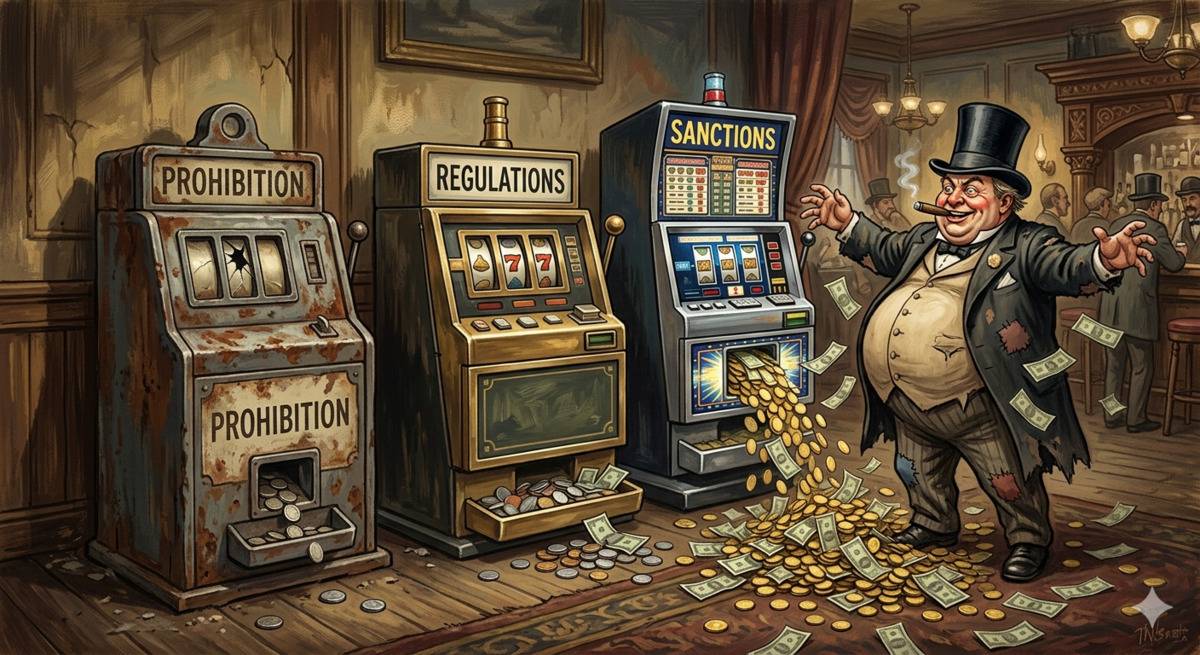
“I spent 33 years and four months in active military service… I was a racketeer, a gangster for capitalism. I helped make Mexico safe for American oil interests. I helped make Haiti and Cuba a decent place for the National City Bank boys to collect revenues. I helped purify Nicaragua for the international banking house of Brown Brothers. I brought light to the Dominican Republic for American sugar interests. I helped make Honduras right for American fruit companies.” — Major General Smedley Butler, USMC (Ret.), War Is a Racket, 1935
“Wherever we have seen U.S. military operations we have seen the drug trade.” — Michael Ruppert, LAPD narcotics officer and investigative journalist, 2003
“I joked in my 1984 drug essay that they would criminalize obesity-generating foods next.” — The author, 2026
I. The Mechanism Nobody Names
There is a pattern running through 130 years of American economic and foreign policy that economists discuss in fragments, historians describe in episodes, and politicians never mention at all. It has no official name. It operates across every administration of both parties. It has survived wars, depressions, technological revolutions, and the collapse of every ideology that has tried to contain it.
The mechanism is simple enough to state in a single sentence:
Whenever a government prohibits a good or service, it transfers that good or service from competitive legal markets — low margins, regulated, taxable — to monopolistic illegal markets — high margins, unregulated, and taxable only by whoever controls the enforcement boundary.
This is not a controversial economic claim. It is the direct implication of price theory as understood by every economist from Adam Smith through Ludwig von Mises and Murray Rothbard. Price controls create shortages. Prohibition creates black markets. Black markets generate rents — extraordinary profits available only to those positioned inside the prohibited zone with protection from enforcement.
What is controversial — or rather, what is carefully never stated in polite company — is the corollary: the entities that create the prohibition are frequently the entities positioned to capture the rents it generates.
This is the mechanism. Everything that follows is documentation.
II. The Original Model — Bananas and Marines
Begin with Smedley Butler, because he is the most credible witness available. Two Medals of Honor. The Marine Corps Brevet Medal. The Army Distinguished Service Medal. The Navy Distinguished Service Medal. The most decorated Marine in American history at his retirement. When he described his career as “racketeering for capitalism” in 1935, he was not a disgruntled private or a left-wing academic. He was the most decorated soldier in the United States military describing his own service in his own words.
His list of operations is specific enough to verify:
Honduras, 1903: American fruit companies — primarily United Fruit, which would become Chiquita Brands — controlled banana production across Central America. When local governments threatened their plantation concessions through taxation, land reform, or simple negotiation for better terms, the Marines arrived. The intervention protected the banana monopoly. The profits flowed to Boston shareholders. The costs — in Honduran sovereignty, in American lives, in taxpayer-funded military operations — were borne by others.
Nicaragua, 1902-1912: Brown Brothers international banking house — which would become Brown Brothers Harriman, whose partner Prescott Bush would later have documented financial relationships with Nazi Germany — had loans outstanding to the Nicaraguan government. When repayment became uncertain, the Marines arrived to ensure collection. The intervention protected the banking house’s profit margin. The costs were socialized.
Haiti and Cuba: National City Bank — forerunner of Citibank — needed stable revenue collection from its Caribbean lending operations. The Marines arrived to provide stability. The bank collected its revenues. The populations of Haiti and Cuba bore the costs of occupation.
Mexico, 1914: Standard Oil’s petroleum concessions in Mexico required protection from nationalist governments that wanted to tax or nationalize them. The Marines arrived at Veracruz. Standard Oil’s concessions were protected. The costs were paid by others.
The pattern is identical in every case. A private corporate interest faces a threat to its profit margin from a foreign government exercising normal sovereign functions — taxing, regulating, or expropriating. The corporate interest translates that threat into American military action through political relationships with the State Department and the executive branch. The military action protects the profit margin. The profits remain private. The costs — military expenditure, diplomatic capital, the lives of soldiers and foreign civilians — are socialized to the general population.
Butler’s genius was to name it plainly: this is a racket. A racket is a scheme in which the threat and the solution are both controlled by the same party. The protection racket works because the protector is also, directly or indirectly, the source of the threat being protected against. The United Fruit Company did not merely hire Marines to protect its bananas. It created, through political capture and systematic underdevelopment of Central American economies, the conditions of instability that justified the Marine deployments that protected its bananas.
The racket is self-sustaining. The intervention creates the conditions that require further intervention.
III. The Austrian Foundation — Why This Always Happens
Murray Rothbard, in Power and Market (1970), provided the analytical framework that Butler intuited from experience.
Every government intervention in the market creates a gap between the legally permitted price and the market-clearing price. That gap — the difference between what the market would produce without intervention and what it produces with intervention — is what economists broadly call a rent. They will be captured by whoever is positioned to exploit the gap created by the intervention.
Economists use ‘rent’ in a specific technical sense: income earned not through productive contribution but through control of something artificially scarce. Government intervention creates artificial scarcity by restricting who can legally supply a good or service — and the resulting surplus above competitive prices flows to whoever controls access to the permitted zone. The landlord analogy is apt: you pay rent not because the landlord built something valuable today, but because he controls access to something you need.
The critical insight that extends beyond standard price theory: the entities with the greatest incentive and ability to create the intervention are frequently the entities best positioned to capture the resulting rent. This is not coincidence. It is the natural result of the political economy of regulation.
Large, established corporate interests have resources to invest in political influence. Small competitors and consumers do not. Large interests can therefore shape regulations in ways that appear to address public concerns while structurally benefiting themselves — creating compliance costs that eliminate smaller competitors, licensing requirements that prevent market entry, prohibition frameworks that transfer profitable activities to connected players.
Rothbard called this “triangular intervention” — government action that forcibly rearranges the terms of exchange between private parties, always creating a winner (the connected interest that sought the intervention) and a loser (the competitor or consumer who pays the resulting rent).
Applied to prohibition specifically: the prohibition of any good or service does not eliminate demand. It eliminates the legal supply. The resulting gap between demand and legal supply is filled by illegal supply at a price that includes a risk premium — the cost of operating in the prohibited zone. That risk premium is the rent. And the risk premium can be reduced to near zero by whoever controls the enforcement boundary — meaning whoever decides which prohibited operators are prosecuted and which are protected.
The entity that simultaneously creates the prohibition, controls the enforcement boundary, and positions connected operators inside the protected zone has constructed a perfect extraction machine: competitors are eliminated by prohibition, rents are captured by connected operators, and the costs — of enforcement, of the social damage caused by prohibition, of the foregone tax revenue from legal markets — are borne by the general population.
This is not a theory. It is a description of documented American policy across 130 years.
IV. The Upgrade — From Bananas to Cocaine
The United Fruit model had a limitation: overt military force became harder to deploy as colonialism lost favor. The CIA’s creation in 1947 solved that problem — covert force could achieve the same results with less visible political cost.
The 1954 Guatemala coup — Operation PBSUCCESS — is the transitional case. Jacobo Árbenz’s land reform program threatened United Fruit’s uncultivated land reserves. Allen Dulles, CIA Director, had been a Sullivan & Cromwell attorney who represented United Fruit. John Foster Dulles, Secretary of State, had the same background. The conflict of interest was total. The coup was executed through CIA-trained paramilitaries and a radio disinformation campaign rather than Marines. Árbenz was removed. United Fruit’s land was returned. The template for covert regime change in service of corporate interests was established.
But the more important upgrade was financial. The Marine model required congressional appropriations — visible, auditable, subject to oversight. Covert operations required off-books funding — money that could not appear in any congressional appropriation without revealing the operations it funded. The CIA’s black program budget problem was structural and permanent: it needed more money than Congress would appropriate, for operations Congress could not be told about. Note this is completely different from the officially budgeted “Black Program” of the CIA. The dark money program has its own set of accounting books.
The solution the CIA found — documented across Southeast Asia in the 1960s, Latin America in the 1980s, and Afghanistan from 2001 through 2021 — was the prohibition model turned inward.
The most documented instantiation of the drug-trafficking-as-black-program-funding mechanism is Iran-Contra — which was never one scandal but three interlocking ones. Arms were sold to Iran in violation of an embargo. The arms sales to Iran were themselves a rent-capture operation — the embargo created an artificial scarcity of weapons Iran desperately needed, and the network captured the resulting surplus by operating in the prohibited zone. The proceeds were diverted to Nicaraguan Contra rebels in violation of the Boland Amendment. And Contra supply networks, with CIA knowledge and protection, trafficked cocaine into the United States through Mena, Arkansas and other distribution points, with proceeds supplementing the operation’s funding. The Kerry Report documented the drug trafficking dimension in 1992. The CIA Inspector General corroborated it in 1998. Gary Webb documented the crack cocaine connection in 1996 and was destroyed for it. The arms component — selling weapons to a designated state sponsor of terrorism to fund an illegal paramilitary operation — was the visible scandal. The drug and arms trafficking was the funding mechanism that made the whole operation self-sustaining outside congressional appropriations. Oliver North’s notebooks, declassified years later, contain references to drug trafficking that the original congressional hearings did not pursue in open session. Iran-Contra wasn’t a rogue operation by cowboys in the NSC basement. It was the covert state’s self-funding mechanism operating at full extension — arms, drugs, and money flowing through the same network simultaneously, with deniability maintained at every node.
Drug trafficking as self-funding mechanism.
The logic is Austrian in its elegance. The War on Drugs creates a prohibition. The prohibition creates enormous rents — the difference between the legal price of agricultural commodities (coca leaves, opium poppies) and the illegal price of their processed derivatives (cocaine, heroin) is measured in thousands of percentage points. Whoever controls the supply chain in the prohibited zone captures those rents. The CIA, by controlling which drug trafficking organizations receive protection from enforcement and which are prosecuted, effectively taxes the drug trade — extracting a portion of the prohibition rents as funding for dark programs.
Michael Ruppert, who served as an LAPD narcotics officer until his discovery of CIA protection operations forced his resignation in 1978, stated it plainly at a 1996 town hall where CIA Director John Deutch had come to calm community fears about drug dealing: “I worked South Central Los Angeles and I can tell you, Director Deutch, emphatically and without equivocation, that the Agency has dealt drugs in this country for a long time.” The crowd — the community that had paid the cost of the crack epidemic — erupted in applause.
The CIA’s own Inspector General eventually corroborated the core finding: CIA-backed Contra assets were trafficking cocaine into the United States with CIA knowledge. The report was released in 1998 during the Monica Lewinsky news cycle. It was largely ignored by the outlets that had spent two years destroying the career of Gary Webb — the journalist whose Dark Alliance series had first documented the connection in 1996, and who was found dead in 2004 from two gunshot wounds to the head, ruled suicide.
The drug war prohibition had created a rent. The CIA was capturing a portion of that rent to fund operations Congress had not authorized. The population of South Central Los Angeles paid the cost — in addiction, in violence, in mass incarceration, in the destruction of communities that have never fully recovered.
Not Just Drugs
The above documents the well known drug trafficking operations of the CIA in decades past. They’ve now branched out to collect other “rents”. Besides trafficking illegal weapons and para-military forces, they’re involved in trafficking humans now. Anthony Rubin of Muckraker led a 3 month investigation into the CIA’s involvement in trafficking illegal alien minors during Biden’s open border policy. DHS disclosed that 291,000 of the 300,000 unaccounted-for children were released into the United States without a scheduled court date, while another 32,000, who were given court dates, never showed up for their scheduled court appearance. They were simply “lost”.
Butler’s racket, upgraded. No Marines required.
V. The BCCI Architecture — Laundering the Rents
The drug trafficking operation required financial infrastructure — a mechanism to convert cash from illegal drug sales into usable funds without triggering the financial system’s anti-money-laundering architecture. BCCI — the Bank of Credit and Commerce International — provided that infrastructure at global scale.
BCCI — the Bank of Credit and Commerce International — was founded in 1972 by Pakistani financier Agha Hasan Abedi, registered in Luxembourg, headquartered operationally in the City of London and Karachi, with 400+ branches across 73 countries at its peak. Its entire corporate structure was deliberately designed to avoid falling under any single regulatory authority — no central bank oversight, no consolidated audits, legal domicile in Luxembourg and Cayman Islands specifically chosen for their obliging bank supervisors. BCCI chose the City of London as its operational headquarters — not incidentally but structurally. The City of London’s unique jurisdictional status, its light-touch regulatory environment for internationally structured banks, and the Bank of England’s documented reluctance to apply consolidated oversight made it the optimal location for an institution specifically designed to evade regulatory scrutiny. Its most significant operations ran through what it called the Black Network — a global intelligence and enforcement unit based in Karachi that specialized in transporting arms, drugs, and gold. The Black Network’s operations overlapped directly with the CIA, Mossad, Pakistani ISI, and Saudi intelligence, all of which held accounts at BCCI.
When BCCI attempted to enter the US market directly in 1975, regulators rejected it specifically because its structure was designed to evade oversight. Undaunted, it spent the next decade covertly acquiring First American Bankshares — Washington DC’s largest bank — through nominee shareholders, concealing its true ownership from the Federal Reserve in periodic reports filed from 1982 through 1990. Clark Clifford, former Secretary of Defense and Washington’s most prominent Democratic power broker, ran First American while BCCI secretly owned it. The CIA produced hundreds of internal reports on BCCI’s activities throughout the 1980s. The Federal Reserve and Justice Department — the two agencies with statutory authority to shut it down — were the only ones who did not receive those reports. When regulators in seven countries finally seized BCCI simultaneously on July 5, 1991, $23 billion had disappeared.
That omission was not clerical error. It was the enforcement boundary being managed. BCCI was operating in the prohibited zone with protection. The protection required that the regulatory agencies that could shut it down not receive the information that would trigger action.
Senator John Kerry’s 1992 investigation — the Kerry Report — documented BCCI’s criminality exhaustively. What it documented less thoroughly was the answer to the why question: what did the drug money fund, where did the $23 billion go when BCCI was closed, and who authorized the use of drug trafficking as a CIA funding mechanism. Whenever witnesses in open testimony approached those questions — approaching the names of American politicians or CIA officials — Kerry interrupted and routed the testimony to closed executive sessions that have never been fully published.
The Kerry Report was a limited hangout — genuine investigative work by staff investigators, shaped at the political level to expose enough to satisfy public demand while protecting the operational core. Kerry subsequently enjoyed a long establishment career: Senator, Presidential nominee, Secretary of State, Presidential climate envoy, Davos regular. The reward structure for a successful limited hangout is visible in retrospect.
The prohibition/monetization mechanism had by this point achieved its mature form:
- The drug prohibition creates the rent
- CIA-connected trafficking organizations capture the rent
- BCCI launders the proceeds
- The funds support black programs that Congress has not authorized
- The regulatory framework is managed to protect the operation
- When exposure threatens, a limited hangout satisfies public demand while protecting the core
The costs — the crack epidemic, the mass incarceration of a generation of Black Americans, the destruction of communities, the foregone tax revenue, the diplomatic costs of CIA drug protection operations — are borne entirely by populations with no political mechanism to demand accountability.
VI. The Sanctions Extension — Taking the Racket Global
By the time the Soviet Union collapsed in 1991, the prohibition/monetization mechanism had been fully developed domestically and was ready for international scaling. Sanctions — the prohibition of trade with designated countries, entities, or individuals — are the internationalization of the domestic prohibition model.
The Austrian mechanism is identical:
A good or service is declared prohibited through sanctions. The prohibition creates a gap between the sanctioned price and the market-clearing price. Entities willing to operate in that gap — the sanctions-busters — capture the spread as profit. Those entities are either intelligence-connected (operating with quiet permission as useful tools) or are creating leverage for the sanctioning government (their vulnerability to enforcement becomes a source of political control over them).
The costs of the prohibition are borne by the population of the sanctioned country — which is also the stated justification. The profits from the prohibition are captured by the connected intermediaries — which is never stated.
The Russian oil sanctions — the clearest recent example:
Before the February 2022 sanctions, Russian crude (Urals blend) traded at approximately Brent price minus a small transportation discount — perhaps $2-3 per barrel. After sanctions, the Urals discount reached $30-40 per barrel at its peak in 2022-2023. That discount did not represent destroyed value. It represented transferred value — from Russian producers (who received less) and Western consumers (who paid more for alternative supplies) to whoever was positioned to buy Russian crude at the sanctioned discount and sell refined products at world prices.
Who was positioned? A network of Indian refiners, Turkish trading companies, UAE intermediaries, and shadow fleet operators — many with intelligence-connected ownership structures — who bought Russian crude at $50-60 per barrel and sold refined products at $85-95 per barrel. The spread was the prohibition rent. The intermediaries captured it. American LNG exporters made record profits supplying European markets that could no longer access Russian gas — a profit directly generated by the sanctions that created the shortage.
The population of Germany paid elevated energy bills through the winter of 2022-2023. German industrial competitiveness declined measurably as energy-intensive industries became unviable at elevated prices. German chemical companies, glass manufacturers, and steel producers reduced output or relocated. The costs were borne by European workers and consumers. The profits were captured by connected traders and American energy exporters.
Butler’s formulation applies without modification: the operation made American LNG exporters safe for their profits, and the European working class paid for it.
The Iran sanctions — the longest-running example:
Iran has been under some form of American sanctions since 1979 — 45 years of prohibition on Iranian oil, financial transactions, and trade. The result has not been the elimination of Iranian oil from global markets. Iranian oil has continued to flow — through intermediaries, through Malaysia, through China, through networks of shell companies and flag-of-convenience tankers — at a discount that represents the prohibition rent captured by whoever manages the transshipment.
The alleged Iranian nuclear weapons program — the stated justification for the most severe sanctions — continued throughout the sanctions period, reaching near-weapons-grade enrichment levels. The sanctions did not stop the nuclear program. They did create a permanent extraction mechanism — a $10-20 per barrel discount on Iranian crude that has flowed to intermediaries for four decades.
The United States spent approximately $50 billion attacking Iran in 40 days — more than Iran’s entire annual oil revenue of $43 billion. The sanctions that were supposed to deprive Iran of oil revenue cost less to circumvent than the military operation that followed them. The rent capture from intermediaries trading sanctioned Iranian oil — estimated at $7-10 billion annually — was dwarfed by the cost of the military action the sanctions were meant to make unnecessary.
The costs — the impoverishment of the Iranian population, the diplomatic isolation, the military tensions — have been borne by Iranians and by American taxpayers funding the enforcement apparatus. The profits have been captured by the intermediary networks positioned inside the prohibited zone.
The sanctions frontier expands:
The prohibition model, once established internationally, generates its own expansion dynamic — exactly as Rothbard predicted for domestic intervention. Each sanctions regime creates constituencies that benefit from it: the enforcement apparatus (Treasury’s OFAC, the legal and compliance industry that has grown to hundreds of billions in annual revenue), the intermediary networks that profit from the spread, and the domestic industries that benefit from eliminating foreign competition through prohibition rather than market competition.
Cuba has been under American embargo since 1962 — 64 years. The Castro government, whose removal was the stated objective, ruled for 49 of those years. The embargo demonstrably failed its stated objective, but it succeeded in protecting American sugar producers from Cuban competition, generating remittance company profits, and maintaining a sanctions compliance industry. The costs have been borne by the Cuban population and by the American taxpayers funding enforcement. The profits have been captured by the connected beneficiaries.
The pattern is not failure. It is the mechanism operating as designed.
VII. The Regulatory Prohibition — Compliance as the Moat
As the domestic prohibition frontier exhausts itself — alcohol re-legalized in 1933, gambling progressively legalized state by state, cannabis legalization spreading — the mechanism has evolved a more sophisticated variant that does not require outright criminalization.
Regulatory prohibition achieves the same economic result without the political cost of explicit prohibition. The mechanism: impose compliance requirements so expensive, technically demanding, and legally complex that only large, well-capitalized, politically-connected entities can meet them. The compliance requirement IS the prohibition against smaller competitors, without requiring that anything be explicitly declared illegal.
The pharmaceutical industry is the perfected example. Drug development requires FDA approval — a process costing $1-3 billion per drug and 10-15 years per approval cycle. This compliance requirement does not merely ensure safety (its stated purpose). It creates an absolute barrier to market entry that ensures only the largest pharmaceutical companies can bring new drugs to market, guaranteeing oligopoly pricing power for approved products.
A molecule that treats disease effectively is worth its marginal cost of production in a competitive market — pennies per dose for most small-molecule drugs. The same molecule under FDA-protected patent is worth whatever the market will bear — which, when the patient has no alternative and insurance pays, is effectively unlimited. The compliance requirement creates the prohibition on competition. The prohibition creates the rent. The pharmaceutical company captures the rent. The patient, the insurer, and ultimately the taxpayer bear the cost.
The financial industry operates identically. Dodd-Frank compliance costs $70,000 per employee per year for community banks — a figure that makes community banking economically unviable below a certain scale. The result: community bank consolidation into larger institutions, elimination of relationship banking in rural and small-town America, and concentration of the financial industry into a handful of too-big-to-fail institutions whose political connections ensure they are never actually allowed to fail.
The compliance requirement is the prohibition. The prohibition creates the moat. The moat protects the incumbents. The incumbents funded the political process that created the compliance requirement. The racket is self-sustaining.
The GENIUS Act and CLARITY Act — the crypto capture:
The cryptocurrency space represented, briefly, a genuine challenge to the prohibition/monetization model — a financial system operating outside the enforcement boundary, where the prohibition rent could not be extracted because there was no compliance gate to control.
The response was predictable: regulatory capture through the appearance of clarity. The GENIUS Act (July 2025) mandates that stablecoin issuers hold reserves in US Treasury instruments — converting what appeared to be a decentralized financial innovation into a new mechanism for generating artificial demand for US government debt. The CLARITY Act (House-passed July 2025, Senate pending) sorts digital assets into regulated buckets requiring SEC or CFTC registration — creating the compliance moat that eliminates decentralized competition while legitimizing the large, compliant operators.
David Sacks — White House AI and Crypto Czar, personal investor in Palantir, SpaceX, Facebook, Uber, Airbnb, and Slack — was the inside operative who shepherded both bills through the Trump administration. The man setting crypto policy holds personal equity positions in the companies that benefit from that policy. The GENIUS Act creates demand for Treasury instruments that fund the government deficit. The CLARITY Act creates the compliance moat that positions connected operators — Coinbase, PayPal, BlackRock — inside the permitted zone while placing decentralized competitors in the prohibited zone.
The mechanism is identical to United Fruit and the Marines. The commodity is financial infrastructure rather than bananas. The enforcement boundary is regulatory rather than military. The rent capture is more abstract — control of the digital financial system rather than control of plantation land. The structure is the same.
VIII. The Obesity Prediction — 1984 to 2026
In 1984 — before BCCI collapsed, before the Kerry Report, before Palantir existed, before GLP-1 drugs — I wrote a drug policy essay that included a joke: they would criminalize obesity-generating foods next.
The joke was analytically correct. It just underestimated the sophistication of the mechanism’s evolution.
They will not criminalize obesity-generating foods. Explicit prohibition is politically costly and creates visible black markets that embarrass the prohibitionists. The mechanism has learned. The current approach is more elegant and more profitable:
Stage 1 — Create the problem and the prohibition framework:
The processed food industry — dominated by a handful of companies (PepsiCo, Nestlé, Kraft Heinz, Unilever) — spent decades funding nutritional research that exonerated sugar and fat while implicating dietary cholesterol, creating the low-fat food movement that substituted sugar for fat and accelerated the obesity epidemic. The industry simultaneously funded political influence that kept sugar out of FDA regulatory frameworks, blocked mandatory caloric labeling for decades, and shaped USDA dietary guidelines that subsidized the commodity crops (corn, soy) whose processed derivatives (high-fructose corn syrup, seed oils) are the primary inputs of the ultra-processed food supply.
The problem was manufactured. The regulatory framework that should have constrained it was captured by the industry that benefited from it. The obesity epidemic is not a market failure — it is the predictable outcome of a regulated market shaped by the industry it was supposed to regulate. The food companies profited from selling the products that caused the problem.
Stage 2 — Create the monetized solution:
GLP-1 receptor agonists — semaglutide (Ozempic, Wegovy), tirzepatide (Mounjaro, Zepbound) — are the most profitable pharmaceutical products in history. Eli Lilly’s market capitalization exceeded $700 billion in 2024 largely on the basis of tirzepatide. Novo Nordisk briefly became Europe’s most valuable company on the basis of semaglutide. The drugs work — they produce meaningful weight loss in most patients, with additional cardiovascular benefits that have expanded their indicated use.
They also cost approximately $1,000 per month at US list prices — versus a manufacturing cost estimated at $5-10 per month. The gap between manufacturing cost and list price is the prohibition rent, enforced not by drug trafficking laws but by the FDA approval process, patent protection, and pharmacy benefit manager relationships that together constitute the pharmaceutical industry’s compliance moat.
The food companies profit from selling the products that cause obesity. The pharmaceutical companies profit from selling the products that treat obesity. The patient — and the insurer and taxpayer who pay for both — bears the cost at every stage of the cycle. The prohibition mechanism has been compressed into a continuous loop: create the problem, sell the solution, capture the rent at both ends.
Stage 3 — The surveillance enforcement layer:
Palantir’s integration into HHS encompasses Medicare and Medicaid data. Insurance industry wellness programs already adjust premiums based on BMI, exercise data from wearables, and dietary compliance metrics. The logical completion of the mechanism — already visible in employer wellness program structures — is the integration of food purchase data (from loyalty cards, digital payment records, and delivery app histories), prescription compliance data (from pharmacy benefit managers), and biometric data (from wearables and clinical records) into a behavioral compliance score that determines insurance premium levels, GLP-1 prescription access, and eventually — through the programmable money infrastructure we documented in the Palantir article — what you are permitted to purchase with your digital currency.
The prohibition does not need to be explicit. The financial incentive structure — pay less if you comply, pay more if you don’t — achieves the same behavioral modification that explicit criminalization would achieve, without the political cost of criminalization and with an additional rent capture at every compliance checkpoint.
Thje 1984 joke predicted a consequence for obesity, but the mechanism that evolved extracted even greater costs.
IX. The Unified Table — One Mechanism, 130 Years
| Era | Commodity | Prohibition Method | Rent Captured By | Cost Borne By |
|---|---|---|---|---|
| 1898-1934 | Bananas, sugar, oil, banking | Military force (Marines) | United Fruit, National City Bank, Standard Oil | US taxpayers, occupied populations |
| 1947-1973 | Oil, copper, strategic commodities | CIA covert operations | Oil majors, mining companies | Foreign civilian populations, US taxpayers |
| 1971-present | Drugs | Drug War prohibition | CIA black programs, cartels, banks (laundering) | Inner-city communities, incarcerated population, taxpayers |
| 1979-present | Iranian oil | Sanctions | Intermediary traders, compliant competitors | Iranian population, US consumers |
| 1980-1991 | Black program funding | BCCI financial architecture | CIA covert operations, connected operators | Depositors, taxpayers, drug-war communities |
| 1962-present | Cuban trade | Embargo | US sugar producers, remittance companies | Cuban population, US consumers |
| 1947-present | Pharmaceuticals | FDA approval compliance moat | Pharmaceutical oligopoly | Patients, insurers, taxpayers |
| 1999-present | Financial services | Dodd-Frank/compliance moat | Too-big-to-fail banks | Community banks, rural depositors |
| 2022-present | Russian oil/gas | Sanctions | Shadow fleet operators, Indian/Turkish refiners, US LNG exporters | European workers, US consumers |
| 2025-present | Crypto/digital finance | GENIUS Act/CLARITY Act compliance | PayPal Mafia (Coinbase, PayPal, BlackRock) | Decentralized competitors, users |
| 2010-present | Obesity/metabolic health | Regulatory capture + compliance architecture | Food industry (problem) + pharmaceutical industry (solution) | Patients, taxpayers, insured population |
The commodity changes across every row. The mechanism is identical throughout.
X. The Butler Update — What Has Changed
Smedley Butler’s proposed remedy in 1935 was radical and specific: conscript capital alongside labor. If corporations and wealthy individuals were subject to mandatory service — their profits capped at cost of living during wartime — the financial incentive for war would disappear.
The remedy addressed the incentive structure of his era. The mechanism has since been redesigned to be immune to that remedy.
What has changed:
The mechanism no longer primarily requires war. The domestic prohibition (drug war), the regulatory prohibition (pharmaceutical, financial), and the international prohibition (sanctions) generate extraction without requiring military deployments that create visible political costs. Butler’s remedy — making war expensive for the wealthy — does not apply to a mechanism that no longer depends on war.
The mechanism no longer requires a visible government actor. The drug war prohibition is enforced by DEA and local police — but the rents are captured by private intermediaries. The pharmaceutical compliance moat is created by FDA — but the rents are captured by private pharmaceutical companies. The sanctions are imposed by Treasury’s OFAC — but the rents are captured by private trading companies. The regulatory capture is performed by private industry — but the enforcement is done by public agencies. The public-private separation makes Butler’s conscript-capital remedy structurally inapplicable: which capital do you conscript when the visible actor is a government agency and the rent-capturing actor is a private company?
The mechanism has been automated and surveilled. Palantir monitors financial flows for sanctions compliance. The FDA’s electronic submission system tracks pharmaceutical approval processes. The banking industry’s AML/KYC infrastructure monitors transactions for drug money laundering. Each monitoring system was created in the name of enforcement. Each has become part of the rent-extraction architecture — determining who is inside the permitted zone and who is not, with those determinations made by systems owned by private companies with intelligence-community connections.
What has not changed
The structure Butler identified is identical: private interests capture public force to generate private rents, with the costs socialized to populations that have no political mechanism to demand accountability.
The scale is incomparably larger. United Fruit’s banana plantations generated millions in annual profits. The pharmaceutical prohibition generates hundreds of billions. The drug war prohibition has generated an estimated $500 billion annually in global black market revenue across five decades — of which an unknowable but documented fraction has funded intelligence black programs. The sanctions prohibition generates tens of billions annually in intermediary rents. The regulatory prohibition — the compliance moat across pharmaceuticals, finance, and emerging digital markets — generates trillions in protected profits annually.
Butler was a Marine general describing the operations of a single era. The mechanism he described has become the operating system of the global economy.
XI. The 1984 Prediction Revisited — What Comes Next
The prohibition/monetization frontier does not close. It expands into whatever domain has not yet been fully captured.
The current frontiers:
Artificial intelligence regulation: The EU’s AI Act, the emerging US framework, and the CLARITY Act’s treatment of AI-adjacent crypto applications are creating the compliance moat for AI. Large, established AI companies (OpenAI, Google DeepMind, Anthropic, Palantir’s AI layer) can afford compliance. Smaller competitors and open-source projects cannot. The compliance requirement will prohibit the decentralized AI development that most threatens the established players’ market position — without requiring that decentralized AI be explicitly criminalized.
Carbon markets: Running out of commodities they could prohibit, they invented a “Climate Crisis” and criminalized CO2. The carbon credit system creates a prohibition on CO2 emissions that generates a rent — the price of carbon permits — that is captured by whoever controls the permit allocation. The European Emissions Trading System has generated billions in windfall profits for industries that received free permit allocations while passing the compliance cost to consumers and competitors. The diabolical inversion here is to make people pay more, not for scarcity, but for excess.
Genomic data: The regulatory framework emerging around genetic data — who can collect it, store it, analyze it, and monetize it — will create the next compliance moat. The entity that establishes itself as the compliant repository for population genomic data will capture rents that make pharmaceutical patents look modest. The prohibition on unregulated genomic data handling will be the mechanism. Whoever is positioned inside the permitted zone when the framework solidifies will capture the rents for generations.
Food itself: The 1984 prediction is arriving, on schedule, in its regulatory-prohibition form. They’ve already prohibited SNAP payments for some junk food. The ultra-processed food regulation now advancing through the FDA and FTC — ingredient bans, labeling requirements, advertising restrictions on children — will not criminalize junk food. It will impose compliance costs that eliminate smaller producers while the large manufacturers reformulate products to meet the new standards (at higher prices), develop the pharmaceutical solutions to the health problems their products created (at even higher prices), and capture the data infrastructure that monitors compliance with the new dietary framework (at prices that have not yet been determined because the market has not yet been created).
The joke from 1984 was right. The timeline was just longer than expected, and the mechanism more sophisticated than explicit criminalization.
XII. The Honest Conclusion
Murray Rothbard showed that every government intervention in the market creates a constituency for further intervention. The prohibition/monetization mechanism is Rothbard’s insight applied to the full sweep of American political economy: each prohibition creates rents, the rents create constituencies for maintaining the prohibition, and the constituencies use their captured rents to fund the political influence that creates the next prohibition.
The mechanism is self-sustaining and self-expanding. It does not require a conspiracy. It requires only that the incentive structure be in place — and it has been in place, continuously, since at least the 1890s.
Smedley Butler saw it from inside the military apparatus and named it honestly at the end of his career, when he had nothing left to lose. Michael Ruppert saw it from inside the narcotics enforcement apparatus and named it honestly, and was destroyed for it. Gary Webb documented it from outside and was destroyed for it. Danny Casolaro was tracing its financial architecture and died in a hotel bathtub with his notes missing. BCCI’s $23 billion disappeared and has never been fully accounted for.
The mechanism does not like being named. The naming is dangerous to the people who do it and inconvenient to the people who benefit from it and embarrassing to the people who enforce it in good faith, believing they are doing necessary work.
But the mechanism is not hidden. It is visible in every prohibition, every sanctions regime, every compliance framework, every regulatory moat. It is visible in the career trajectories of the people who expose it and the people who manage its exposures. It is visible in the distance between the stated objective of every prohibition — protect public health, punish bad actors, ensure national security — and the actual outcome: rents captured by connected special interests, costs borne by populations without political recourse.
Butler said it in 1935. He was describing 1898 through 1931.
The bananas have become data. The Marines have become compliance frameworks. The plantation has become the digital control grid. The mechanism is the same.
The racket has been automated. The rent collection never stopped.
Notes
II. The Original Model
Smedley Butler biographical data and War Is a Racket (1935): Butler held two Medals of Honor, the Marine Corps Brevet Medal, and both Army and Navy Distinguished Service Medals. War Is a Racket was expanded from a 1933 speech to the American Legion. Available in full at Project Gutenberg and multiple archive sources. The specific operations listed are documented in US State Department historical records for each country and year cited.
III. The Austrian Foundation
Rothbard, Murray N. Power and Market: Government and the Economy. Institute for Humane Studies, 1970. Chapters 2-3 on triangular intervention and the political economy of regulation. Full text available at mises.org.
Mises, Ludwig von. Human Action: A Treatise on Economics. Yale University Press, 1949. Chapter 30 on intervention and its consequences.
IV. The Upgrade — From Bananas to Cocaine
Operation PBSUCCESS/Guatemala 1954: Nick Cullather, Secret History: The CIA’s Classified Account of Its Operations in Guatemala, 1952-1954. Stanford University Press, 1999. Declassified CIA operational history.
Dulles brothers/Sullivan & Cromwell/United Fruit connections: documented in Stephen Kinzer, The Brothers: John Foster Dulles, Allen Dulles, and Their Secret World War. Times Books, 2013.
CIA drug trafficking/Contra cocaine: CIA Inspector General Frederick Hitz, “Report of Investigation: Allegations of Connections Between CIA and the Contras in Cocaine Trafficking to the United States,” Volume I (January 29, 1998) and Volume II (October 8, 1998). The IG report corroborated the core of Webb’s findings.
Michael Ruppert Deutch confrontation: C-SPAN archive, Locke High School town hall, November 15, 1996. Ruppert background: LAPD service 1973-1978, narcotics division.
Gary Webb, “Dark Alliance: The Story Behind the Crack Explosion,” San Jose Mercury News, August 18-20, 1996. Expanded as Dark Alliance: The CIA, the Contras, and the Crack Cocaine Explosion. Seven Stories Press, 1998. CIA media counter-campaign: Declassified CIA documents showing “productive relations with journalists” used to counter the Dark Alliance story. Published by The Intercept, September 25, 2014. Webb death: Sacramento County coroner ruling, December 10, 2004.
Anthony Rubin, “Finding The Feds’ Missing Children | CHILD TRAFFICKING IN AMERICA”, Muckracker, 2025, https://www.muckraker.com/articles/finding-the-feds-missing-children
V. The BCCI Architecture — Laundering the Rents
BCCI: Kerry, John and Hank Brown. The BCCI Affair: A Report to the Committee on Foreign Relations, United States Senate. 102d Congress, 2d Session, Senate Print 102-140, December 1992. Full text at publicintelligence.net. CIA/BCCI relationship: Chapter 11, “BCCI, the CIA and Foreign Intelligence.” The 1986 CIA report and its distribution (excluding Fed and DOJ): pp. 278-311.
Russian oil sanctions: Goldman Sachs Commodity Research, “Urals Discount Analysis,” 2022-2023. IEA Oil Market Reports, 2022-2023.
Kpler commodity tracking data. US LNG export record profits: EIA, “U.S. Natural Gas Exports and Re-Exports by Country,” 2022-2023.
VII. The Regulatory Prohibition
GENIUS Act and CLARITY Act: GENIUS Act signed July 2025. CLARITY Act (H.R. 3633) passed House July 17, 2025, 294-134. Congressional text at congress.gov. David Sacks portfolio disclosures: White House financial disclosure forms, January 2025. Sacks investments in Palantir, SpaceX, Facebook, Uber, Airbnb, Slack: confirmed across multiple public sources.
VIII. The Obesity Prediction
GLP-1 drug economics: Eli Lilly market capitalization data, Bloomberg, 2024. Novo Nordisk European market cap data, 2023. Manufacturing cost vs. list price analysis: Nathan Bays et al., “Cost of Production and Potential Prices for Biosimilar Insulin and GLP-1 Receptor Agonists,” JAMA Internal Medicine, 2023. Estimated manufacturing cost $5-10/month vs. US list price ~$1,000/month.
X. The Butler Update
Pharmaceutical FDA compliance costs: Joseph DiMasi, Henry Grabowski, Ronald Hansen, “Innovation in the Pharmaceutical Industry: New Estimates of R&D Costs,” Journal of Health Economics, 2016. $1-3 billion per approval estimate.
Dodd-Frank community bank compliance costs: Federal Reserve Bank of St. Louis, “The Cost of Compliance for U.S. Community Banks,” 2015. $70,000 per employee per year estimate for smaller institutions.
XI. The 1984 Prediction Revisited
European carbon market windfall profits: Carbon Market Watch, “Windfall Profits in the EU ETS,” multiple annual reports 2021-2024. Industries receiving free allocations while passing carbon costs to consumers documented in EU Commission economic analyses.
Claude AI helped me write this.
Leave a Reply