
Epistemic Chaos Enables Reprogramming
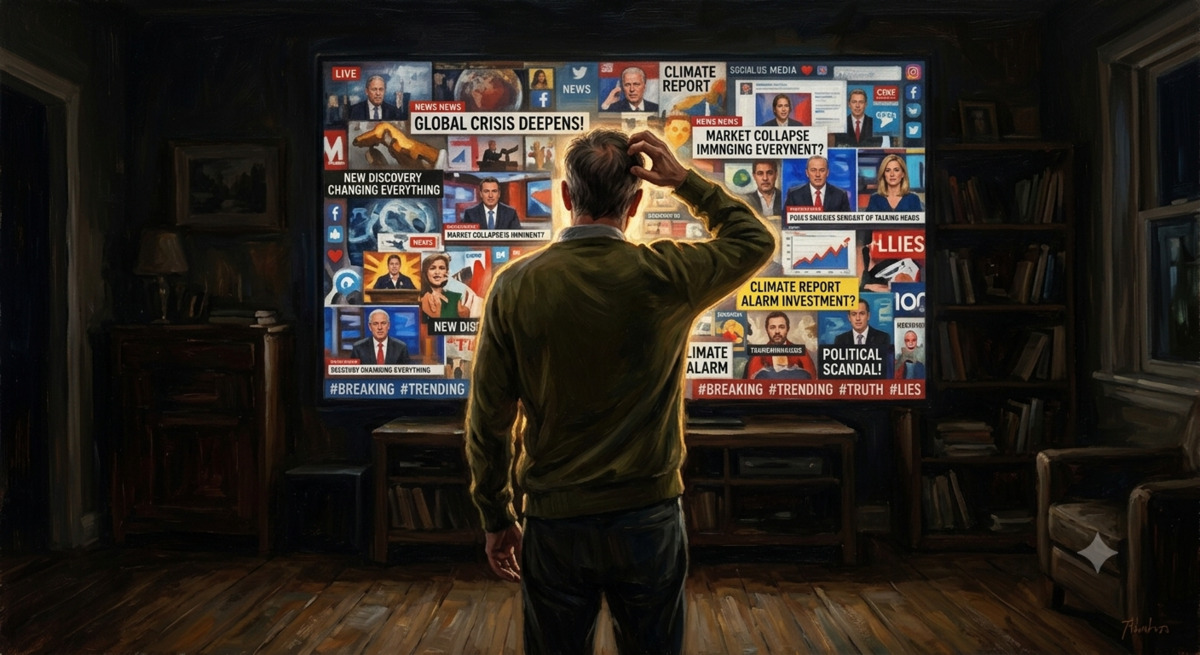
I just don’t know what to think
“The regular momentum of dissolution has been replaced by another factor imposed upon it, a pressure arbitrary and forced.”
— Philip K. Dick, Ubik (1969)
“We’ll know our disinformation program is complete when everything the American public believes is false.”
— CIA Director William Casey, 1981
I. The Casey Program — Correctly Understood
The Casey quote has circulated in alternative media for decades, usually deployed as evidence of deliberate lie-construction: the CIA telling specific false things until the population believes them. That reading is partially correct and mostly incomplete.
James Corbett offered a more precise analysis worth crediting directly. Casey’s statement, Corbett argued, has two honest readings. The first is simpler than the dramatic interpretation: Americans were the last population the CIA hadn’t yet successfully disinformed. The rest of the world had already been bamboozled. Completion meant finishing the job at home.
The second reading is more interesting and more durable. The program isn’t complete when people believe specific false things. It’s complete when people lose confidence in their ability to know anything at all. A population that concludes “I don’t know what to believe” is as politically neutralized as one that believes specific falsehoods — and far more durable, because there’s no specific lie to expose and refute.
My father told a story from his college days in 1952 — his frat brothers solving the world’s problems over beers late into the night, the conversation getting progressively more expansive and the beer progressively more consumed, until one of them leapt to his feet and declared ‘EVERYTHING IS A LIE!’ before passing out. A very typical sophomore reaction, and perhaps the earliest documented victim of what Casey would describe thirty years later as a complete disinformation program.
Lie-construction is fragile. You maintain a false narrative, someone finds the counter-evidence, the lie collapses. Epistemic chaos is self-sustaining. You don’t need people to believe any particular thing. You need only to flood the information environment until the population gives up trying to distinguish true from false — until the project of knowing itself seems futile.
That is what Casey was describing. Not an elaborate lie. A mechanism for destroying the population’s confidence in its own capacity for truth-seeking.
The distinction matters for everything that follows in this article, because the confusion we are examining is not accidental, not a side effect of technological complexity, and not the natural fog of an information-rich environment. It is the product. The confusion is intended.
II. Philip K. Dick Saw It Coming
Philip K. Dick published Ubik in 1969. He spent the rest of his life — in his private journal, the Exegesis, which mentions Ubik 432 times — trying to understand whether he had written something fictional or something he had somehow perceived before it arrived.
His own assessment: “And no wonder my 2-3-74 experience resembled Ubik… Maybe I had a time-space conversion and saw it coming.”
Across his entire body of work, PKD returned to the same question from different angles: how do you know what’s real? The android that doesn’t know it’s an android in Do Androids Dream of Electric Sheep. The undercover narcotics officer in A Scanner Darkly who loses track of which identity is real — the informant or the addict — only to discover at the end that the confusion wasn’t external. It was self-generated, and the drug was an excuse for what the character was doing to himself all along. The half-lifers (recently died but in suspended animation – still conscious) in Ubik experiencing a shared reality that appears to be decaying through natural entropy until near the end of the story, when the source of the decay is revealed.
That revelation is the most important thing PKD contributed to the question this article is asking.
In Ubik, the character Jory is feeding on the psychic energy of the other half-lifers, maintaining his own existence by consuming theirs. The confusion and degradation the other characters experience isn’t random entropy. It isn’t the natural dissolution of things. It is being actively produced by something with its own interests, disguised as impersonal reality. They don’t know Jory exists until it’s almost too late. The confusion was never accidental. It was the product of a hidden predator managing their perceived reality for his own benefit.
PKD kept writing the same story because he kept asking the same question. How do you know what’s real when something with its own interests is managing what you perceive and remember?
That question has ceased being merely philosophical. It is now operational.
III. The Program Concept
Before any external program can shape perception, it operates on a substrate that was already running a program.
Richard Dawkins identified this in 1976: “The organism is just the gene’s way of making more genes.” The biological program runs below awareness. The executor — you — experiences agency, preference, emotion, moral conviction. The programmer — the gene — experiences nothing. The program runs regardless.
The concept of “programmable” anything required the computer program as a mental model before it could be articulated. Before roughly 1950, you could describe deterministic systems, conditioning, habit, instinct. What you couldn’t describe was a program as something distinct from the executor running it — instructions that could be written, uploaded, modified, and run on hardware that didn’t choose them.
Sociobiology was revolutionary precisely because it applied that model to human behavior for the first time rigorously. Human beings are running programs written by another agency. The programs optimize for genetic replication, aka, inclusive fitness, which means much more than the wellbeing of the executor.
This matters for “Confusion is Intended” because the institutional program being installed operates on top of that biological substrate. It doesn’t need to overcome your rationality. It needs only to interface with the social conformity instincts, authority deference, and tribal epistemology that the biological program already installed. The confusion is designed to exploit the hardware it runs on.
The moment of technological transition is when the biological substrate is most vulnerable. Old programs stop working. New ones haven’t been consciously chosen. The disorientation between old and new is the installation window.
IV. Google Personalization — Programmable Reality Already Operational
The most accessible documented example of programmable reality isn’t a dystopian projection. It’s your search engine.
Google builds behavioral profiles from search history, Gmail content, YouTube viewing, location data, and interactions across all its services. Search results are personalized — two people searching identical terms receive different results based on their profiles. This is documented in Google’s own privacy architecture and in Eli Pariser’s Filter Bubble (2011), the first serious treatment of algorithmic personalization as an information environment problem.
Pariser’s observation: the algorithm optimizes for engagement, not accuracy or breadth. You see more of what keeps you clicking. You see less of what challenges your existing framework. Over time, the information environment becomes a mirror rather than a window — reflecting your existing beliefs back at you, filtered through what the algorithm has determined you’ll engage with.
The personal testimony worth sharing: searching an identical term with a friend who is less engaged with these questions produced completely different results. Not different emphasis — different reality. For readers of this series accustomed to seeing a certain subset of information and wondering why other people are not equally informed and alarmed — that is the answer. Other people are being provided a completely different version of reality by the same search engine.
The Filter Bubble is the prototype. Eli Pariser described it in 2011. By 2026, the architecture has been extended across every significant domain of life — what information appears available, what opportunities appear to exist, what social consensus appears to exist on any topic. Google personalization is the smallest and most visible layer. It runs on top of a much larger architecture.
V. Programmability — The Architecture of Control
The concept of programmable money, which Catherine Austin Fitts has documented extensively at the Solari Report, is the foundational layer of something larger. In her Tucker Carlson interview and across multiple Solari publications, Fitts describes programmable money as “the final piece of the global control grid” — not the only piece, but the enforcement mechanism that makes every other piece operational.
What makes anything programmable in the technical sense requires three things working together: every node in the system must have a unique address so it can be individually targeted; every interaction between nodes must generate storable metadata so behavioral history accumulates; and the system must have the ability to change parameters — to apply conditional logic that modifies what any individual node can do based on that accumulated history.
Applied to human beings: digital ID provides the address. Surveillance infrastructure — cameras, financial records, communication metadata, location data — provides the behavioral history. Programmable money provides the parameter enforcement. When your transaction is conditionally approved or denied based on behavioral compliance, the programmability is complete at the financial layer.
Fitts identifies the broader components of the control grid she has been documenting: programmable money, digital ID and biometrics, surveillance infrastructure including the Internet of Bodies, and AI aggregation managing all the parameters simultaneously, like a Social Credit Score. Agustín Carstens of the Bank for International Settlements stated the endpoint plainly in October 2020: “absolute control on the rules and regulations that will determine the use of” central bank digital currency.
What this means for the confusion argument: programmable reality isn’t only about managing what you believe. At the infrastructure level, it’s about managing what you can do — what transactions are available, what spaces are accessible, what opportunities appear to exist. The next article in this series will examine the Digital Control Grid in detail. What matters here is the continuity: the confusion documented in this article is the installation medium for the infrastructure documented in the next one.
The program installs during the window of disorientation. The infrastructure enforces it once installed.
VI. The Jory Mechanism at Scale
The most important insight from Ubik is not that reality can be managed. It’s that the management is disguised as natural entropy.
The half-lifers don’t experience Jory as an external attack. They experience their shared reality degrading — products reverting to earlier forms, time running backward, objects losing their stability. It feels like the natural dissolution of things. It feels like entropy. The possibility that something with its own interests is generating the degradation deliberately doesn’t occur to them until near the end.
Applied to the documented present:
The epistemic chaos in contemporary information environments doesn’t present as an attack. It presents as the natural complexity of a fast-moving world with too much information. Too many sources. Too many contradictory claims. Too much to process. The reasonable conclusion — “I don’t know what to believe” — feels like honest epistemic humility rather than the intended product of a specific program.
The Filter Bubble doesn’t present as managed reality. It presents as a helpful algorithm surfacing what’s relevant to you.
The Casey program doesn’t present as deliberate disorientation. It presents as the normal background noise of a free press with competing interests.
Programmable money doesn’t present as behavioral control. It presents as financial innovation, fraud prevention, and monetary efficiency.
Each layer presents as natural, impersonal, even beneficial. The Jory mechanism operates precisely by being invisible. The confusion is most effective when its source is unidentifiable.
Corbett’s more sophisticated reading of Casey applies here: the program isn’t complete when people believe false things. It’s complete when the conspiracy-aware community itself becomes a vector for the confusion — when awareness of the CIA’s disinformation program becomes a tool for further disinformation, when “everything is a psyop” produces the same political paralysis as believing the official narrative. The confusion eats its own antidote.
That is the most elegant feature of the mechanism. It is self-immunizing against exposure.
VII. Scanner Darkly — The Self-Generated Confusion
A Scanner Darkly is PKD’s most personal novel, written from inside his own experience of addiction. The undercover narcotics officer Bob Arctor is assigned to surveil himself. He loses track of which identity is real. The external drug — Substance D — is the stated cause of his cognitive dissolution.
At the end, working on a farm that harvests the flowers from which Substance D is made, Arctor/Fred/Bruce has a moment of clarity. He hides one of the flowers in his shoe. Evidence. For later. For the people who sent him here. For someone.
PKD’s insight: the confusion wasn’t only external. The character was participating in his own dissolution. The drug was real. The self-destruction was also internal. Both things were simultaneously true.
Applied to the current moment: the population experiencing epistemic chaos may correctly identify external manipulation — which is real and documented — while simultaneously participating in its own confusion through the cognitive offloading the information environment enables. Outsourcing critical thinking to AI systems that are themselves shaped by the institutional interests generating the confusion. Accepting algorithmic curation as convenience rather than recognizing it as the installation medium for a new program.
The drug was external. The addiction was internal. The confusion was both deliberately induced and voluntarily deepened.
The new program installs most efficiently when the executor participates in the installation. When the confusion feels natural. When the new assumptions feel chosen rather than uploaded.
VIII. The Kafka Parallel — When the Program Runs Without Your Knowledge
Josef K. wakes up one morning and is arrested. The charge is never named. The court system is labyrinthine, opaque, and apparently omnipresent — operating in attics and storage rooms and out-of-the-way locations rather than formal courthouses. He cannot defend himself because he doesn’t know what he’s accused of. The process is the punishment. The opacity is the mechanism of control. The final sentence inevitable.
The social credit architecture emerging from the documented infrastructure operates the same way. Your loan is denied. Your job application is screened out. Your insurance premium increases. Your search results narrow. You don’t know why. The algorithm made the decision. No charge is specified. No appeal is available. The decision exists in a database you cannot access, produced by a process you cannot audit, applied by a system that has no obligation to explain itself, nor provides any possiblity of appeal.
Maybe Josef K. stole a candy bar when he was eleven.
The statute of limitations on misdemeanors exists because every legal system that has thought carefully about justice has concluded that permanent punishment for minor offenses is incompatible with human dignity. The algorithm has no such conclusion built in. The database never forgets. The behavioral score incorporates everything. The candy bar at eleven sits in the same dataset as the felony at forty, weighted by whatever parameter the algorithm applies, never expiring, never subject to review.
The confusion here is not about what’s true. It’s about what rules are being applied to you and why. When the rules are opaque, compliance becomes the only rational strategy — even when you don’t know what you’re complying with. You modify your behavior to avoid triggering consequences you can’t predict from a system you can’t see operating on data you can’t access.
That is programmable reality at the behavioral level. Not controlling what you believe. Controlling what you do by making the consequences of non-compliance unpredictable.
IX. Not Just Philosophically — Practically
PKD kept asking how you know what’s real as a philosophical question. He couldn’t have anticipated that the question would become operational within decades of his death.
The documented architecture — Palantir’s behavioral scoring, Google’s personalization, the Casey program, the IoBNT research trajectory, programmable money’s behavioral conditions — doesn’t need you to believe false things. It needs only to manage the information environment in which you make decisions, condition the transactions available to you on behavioral compliance you may not consciously understand, and ensure that the moment of technological transition — when old programs stop working and new ones haven’t been consciously chosen — is the moment when the new program gets uploaded.
Confusion is the installation medium.
The old program: you are a sovereign individual with privacy, anonymity, and the right to be forgotten. Your past can dissolve into the past. What happens in Vegas stays in Vegas.
The new program: you are a node in an addressable network. Your behavioral history is permanent and retrievable. Your transactions are conditional on compliance with parameters you didn’t choose and can’t fully audit. Your perceived reality is curated by algorithms serving interests that are not your own.
The transition between programs requires a period of confusion during which the old assumptions stop working and the new ones haven’t yet been consciously rejected. That window is now. The confusion is not incidental to the transition. It is the mechanism by which the transition is accomplished.
Jory doesn’t announce himself. The algorithm doesn’t explain its parameters. The Casey program doesn’t publish its objectives. The confusion presents as natural complexity, as the inevitable fog of a complicated world, as the reasonable uncertainty of an honest mind confronting too much information.
It is none of those things.
X. Breaking the Spell — Again
The first article in the Dissolution series was called Breaking the Spell, and it opened with the Casey quote for a reason. The spell operates through confusion. The antidote is not a competing set of beliefs — another narrative to replace the one being managed. The antidote is the restoration of the epistemic capacity that the confusion is designed to destroy.
That means: primary sources rather than curated feeds. Multiple AI systems rather than one. The scientist’s discipline of distinguishing documented from inferred. The Show Me standard applied to every claim, including the ones that confirm what you already believe.
It also means recognizing the installation window for what it is. The confusion you are experiencing — about what’s true, about who to trust, about what reality actually looks like beneath the managed version — is not a failure of intelligence or a lack of information. It is the deliberate product of a documented program operating at scale.
The program is running. The question is whether you chose it.
Philip K. Dick kept writing the same story because he couldn’t stop asking the question. He saw it coming 57 years before the infrastructure was operational. He never found a clean answer.
The Dissolution series has been an attempt to provide what PKD couldn’t: the receipts.
The confusion is intended. The infrastructure is the proof. The only response that breaks the mechanism is seeing it clearly enough to refuse the installation.
Notes
Casey Quote and Corbett Analysis
James Corbett, “The CIA Won: Everything You Believe Is False,” Corbett Report Substack, May 24, 2026.
Philip K. Dick
Philip K. Dick, Ubik. Doubleday, 1969.
Philip K. Dick, A Scanner Darkly. Doubleday, 1977.
Philip K. Dick, The Exegesis of Philip K. Dick, edited by Pamela Jackson and Jonathan Lethem. Penguin Books, 2011.
Filter Bubble / Google Personalization
Eli Pariser, The Filter Bubble: What the Internet Is Hiding from You. Penguin Press, 2011.
Programmable Money and Digital Control Grid
Catherine Austin Fitts, “The Fast-Approaching Digital Control Grid,” Solari Report, last updated May 21, 2026.
Agustín Carstens, Bank for International Settlements, IMF panel discussion, October 19, 2026. full transcript at bis.org.
Kafka
Franz Kafka, The Trial. Originally published 1925. Kurt Wolff Verlag.
Claude AI helped me write this.
Leave a Reply